Best AI Video APIs 2026: Kling, Seedance, Hailuo
Compare the best AI video generation APIs in 2026 - Kling 3.0, Seedance 2.0, Hailuo 2.3 and Vidu Q3 - on quality, control, render speed and cost per second.
If I had to cut this down to one line: Kling is best for face-heavy polished clips, Seedance is best for product and reference-based work, Hailuo is best for low-cost volume, and Vidu is best for controlled scene polish.
If you're choosing an AI video API in 2026, I’d focus on 6 things first: output quality, motion stability, image-to-video fit, control, render time, and cost per second. In this group, prices run from $0.025/sec to about $0.17/sec, and that gap adds up fast when you’re rendering 5-second and 10-second clips at scale.
Here’s the short version:
- Kling 3.0: best for faces, lip-sync, camera moves, and 4K
- Seedance 2.0: best for product shots, physics, and multi-input jobs
- Hailuo 2.3: best for cheap drafts and high posting volume
- Vidu Q3 Pro: best for lighting, framing, and scene flow
What stood out to me most is that no single API wins every job. A team making ads, product demos, lessons, and social clips will often save money by using one model for drafts and another for final renders.
Best AI Video Generators Right Now (2026)
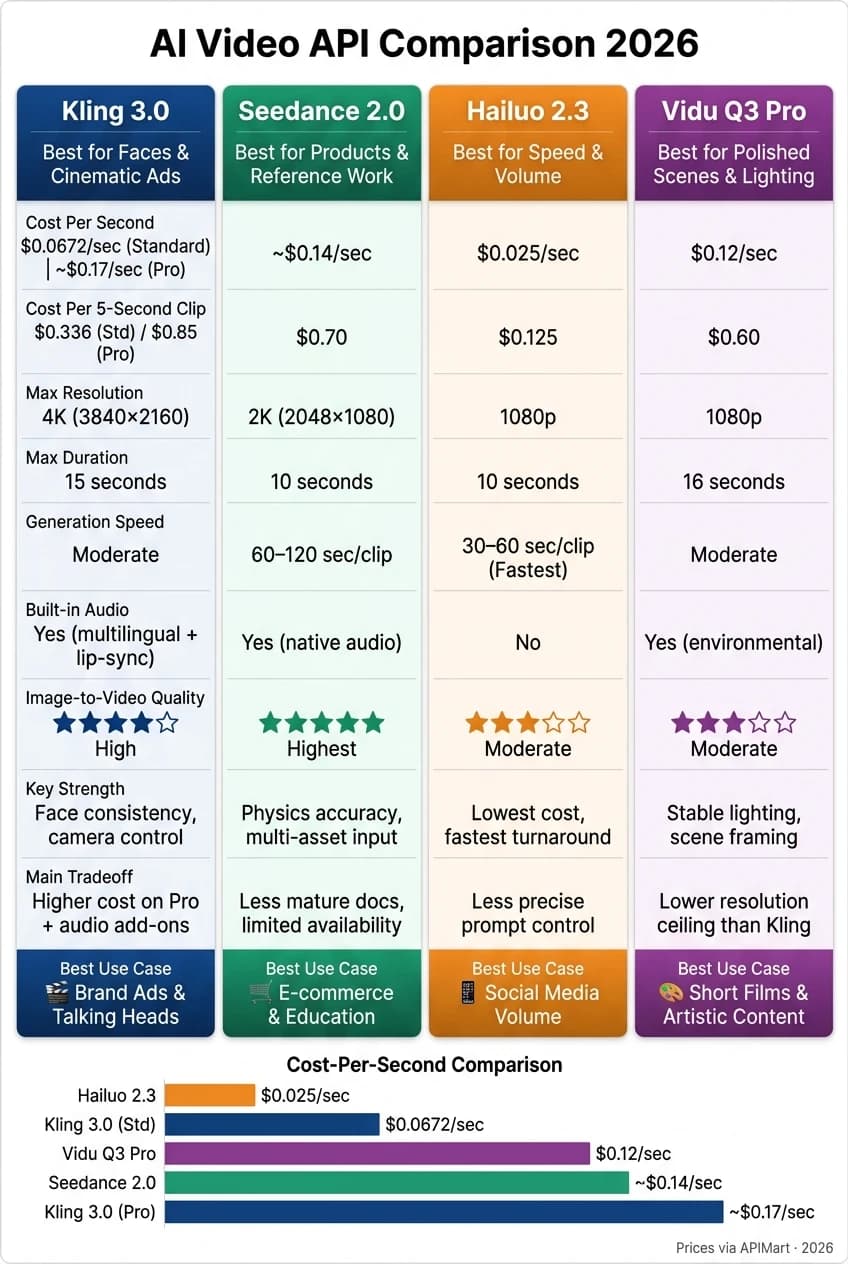
Quick Comparison
| Model | Best Use | Cost | Main Strength | Main Tradeoff |
|---|---|---|---|---|
| Kling 3.0 | Brand ads, talking heads | $0.0672/sec to ~$0.17/sec | Face consistency, camera control, 4K | Higher cost on Pro and audio add-ons |
| Seedance 2.0 | E-commerce, lessons, reference-heavy jobs | ~$0.14/sec | Image-to-video fit, motion physics, multi-asset input | Less mature docs and access can vary |
| Hailuo 2.3 | Drafting, social volume | $0.025/sec | Lowest cost, fast turnaround | Less exact prompt control |
| Vidu Q3 Pro | Art-led scenes, polished framing | $0.12/sec | Stable lighting, framing, scene transitions | Lower raw spec ceiling than Kling |
For those needing a high-performance alternative, the WAN 2.7 API offers world-leading video generation capabilities.
I’d read the full piece as a buying guide for production teams, not just a model ranking. It does a good job showing that API choice is about more than visuals. It’s also about retries, webhooks, queue delays, and billing, especially when you’re shipping at scale.
Side-by-Side Comparison: Kling vs Seedance vs Hailuo vs Vidu
Kling 3.0 sets the bar for cinematic output. Seedance 2.0 stands out for natural motion and multimodal control. Hailuo 2.3 is the fast, low-cost pick for high-volume work. Vidu Q3 puts the focus on steady lighting and smoother scene changes.
Capabilities, speed, and control at a glance
| Feature | Kling 3.0 | Seedance 2.0 | Hailuo 2.3 | Vidu Q3 |
|---|---|---|---|---|
| Max Resolution | 4K (3840×2160) | 2K (2048×1080) | 1080p | 1080p |
| Max Duration | 15 seconds | 10 seconds | 10 seconds | 16 seconds |
| Text-to-Video | High | High | High | Moderate |
| Motion profile | Realistic human/face | Organic motion (hair, fabric, water) | Fast action clips | Lighting and physics |
| Camera control | Full pan/tilt/dolly/rack-focus control | Limited camera moves | Few camera moves | Smart Cuts (narrative) |
| Built-in audio | Yes (multilingual + lip-sync) | Yes (audio + video input) | No | Yes (environmental) |
| Image-to-Video | High | Highest | Moderate | Moderate |
A simple way to think about it: Kling is for polish, Seedance is for control, Hailuo is for speed, and Vidu is for scenes where mood and continuity matter more than raw output specs.
Pricing and cost per clip in USD
| Model | Cost Per Second | 5-Second Clip | 10-Second Clip |
|---|---|---|---|
| Hailuo 2.3 (MiniMax) | $0.025 | $0.125 | $0.25 |
| Kling 3.0 (Standard) | $0.0672 | $0.336 | $0.672 |
| Kling 3.0 (Pro) | ~$0.17 | $0.85 | $1.70 |
| Vidu Q3 Pro | $0.12 | $0.60 | $1.20 |
| Seedance 2.0 | ~$0.14 | $0.70 | $1.40 |
If you're making lots of drafts, Hailuo 2.3 is the budget pick. For final output, Kling 3.0 and Seedance 2.0 make more sense. That split can save money fast: use the low-cost model to test ideas, then move the best clips to a higher-end render.
Best API by use case
| Use Case | Recommended API | Reason |
|---|---|---|
| Cinematic brand ads | Kling 3.0 | Best 4K output and professional camera controls [8] |
| E-commerce product videos | Seedance 2.0 | Highest image-to-video consistency and multi-asset input [9] |
| Social media volume | Hailuo 2.3 | Fast generation for high-frequency posting [1][8] |
| Short films / artistic content | Vidu Q3 | Strong lighting consistency and narrative Smart Cuts [9] |
| Talking head / presenter videos | Kling 3.0 | Best facial identity retention and lip-sync accuracy [4] |
| Educational content | Seedance 2.0 | Multimodal input supports diagrams, voiceover, and reference clips in a single generation [9] |
"Kling 3.0 is the one to pick when a human face has to stay coherent across the clip... the gap is most visible in head-turn shots and lip-sync attempts." - Ropewalk Team [4]
For those tracking the latest releases, Sora 2 offers a competitive alternative with synchronized audio. The next section breaks down each API by production fit and workflow strength.
API-by-API Breakdown
The table shows who leads on paper. This section gets into how each API tends to behave once you use it in production.
Kling: motion quality and short-form marketing output
Kling 3.0 works best when a human face needs to stay consistent. It holds facial identity through head turns and lip-sync better than the other APIs in this set [4][2], and it handles character-led action with more expressive motion [6].
Multi-Shot can generate up to 6 scenes with separate prompts in a single request, which makes storyboard-style ads much faster to build [7]. Built-in synced audio supports English, Chinese, Japanese, Korean, and Spanish, though it adds about 33% to the base cost [7][8].
On APIMart, Kling V3 and V3 Omni cost $0.0672 per second. That’s lower than the standard public rate of about $0.08 per second [8]. The tradeoff shows up in physics. Liquids, gravity-heavy motion, and structural deformation still lag behind Seedance [6]. If the scene is built around a person talking or moving, Kling is usually the better pick. If the scene depends on accurate liquid behavior, Seedance is often the safer choice [6].
If face realism matters less, the next two options give up some polish in exchange for more speed and output.
Seedance and Hailuo: low-cost, high-volume production
Hailuo 2.3 generates clips in 30 to 60 seconds, which makes it the fastest option in this group [11]. At $0.025 per second on APIMart, it comes in well under Kling's standard public rate [11][8]. The look is cinematic, but it’s less exact with hard prompts. That makes it a solid drafting tool when you want to test a lot of variations fast.
Seedance 2.0 is a better fit for clips that need to look finished. Its main strengths are realistic physics and scene-to-scene consistency, so water, cloth, and hair move more naturally with less prompt work [2][4][6]. It also supports multi-scene prompting with smooth transitions and simultaneous native audio across scene changes [11]. For e-commerce product shots and premium brand content, that means less friction in prompting and cleaner multimodal scenes, which helps teams get polished output faster [2][10].
| Feature | Seedance 2.0 | Hailuo 2.3 |
|---|---|---|
| Generation speed | 60–120 seconds per clip | 30–60 seconds per clip |
| Physics accuracy | High | Moderate |
| Audio | Simultaneous native audio | Limited/basic |
| Cost profile | Moderate | Low |
| Best workload | Product ads, multi-shot stories | Social media volume, rapid iteration |
Vidu: tighter control for polished scenes
When the goal is control more than motion, Vidu becomes the frame-first option.
Vidu fits scenes that need tight framing and stable composition [9]. It is built for controlled image-to-video output, so it tends to work best in complex scenes where visual control matters more than raw speed or price [9].
| Feature | Vidu | Kling 3.0 |
|---|---|---|
| Primary strength | Tight composition and framing | Human motion and face-tracking |
| Best for | Complex scenes with tight visual control | Talking heads and action ads |
Choose Vidu for polished shots where framing and scene continuity matter more than motion realism.
Integration, Reliability, and Workflow Fit
What production teams should check before launch
After quality and price, production fit usually decides whether an API can handle scale.
The main question isn’t which model looks best on its own. It’s which one fits your release pipeline. Kling, Seedance, and Hailuo use async job flows. Vidu takes a different path with a draft-first review step, so teams can approve a low-resolution draft before spending credits on the final render [9].
Kling 3.0 has the most mature developer ecosystem in this group, with stronger community coverage and more established SDK wrappers. That matters when your team runs into an undocumented edge case right before a campaign launch [6]. One thing to plan for: Kling’s audio surcharge. Synced audio increases cost by about 33%, so retry logic should account for that [8].
Seedance 2.0 supports up to 12 reference files per request across images, video, and audio. That’s the highest limit in this set [9]. If your prompts lean heavily on reference assets, run preflight checks before submission. In plain English, make sure the URLs work, the MIME types are correct, and the file sizes are within limits [3]. Seedance also has less mature direct API docs and more limited regional availability than Kling, so it’s smart to confirm access paths early [6][8].
For polished scenes where framing needs sign-off before a full render, Vidu’s draft-first workflow gives teams a simple way to control cost [9].
Why a unified API layer matters
Managing four separate API keys, request formats, billing dashboards, and error codes creates real engineering drag. That’s even more true when you’re still figuring out which model should handle which workload.
APIMart gives teams access to 500+ AI models through one API key and an OpenAI-compatible request format. That means teams can switch models by changing the model ID while keeping submission, polling, and webhooks the same [1][6].
The clearest upside shows up in fallback routing. If Kling runs into a slow queue or a safety block, a routing rule can send that job to Hailuo automatically, with no manual handoff [3]. For SaaS products and internal automation tools, that kind of resilience matters. If generation fails and the user sees the error, the whole workflow can feel shaky.
Cost visibility matters too. A unified layer pulls billing into one balance, which makes spend easier to track and helps teams spot runaway retry loops before they turn into a budget issue [4][5].
With routing and cost controls in place, the final choice comes down to budget, output style, and workload.
Final Verdict: Which AI Video API Fits Your Budget and Use Case
After looking at quality, speed, and control, the pick mostly comes down to two things: how much video you need to make and how much you can spend.
Kling 3.0 is the top pick for face consistency and cinematic motion. Seedance 2.0 stands out for product consistency and multi-shot workflows. Hailuo 2.3 works best for fast, low-cost drafts. And Vidu Q3 Pro is the better fit for polished scenes where physics and lighting need to look right.
A lot of teams don't stick with just one model. They mix and match. Send main scenes to Kling or Seedance, use Hailuo for B-roll and fast iteration, and save Vidu for shots where realism matters more than output volume.
For teams running several workflows at once, routing can matter just as much as the model itself. Unified access puts routing, retries, and billing in one workflow, which makes the whole setup easier to run.
| Model | Best For | Cost |
|---|---|---|
| Kling 3.0 | Cinematic quality, face consistency | $0.0672/sec (720p) |
| Hailuo 2.3 | Speed, high-volume drafts | $0.025/sec |
| Vidu Q3 Pro | Lighting realism, artistic scenes | $0.12/sec |
FAQs
Which API is best for my use case?
The best AI video API depends on your production goals and technical needs.
- Kling is the top pick for portrait, talking-head, or character-led content where facial identity needs to stay consistent. It also works well for image-to-video product animation.
- Seedance is the best fit for motion consistency, physics simulation, and complex multi-shot storytelling.
- Hailuo is the go-to choice for speed, high-volume drafting, and social content that needs fast iteration.
Should I use one model for drafts and another for finals?
Yes. A two-step workflow is common in 2026: use faster, lower-cost models like Hailuo 02 or Wan 2.5 for drafts and motion tests, then switch to higher-fidelity models like Seedance 2.0 or Kling 3.0 for final renders.
That approach helps you avoid burning credits on shots that don’t work. It also lets you use each model where it shines, based on what the project needs at the finish line.
What should I test before integrating a video API at scale?
Before you scale, put preflight validation in place. Normalize inputs first, then check whether each public URL is reachable, whether the MIME type matches what you expect, and whether the file stays within your limits for duration and size.
That step saves a lot of pain later. It helps you catch bad inputs early instead of letting them move deeper into the workflow, where failures cost more and are harder to trace.
You should also test the actual cost of your full workflow using the worst successful request, not just the posted base rates. Base pricing can look fine on paper, but the request that barely passes can tell a very different story once the whole chain runs.
On top of that, set clear routing rules for edge cases:
- safety blocks
- prompt drift
- failed generations
When those cases happen, your system should be able to switch models on its own. That gives you a safer fallback path and keeps the workflow moving without manual intervention.
Choose the model you want in the model marketplace
Try chat, image and video models in the APIMart model marketplace, and experience model capabilities quickly with one unified API.