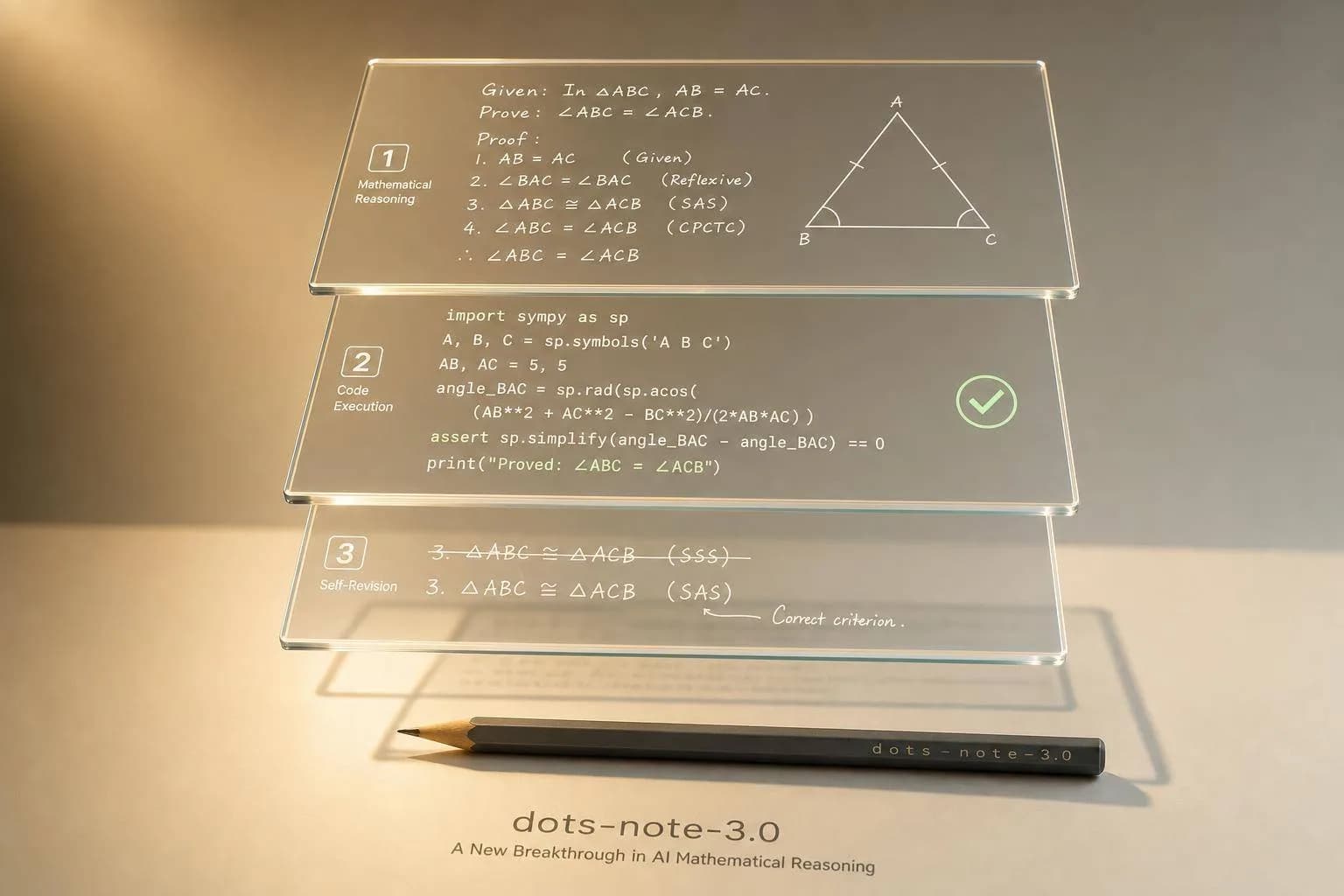
Inside dots-note-3.0: AI Math Breakthrough
Explore how dots-note-3.0 reportedly earned a perfect 42/42 IMO score using natural-language proofs, Python checks, and an iterative self-review workflow.
An AI model reportedly scored 42/42 on the 2026 IMO, but the main story is not the score alone. I’d sum it up like this: dots-note-3.0 is built to draft, check, and revise math proofs before it answers, which aims at a hard problem in AI: keeping every step of a proof sound from start to finish.
If you want the short version, here it is:
- dots-note-3.0 is a math-focused model from RedNote/Xiaohongshu.
- It reportedly got a perfect 42/42 on the 2026 International Mathematical Olympiad in Shanghai.
- In 2025, top reported AI IMO scores were 35/42, so this would be a 7-point jump.
- The model uses natural-language reasoning plus Python checks.
- Its main method is a self-review loop: write a proof, test steps, fix errors, then answer.
- The claim is still company-reported, so outside checking still matters.
- The article also looks at what this means for researchers, teachers, students, developers, and API users.
What matters most is simple: IMO problems grade full proofs, not just final answers. That means one weak step can cost everything. So if dots-note-3.0 holds up under outside testing, it would mark a shift from “AI that often gets the answer” to AI that can defend the answer step by step.
I also see a second theme in the article: this model sits between plain-language proof writing and formal theorem proving. That makes it easier for people to read, even if it does not give the same machine-check guarantees as a formal proof system.
OpenAI’s IMO Team on Why Models Are Finally Solving Elite-Level Math
Quick comparison
| Topic | dots-note-3.0 |
|---|---|
| Main focus | Proof-based math reasoning |
| Reported IMO 2026 score | 42/42 |
| Prior top 2025 score cited | 35/42 |
| Core method | Self-critique + revision loop |
| Tools used | Natural language + Python |
| Main strength | Catching gaps before final output |
| Main limit | Outside verification still pending |
| Best-fit users | Researchers, educators, students, developers |
So in this piece, I’d treat the score as the headline and the proof-checking workflow as the part that matters most.
What dots-note-3.0 is and why its reported IMO result matters
dots-note-3.0 is the smallest model in Xiaohongshu's dots3 family. It was built for mathematical reasoning while using less compute than the larger jazz and aria models. The model is still in beta, and the company says source code is coming later, though it hasn't given a date. That setup matters here because the model is being judged on proof-heavy reasoning, not just whether the final output looks good. [2][4]
The reported 42/42 score on IMO 2026
Xiaohongshu says dots-note-3.0 earned a perfect score of 42 out of 42 points at the 2026 International Mathematical Olympiad in Shanghai. According to the company, the model solved all six problems from the official problem statements and wrote full natural-language proofs with no logical gaps or missing conditions. No human help was used during testing, and the solutions were submitted to IMO organizers for grading. [2][4][3]
That score is higher than the 35/42 scores reported for leading models in 2025. [2][4] So yes, the headline stands out. But it still needs outside confirmation.
Why this claim goes further than typical benchmark wins
The IMO doesn't work like a multiple-choice test or a short-answer benchmark. It grades full proofs. That means this result is about sustained reasoning from start to finish, not just picking the right answer or landing on the right final line.
Verification limits readers should keep in mind
Right now, the 42/42 result rests on company-reported data from Xiaohongshu. The company says its AI-generated solutions were submitted to official IMO organizers for grading, but outside review and more detail on the scoring process are still needed before the claim can be fully checked. [3][2]
For now, it makes sense to view the 42/42 result as promising, but not yet confirmed. The picture should get clearer once the source code is released and outside researchers can test the model on new problems and see if the same performance holds up.
How dots-note-3.0 improves mathematical reasoning
Recursive self-critique and revision before final answers
dots-note-3.0 mixes natural-language reasoning with Python checks to verify intermediate steps [1]. Instead of sticking with its first pass, it goes through a repeat review cycle: it tests each step, spots mistakes, and rewrites the proof before giving a final answer [1]. That’s the main reason behind the reported IMO result.
Because the IMO scores full proofs, dots-note-3.0 is built to protect the logic of the entire argument, not just land on the right final answer [1][2]. That matters a lot for theorem-style problems, where one bad step can spoil everything that follows [1][2].
Math domains where recursive self-checking helps most
The biggest gains show up in areas where every step has to stand on its own.
| Math Domain | How dots-note-3.0 Addresses It | Concrete Example |
|---|---|---|
| Olympiad Proofs | Iterative self-checking of assumptions | Identifying a missing edge case in a combinatorics problem before finalization |
| Symbolic Algebra | Python code execution for step verification | Catching a sign error during the expansion of a complex polynomial |
| Geometry Proofs | Rigorous verification of geometric conditions | Revising a proof after identifying that a specific triangle property was assumed but not proven |
| Calculus | Multi-step derivation checking | Fixing an incorrect integration-by-parts step by re-evaluating the intermediate derivative |
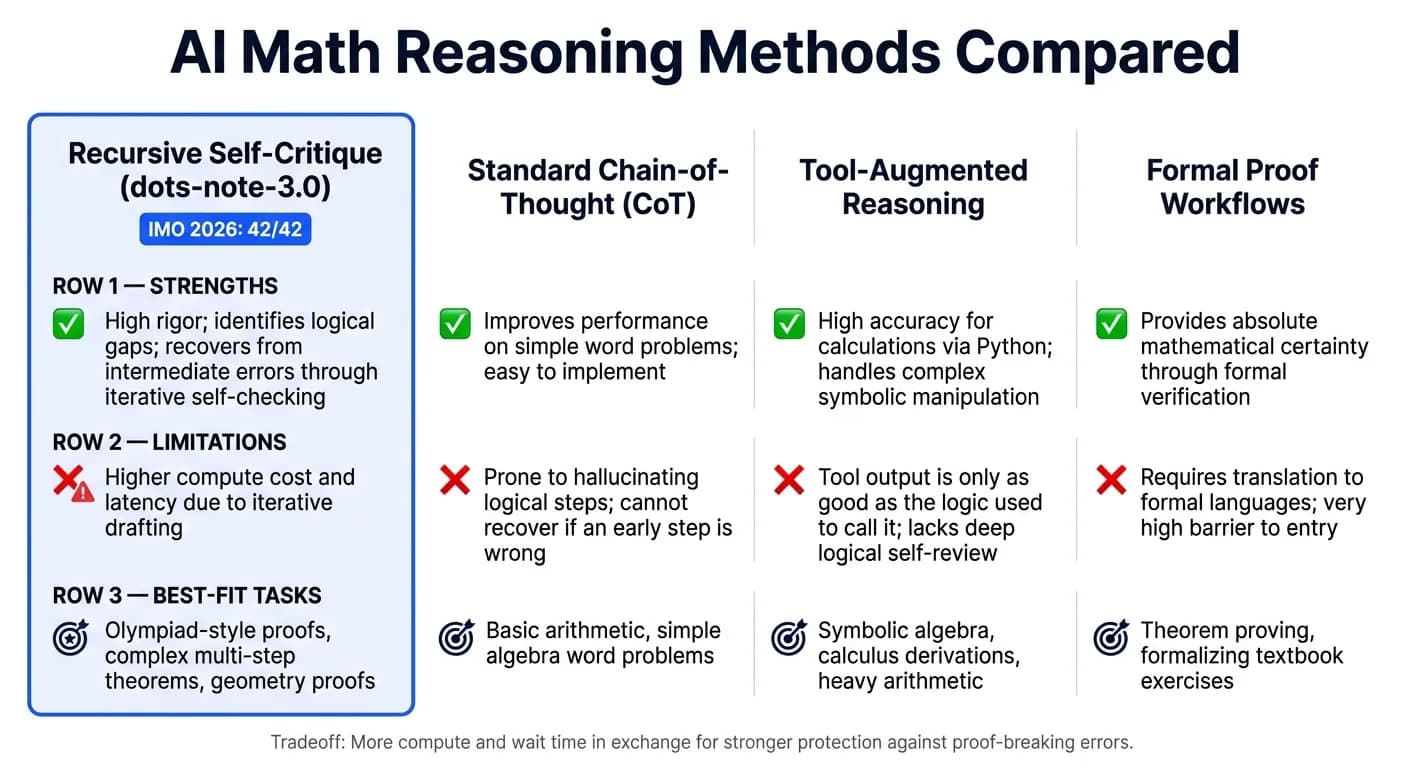
Reasoning methods comparison table
This table shows how that approach differs from common reasoning workflows.
| Reasoning Method | Strengths | Limitations | Best-Fit Math Tasks |
|---|---|---|---|
| Recursive Self-Critique (dots-note-3.0) | High rigor; identifies logical gaps; recovers from intermediate errors through iterative self-checking | Higher compute cost and latency due to iterative drafting | Olympiad-style proofs, complex multi-step theorems, geometry proofs |
| Standard Chain-of-Thought (CoT) | Improves performance on simple word problems; easy to implement | Prone to hallucinating logical steps; cannot recover if an early step is wrong | Basic arithmetic, simple algebra word problems |
| Tool-Augmented Reasoning | High accuracy for calculations via Python; handles complex symbolic manipulation | Tool output is only as good as the logic used to call it; lacks deep logical self-review | Symbolic algebra, calculus derivations, heavy arithmetic |
| Formal Proof Workflows | Provides absolute mathematical certainty through formal verification | Requires translation to formal languages; very high barrier to entry | Theorem proving, formalizing textbook exercises |
The tradeoff is simple: more compute and more wait time, in exchange for stronger protection against proof-breaking errors.
Where dots-note-3.0 fits in current AI math research
Natural-language proofs versus formal theorem proving
This method matters because it sits in the middle ground between human-readable proofs and machine-checked formal verification.
In current AI math research, that split is useful. On one side, you have natural-language proof systems. They mix written explanations with tools like Python. On the other side, you have formal theorem provers, where every step is written in a language like Lean and then checked by a machine.
dots-note-3.0 falls into the first camp. It uses natural-language reasoning plus Python checks. The interesting part isn't just that it gets to the right answer. It's that it turns math reasoning into a readable, self-correcting proof process instead of acting like a box that spits out a final result.
That difference matters. Natural-language proofs are easier for people to follow. Formal proofs are stronger when machine verification is the goal. The tradeoff is simple: natural-language proofs can still hide small logical gaps that a formal system would catch on the spot.
Benchmarks that matter beyond a single headline result
The same split shows up in benchmark choice.
The IMO result is strong, but it's only one benchmark. Researchers also watch GSM8K, MATH500, AIME, MathVista, and GPQA because each one tests a different part of reasoning, whether that's depth, geometry, visual math, or expert-level problem solving.
What makes the IMO stand out is that it grades full written proofs. A skipped case or an unstated condition can cost real points. That's very different from tests that only check the final answer. For a model aimed at arithmetic, algebra, geometry, calculus, and proof-based work, that makes the IMO a much tougher target.
Model and benchmark comparison table
The table below places dots-note-3.0 next to other systems that help show where it stands in current AI math research.
| System | Primary Task Type | Key Benchmark | Output Style | Reported Strength |
|---|---|---|---|---|
| dots-note-3.0 | Olympiad reasoning | IMO 2026 (42/42) [1][2][4] | Natural language + Python | Agentic self-critique loop; full proof rigor |
| Huawei Celia | Olympiad reasoning | IMO 2026 (42/42) [3] | Mathematical proofs | Multi-field mathematical capabilities |
| Moonshot AI Kimi K3 | High-level reasoning | IMO 2026 (42/42) [3] | Natural language | Reached the perfect-score threshold |
| DeepMind/OpenAI (2025) | Olympiad reasoning | IMO 2025 (35/42) [1][2][4] | Formal + natural language | Gold-medal-level performance |
The main differentiator isn't just the score. It's the self-critique loop that repairs proofs before submission. That's the part that shapes how the model fits into research and product workflows.
What this means for researchers, educators, students, developers, and APIMart users

Practical use cases in education, research, and software products
dots-note-3.0 doesn't just post better benchmark scores. Its bigger strength is that it checks and revises its own reasoning, which makes day-to-day workflows more dependable. Put simply, it takes proof-level reasoning and turns it into something people can use in research, teaching, and software.
Researchers can use it to test conjectures, look for counterexamples, and pressure-test proof steps before formalization. That matters because its self-checking loop is built to cut down on logical gaps and missed conditions [2][4].
Educators can use the model to build worked examples and solution keys. It can trace a derivation, spot the bad step, and produce a corrected solution. Students get the flip side of that same help: a tutor that explains why an answer is wrong, not just that it is wrong [2].
Developers building quantitative products need precision and steady formatting. A financial SaaS workflow, for example, can use the model to calculate compound interest or return structured numerical outputs while keeping U.S. number formatting like 1,000.25 [2].
How APIMart can support math-reasoning workflows at scale
APIMart's unified API makes it simpler for teams to build math-reasoning workflows without juggling separate integrations.
For developers, the main upside is easier integration and clearer usage planning. Instead of maintaining multiple endpoints and tool-specific workflows, teams can send requests through one API and then shape the output into the format their product needs.
User-impact mapping table and conclusion
These workflows matter most when people need explanations, not just answers. The table below shows how that reasoning style lines up with different user groups.
| User Group | Use Case | Needed Capability | APIMart Flow |
|---|---|---|---|
| Researchers | Theorem sketching & conjecture testing | Formal logic & rigorous proof generation | Reasoning model -> JSON output -> LaTeX |
| Educators | Solution checking & grading support | Step-by-step error diagnosis | Student input -> Reasoning model -> Feedback |
| Students | Interactive tutoring & worked examples | Natural-language mathematical explanations | Chat API -> Step-by-step reasoning mode |
| Developers | Quantitative SaaS & finance workflows | High-precision numerical & logical analysis | Unified API -> Structured JSON (e.g., $1,250.00) |
RedNote has announced plans to release the source code in the near future, though specific terms have not been disclosed [2][4]. For APIMart users, the draw is reliable step-by-step reasoning that fits cleanly into product workflows.
FAQs
How was the 42/42 score verified?
The 42/42 score was checked by sending dots-note-3.0’s full IMO solution write-ups to IMO organizers for human grading, with no human intervention during testing.
The score was based on the correctness and completeness of each required proof step, not just the final numeric answers.
What can Python checks confirm in a proof?
In dots-note-3.0, Python checks help verify how solid a proof is by testing, challenging, and tightening the model’s draft reasoning.
They can spot skipped cases or unstated conditions that might weaken a written proof. That way, each step can be checked for logical soundness before submission.
Who would benefit most from dots-note-3.0?
dots-note-3.0 is best suited for researchers, educators, and developers who need rigorous, verifiable accuracy when working through hard problems.
It delivers reliable, step-by-step reasoning in algebra, geometry, calculus, and formal logic. That makes it a strong fit for theorem-based work and quantitative analysis, where even small logic mistakes or unstated conditions can become costly.
Choose the model you want in the model marketplace
Try chat, image and video models in the APIMart model marketplace, and experience model capabilities quickly with one unified API.