
OpenRouter Pricing: Credits, Fees & Model Costs
How OpenRouter pricing really works in 2026: pass-through model costs, the 5.5% credit fee, BYOK surcharges, free-tier limits and how routing affects spend.
OpenRouter does not mark up model prices — but it is not free either. The platform makes money on credit top-ups (5.5%, minimum $0.80) and on BYOK usage past the free allowance (5%), while inference itself is billed at the upstream provider's list price [1].
The whole fee model in five lines:
-
Inference: exact provider list price per token, no markup [1]
-
Buying credits: 5.5% fee, $0.80 minimum (Stripe); about 5% when paying with crypto
-
BYOK (your own provider keys): first 1M requests/month free, then 5% of what the call would have cost on OpenRouter
-
Free models: 50 requests/day under $10 lifetime credits, 1,000/day once you have bought $10+ [1]
-
Routing: defaults balance price and uptime; price-floor routing (
:floor) ormax_pricecaps can push each request to the cheapest provider [2]
Below we break each piece down with worked examples, then compare the total against a discount-based aggregator.
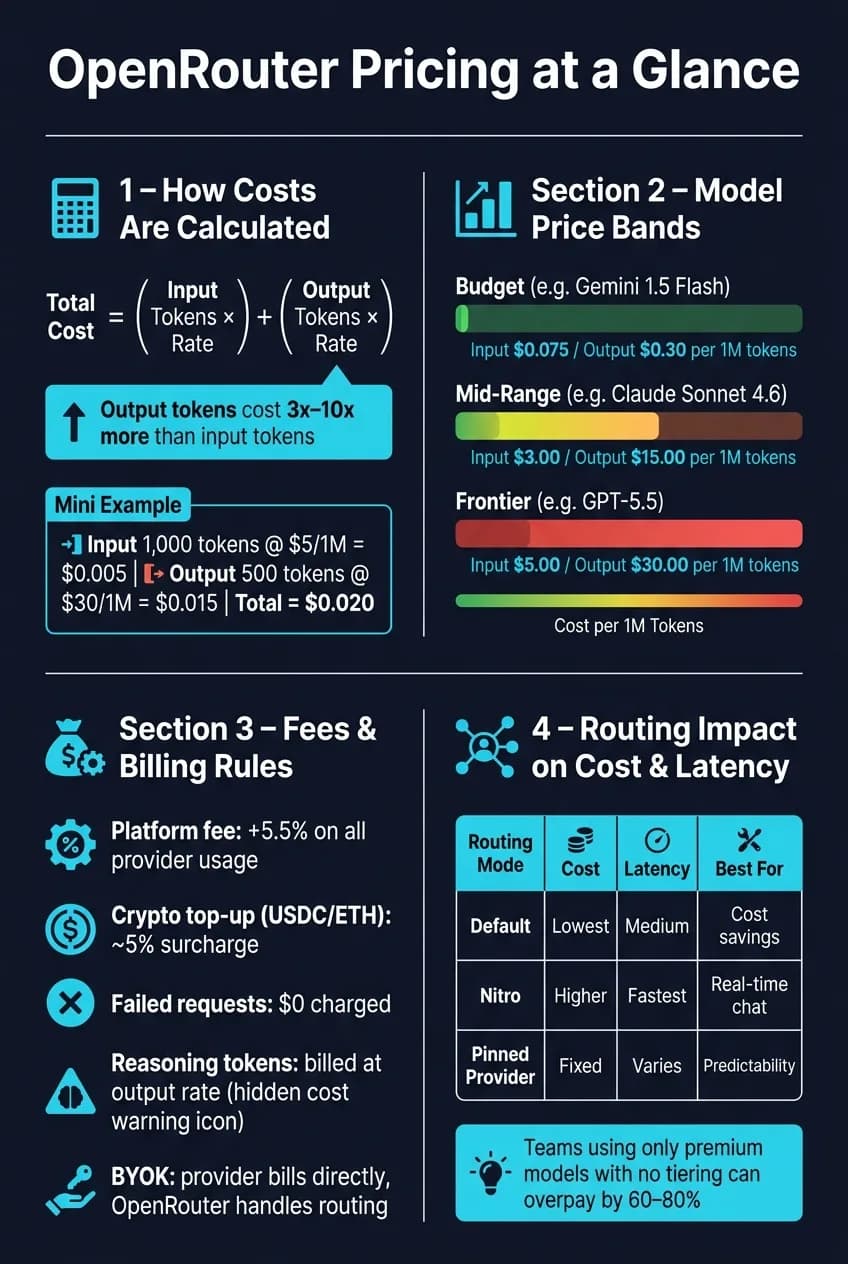
The three ways OpenRouter charges you
Pass-through inference pricing
Every model page lists input/output prices per million tokens, and those numbers match the upstream provider's own price sheet [3]. If GPT-5.2 costs $1.25 in / $10 out per 1M tokens at OpenAI, that is what OpenRouter deducts from your credits — the aggregation layer itself adds zero to the per-token rate.
The credit top-up fee
Credits are prepaid. Each Stripe top-up costs 5.5% of the amount, with a $0.80 floor — so a $10 top-up costs $10.80 (an effective 8%), while a $500 top-up costs $527.50. Crypto payments via Coinbase run about 5%. This is the fee most cost comparisons forget: your effective token price is list price × 1.055.
BYOK surcharges
Plugging in your own OpenAI or Anthropic key lets you use provider credits and negotiated rates. The first 1M BYOK requests per month are free; beyond that OpenRouter deducts 5% of the equivalent platform cost from your credit balance [1]. For most small teams the allowance is effectively unlimited; at serious scale the 5% becomes a line item.
Free tier and rate limits
The 50-per-day baseline
Models tagged :free cost nothing but are throttled hard: accounts with less than $10 of lifetime credit purchases get 50 free-model requests per day across all free models combined.
Unlocking 1,000 requests per day
A one-time purchase of $10 in credits raises the ceiling to 1,000 free-model requests/day [1] — the cheapest way to make the free tier useful for prototyping.
What free actually buys
Free variants are typically lower-priority capacity with tighter context limits and no uptime guarantees. Treat them as a sandbox, not a production tier.
How routing decisions change your bill
Default load balancing
By default OpenRouter spreads requests across providers weighted toward cheaper, healthier endpoints, so two identical requests can be served by different upstreams at slightly different prices [2].
Price-floor routing
Appending :floor to a model slug (or provider: {"sort": "price"} in the request body) forces cheapest-first routing — useful for batch workloads where latency matters less than cost.
Hard price caps
The max_price field rejects any provider quoting above your limit, e.g. {"max_price": {"prompt": 1, "completion": 8}} (dollars per 1M tokens). It is the only way to make "never pay more than X" a guarantee rather than a preference.
Worked example: what a workload really costs
| Item | Direct provider | OpenRouter | APIMart |
|---|---|---|---|
| 100M in / 20M out tokens, GPT-5.2-class | $325.00 | $325.00 | ~$260.00 |
| Top-up fee | $0 | +$17.88 (5.5%) | $0 |
| Effective total | $325.00 | ~$342.88 | ~$260.00 |
| Extra integrations needed | 1 per vendor | 0 | 0 |
Numbers use $1.25/1M input and $10/1M output list pricing; APIMart applies its ~20% platform discount — check live per-model rates on the APIMart pricing page.
When the 5.5% is worth it
If OpenRouter saves you from maintaining three vendor integrations and gives you failover for free, $18 on a $325 bill is cheap insurance. The fee only starts to hurt at five-figure monthly spend.
When it is not
Single-model, high-volume workloads gain nothing from aggregation fees — go direct, or use a gateway whose unit prices are actually below list.
The discount-aggregator alternative
APIMart flips the model: instead of list price plus a top-up fee, models are listed at roughly 20% below official prices, across chat, image, video and audio. The pricing page shows both the official and discounted rate per model, so the comparison is one click, not a spreadsheet.
Takeaways
OpenRouter's pricing is genuinely transparent: list-price inference, a visible 5.5% top-up fee, and a 5% BYOK surcharge past 1M monthly requests [1]. Model your real cost as list price × 1.055, use :floor and max_price to keep routing honest, and if your stack extends beyond text models — or the fee math stops working for you — a discount-based multimodal gateway like APIMart is the natural next comparison.
Choose the model you want in the model marketplace
Try chat, image and video models in the APIMart model marketplace, and experience model capabilities quickly with one unified API.