
OpenRouter vs Direct Model APIs: Which Is Better?
OpenRouter vs calling OpenAI, Anthropic or Google directly: we compare pricing, fees, latency, rate limits, reliability and lock-in for AI developers.
Should you call model providers directly, or put an aggregator like OpenRouter in front of them? The honest answer: it depends on how many models you use, how much traffic you push, and who is on call when a provider goes down.
Here is the short version:
-
One provider, high volume, enterprise contract: go direct — you get provider-native features, org-level controls, and no extra fee layer
-
Several models across vendors, or you switch models often: an aggregator wins — one API key, one billing account, one integration
-
Fees: OpenRouter passes through provider inference pricing with no markup, but charges 5.5% (min $0.80) when you buy credits [1]
-
Reliability: aggregators can route around provider outages automatically; with direct APIs, failover is your code and your pager
-
Alternatives exist: APIMart takes the same unified-API idea beyond text and covers image, video and audio models at roughly 20% below official list prices
If that summary is enough, you can stop here. The rest of this article walks through the trade-offs with real numbers.
What OpenRouter actually gives you
OpenRouter is a unified gateway that exposes hundreds of models from OpenAI, Anthropic, Google, Meta, Mistral, DeepSeek and others behind one OpenAI-compatible endpoint [2].
One API surface for many vendors
You integrate once against an OpenAI-style /chat/completions schema and switch models by changing a string like anthropic/claude-sonnet-4.5 or deepseek/deepseek-chat. No per-vendor SDKs, no separate auth flows, no five different billing dashboards.
Provider routing and automatic failover
Each model can be served by multiple upstream providers. OpenRouter load-balances across them and reroutes when one returns errors or degrades, which smooths over single-provider incidents [3]. You can also pin providers, sort by price or throughput, or supply fallback models.
What the middle layer costs
Inference itself is pass-through: you pay the same per-token rates as going direct [1]. The platform fee shows up when you top up credits — 5.5% with a $0.80 minimum (5% via crypto). If you bring your own provider keys (BYOK), the first 1M requests per month are free, then a 5% surcharge applies.
What you get by going direct
Calling OpenAI, Anthropic or Google directly removes the middle layer entirely — and that has real advantages.
No extra hop, no extra fee
Your requests travel straight to the provider, so there is no added network hop and no credit-purchase fee. At $10k+/month of inference, a 5.5% top-up fee is real money that direct billing avoids.
Provider-native features land first
Bleeding-edge features — new modalities, fine-tuning endpoints, batch APIs, prompt caching variants — ship on native APIs first. Aggregators usually support them days or weeks later, and occasionally never.
Enterprise controls and compliance
Direct accounts give you provider-level org management: SSO, audit logs, data-processing agreements, regional endpoints and negotiated rate limits. If procurement requires a signed DPA with the model vendor, direct is the path of least resistance.
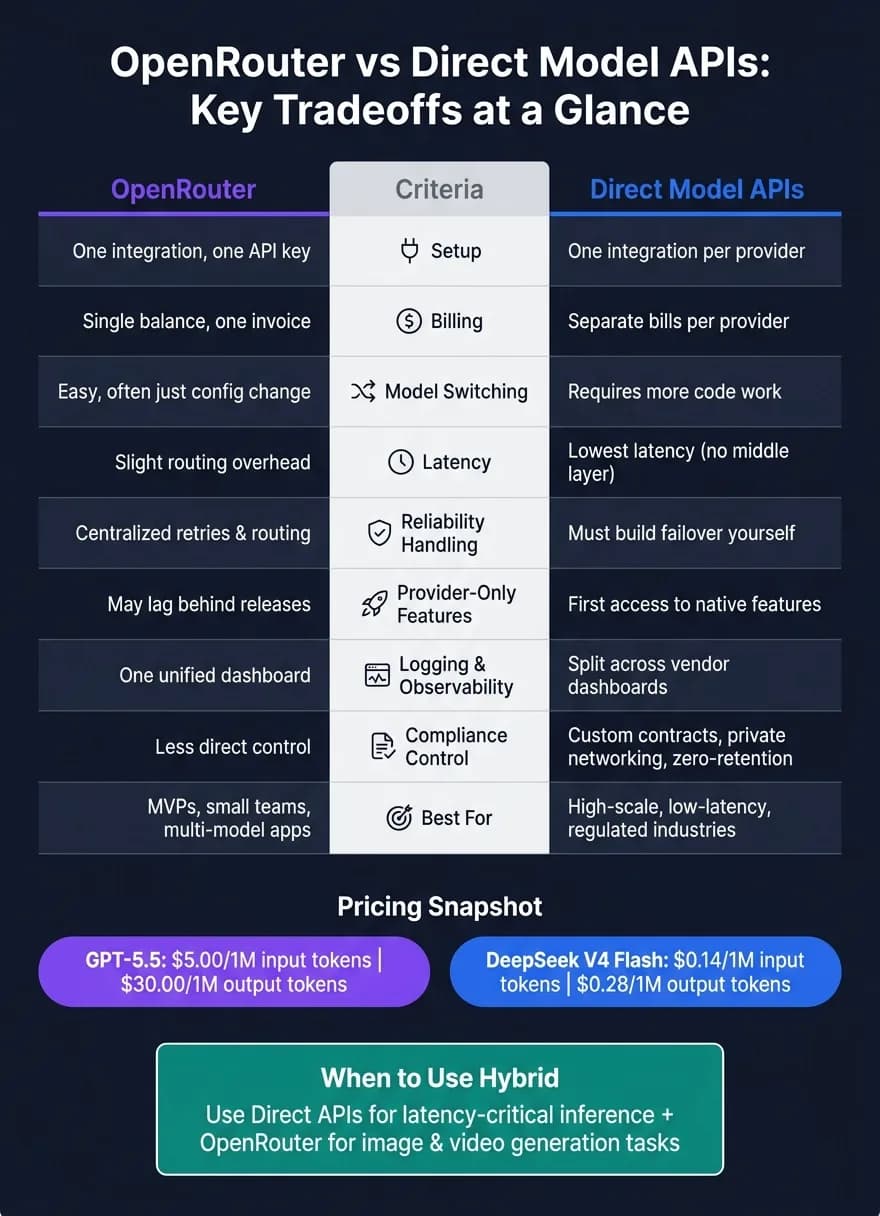
Head-to-head comparison
| Dimension | OpenRouter | Direct APIs |
|---|---|---|
| Integration effort | One endpoint, one key | One integration per vendor |
| Inference price | Provider list price, no markup | Provider list price |
| Extra fees | 5.5% on credit top-ups | None |
| Model switching | Change a model string | New SDK / endpoint work |
| Failover | Built-in provider routing | Build it yourself |
| Newest features | After aggregator adds support | Day one |
| Rate limits | Pooled across providers | Per-account, negotiable |
| Billing | One invoice | One per vendor |
Pricing
For pure per-token cost the two are tied — OpenRouter does not mark up inference [1]. The delta is the top-up fee and, at high scale, BYOK surcharges. Direct wins narrowly on total cost; aggregators win on not managing five prepaid balances.
Reliability and failover
Provider incidents happen monthly across the industry. With direct APIs you need retry logic, circuit breakers and a second integration for real redundancy. OpenRouter's routing gives you cross-provider failover in the request itself, and model-level fallbacks via the models array [4].
Lock-in and migration cost
Direct integrations concentrate lock-in at the vendor level: swapping Claude for Gemini means new code paths. An aggregator moves the lock-in up one level — switching models is trivial, but you now depend on the gateway itself. Keeping your integration OpenAI-compatible hedges both ways.
So which should you pick?
Choose an aggregator if…
You run more than one model in production, A/B test models regularly, want automatic failover, or you are a small team that does not want to babysit multiple vendor accounts. The integration savings usually dwarf the fee.
Choose direct if…
You are single-vendor at meaningful scale, need contract terms or compliance guarantees from the provider, or depend on features the day they ship. Enterprise deals with committed spend also unlock pricing aggregators cannot touch.
The hybrid pattern
Many teams do both: direct integration for the primary high-volume model, aggregator as the escape hatch for experiments and failover. Because both speak the OpenAI schema, the switch is a base-URL change.
Where APIMart fits in this comparison
OpenRouter focuses on language models. If your product also touches image, video or music generation, you would still be juggling extra vendors — which is the exact problem aggregation was meant to solve.
Multimodal coverage under one key
APIMart aggregates 500+ models including GPT-5-class chat models, GPT-Image-2, Sora 2, Kling, Veo and Suno — text, image, video and audio behind one account.
Discounted rather than pass-through pricing
Instead of list-price pass-through plus a top-up fee, APIMart lists models at roughly 20% below official prices — you can verify per-model rates on the pricing page.
Same OpenAI-compatible integration
Endpoints follow the OpenAI schema, so the hybrid pattern above works identically: point your existing SDK at a different base URL and keep your code unchanged.
Bottom line: direct APIs are the right call for single-vendor scale and compliance; aggregators are the right call for flexibility and failover. If your roadmap includes anything beyond text, pick an aggregator that already covers those modalities.
Choose the model you want in the model marketplace
Try chat, image and video models in the APIMart model marketplace, and experience model capabilities quickly with one unified API.