Seedance 2 Mini vs Kling 3.0 Fast: Cheap Video API
Seedance 2 Mini vs Kling 3.0 Fast compared on price per second, clip cost, prompt adherence, motion, audio, and API workflow to pick the cheaper video API.
If I had to boil it down to one line: Kling 3.0 Fast is cheaper per clip, while Seedance 2 Mini often saves time when you need built-in audio, lip sync, and reference-heavy jobs.
If you’re picking between these two low-cost video APIs, here’s the short answer:
- Choose Kling 3.0 Fast if your main goal is the lowest clip cost
- Choose Seedance 2 Mini if you want audio and video in one call
- Choose Kling for prompt precision and lower-cost draft runs
- Choose Seedance for reference-based workflows, character consistency, and fewer workflow steps (similar to the stability found in MiniMax Hailuo 02)
- Watch the hidden cost: retries can shrink Kling’s price lead if outputs fail or need reruns
This comparison looks at the things that matter most in day-to-day use:
- Price per second
- 10-second and 15-second clip cost
- Prompt follow-through
- Motion and frame-to-frame stability
- Lip sync and audio
- Human faces, products, and action scenes
- API workflow through APIMart
The TRUTH about Seedance 2.0 - REAL TEST vs Kling 3.0
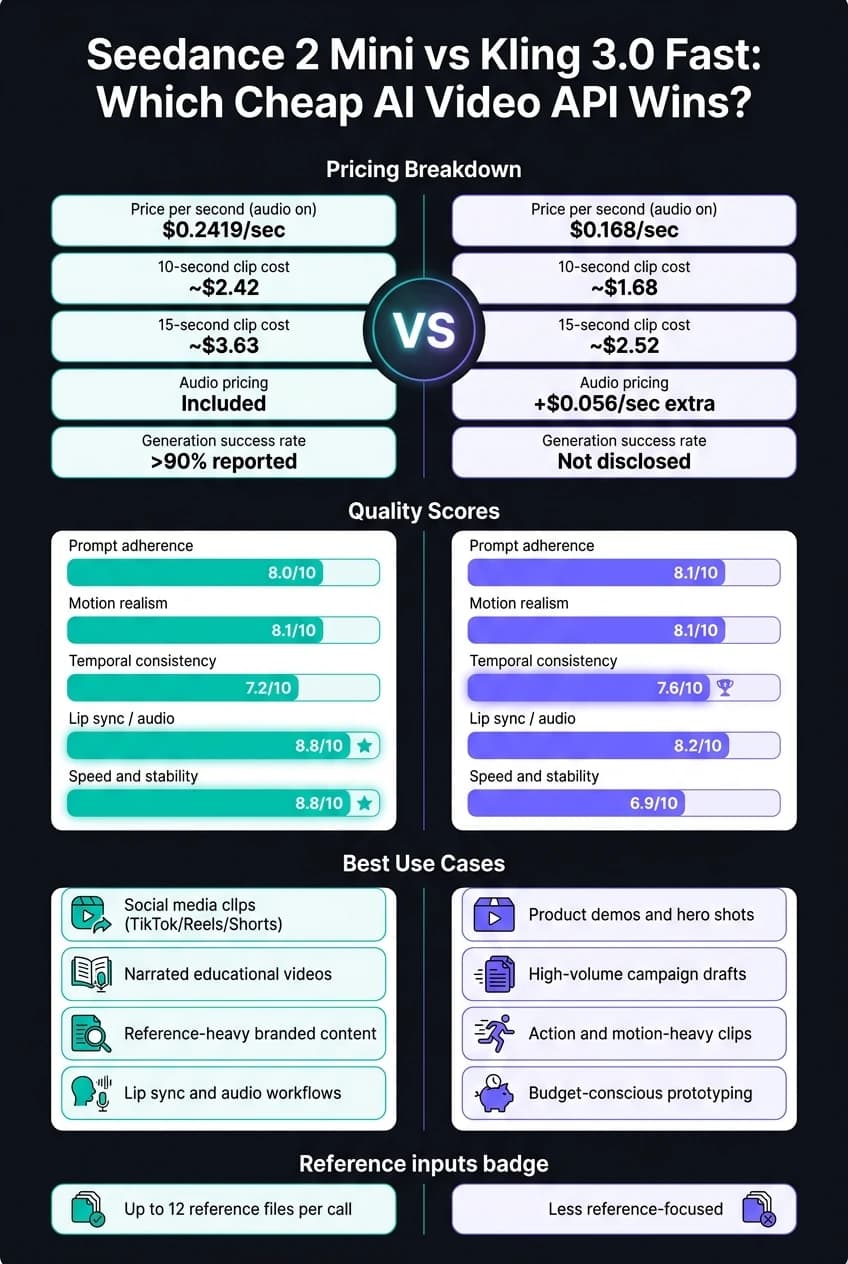
Quick Comparison
| Criteria | Seedance 2 Mini | Kling 3.0 Fast |
|---|---|---|
| Best for | Audio-led social clips, narrated visuals, reference-heavy work | Lower-cost drafts, product shots, motion-heavy clips |
| Price per second | $0.2419/sec | $0.126/sec without audio, $0.168/sec with audio |
| 10-second clip | ~$2.42 | ~$1.68 with audio |
| 15-second clip | ~$3.63 | ~$2.52 with audio |
| Audio | Included | Extra $0.056/sec |
| Prompt adherence | 8.0/10 | 8.1/10 |
| Motion realism | 8.1/10 | 8.1/10 |
| Temporal consistency | 7.2/10 | 7.6/10 |
| Lip sync / audio | 8.8/10 | 8.2/10 |
| Speed and stability | 8.8/10 | 6.9/10 |
| References | Up to 12 files in one call | Less reference-focused |
| Reported success rate | Over 90% | Not disclosed |
My read: if you publish lots of short ad tests and want to keep spend down, Kling 3.0 Fast is the safer first pick. If you need native audio, lip sync, and character consistency without extra post work, Seedance 2 Mini can be the better buy even at a higher sticker price.
That’s the core trade-off the full article breaks down.
Seedance 2 Mini: What It Is and How It Works
Seedance 2 Mini is ByteDance's faster, lower-cost version for rapid prototyping, draft passes, and high-volume production flows. It runs 30–60% faster than the standard Seedance Pro model [3]. For buyers, the big question is simple: does that extra speed still give you enough usable clips to keep spend in check?
It supports text-to-video (T2V), image-to-video (I2V), and reference-to-video (Ref2V) workflows, with clip lengths from 4 to 15 seconds [2][9]. One standout feature is the @-reference system. It lets developers attach up to 9 images, 3 video clips, and 3 audio tracks in a single API call to guide the result [8]. Audio - including sound effects, ambient noise, and lip-sync - is generated in the same call as the video (similar to Sora 2), so there's no separate audio layer to stitch in later [2][7]. Supported aspect ratios include 21:9, 16:9, 4:3, 1:1, 3:4, and 9:16, which is useful when you're producing for several formats at once [2].
Where Seedance 2 Mini Performs Best
Seedance 2 Mini stands out most in character consistency. It scored a perfect 10/10 on the NoviAI character consistency benchmark and reaches about 91% character similarity across multi-shot briefs , a level of consistency also seen in models like MiniMax Hailuo 2.3 [7][8]. That matters when one clip has to line up closely with the next. For branded work, it means a character's face, outfit, or product can stay in sync from scene to scene.
It also does well in physical simulation. Across seven scene consistency dimensions, Seedance ranks first in four: physical simulation, object permanence, scene logic, and lighting realism [6]. If your team is building branded story-driven ads or any project where visual identity has to stay locked across shots, Seedance 2 Mini looks like a strong pick at this price point [5][8].
Seedance 2 Mini Trade-Offs to Know Before You Buy
The lower price comes with some limits. The fast tier is usually capped at 720p, or 480p on some endpoints, so it's better suited to drafts than final 1080p deliverables. That's a real limit for marketing clips or product demos that need broadcast-ready output [1][2].
Motion style is also more restrained. It leans toward cinematic steadiness instead of heavy, fast-moving energy, which may not fit action-focused social content [6][7]. And the @-reference system takes some practice. Character references should come first, then product or style, with motion references last [8]. The reported generation success rate is over 90%, but that still means some reruns will show up in the workflow [5].
Kling 3.0 Fast takes a different path, so the next section looks at where speed gives way to control.
Kling 3.0 Fast: What It Is and How It Works
If Seedance 2 Mini leans toward consistency, Kling 3.0 Fast leans toward motion and output. It’s a high-throughput video model built for fast generation, energetic movement, and a low cost per clip. That makes it a good match for action-heavy footage where motion matters more than fine detail. The main question is simple: does faster generation cut the cost per usable clip?
Kling 3.0 Fast uses scene-coherence logic to keep continuity steady in multi-participant scenes and more complex physics setups [7]. It supports text-to-video and image-to-video, along with first-frame and last-frame conditioning [1][9]. Audio support includes dialogue, ambient sound, and effects for a small added cost [2][7].
Where Kling 3.0 Fast Performs Best
Kling 3.0 Fast stands out when motion is the whole point. It handles action sequences and dynamic product spins with natural follow-through and more energy in movement [6]. A 5-second clip usually renders in 25–60 seconds [3]. At about $0.35 per 5-second clip or $0.70 per 10-second clip, it works well for high-volume social media testing and fast prototyping [3][6].
It also tends to deliver smoother human faces with fewer generation attempts [7]. On the Artificial Analysis Video Arena leaderboard, it holds an Elo score of 1,241 to 1,243 as of early 2026 [3][7]. It also earned a 7.9/10 on MaxVideoAI for its Standard engine [1]. For social clips, product spins, and fast ad testing where camera energy matters more than frame-by-frame precision, it’s a strong default. That also makes it a useful benchmark for cost-per-usable-clip performance.
Kling 3.0 Fast Trade-Offs to Know Before You Buy
There’s a clear trade-off, especially in crowded scenes. Its main weak spot is object permanence in crowded or occluded shots, where drifting or morphing artifacts can show up [6]. You’ll notice this less on shorter 5- to 10-second clips, which is why that range is often treated as the quality sweet spot [6][9]. If your team is building longer sequences or scenes with intricate layering, plan for re-renders.
It also follows prompts more closely, which helps when you need to match a specific brief or storyboard [4]. The built-in filter is strict, and the 2026 update made it stricter, so edgy or suggestive prompts may get blocked [3]. For brand-safe marketing work, that’s a solid fit. For more experimental briefs, it’s smart to test prompts before production.
Head-to-Head: Price, Speed, Quality, and Integration
Pricing and Cost Per Usable Clip
Now that the strengths of each model are on the table, the next step is simple: which one stays cheaper once retries and usable output are part of the math?
Kling costs less per second. But Seedance includes audio and reports a higher generation success rate, which can cut wasted runs. Kling 3.0 Fast costs $0.126/sec with audio off and $0.168/sec with audio on, while Seedance 2 Mini costs $0.2419/sec with native audio included [2].
On a 10-second clip, that works out to about $1.68 for Kling with audio and about $2.42 for Seedance [2]. On a 15-second clip, Seedance comes to about $3.63 versus Kling's $2.52 with audio turned on [2].
| Metric | Seedance 2 Mini | Kling 3.0 Fast |
|---|---|---|
| Price per second (audio on) | $0.2419/sec [2] | $0.168/sec [2] |
| 10-second clip cost (audio on) | ~$2.42 [2] | ~$1.68 [2] |
| 15-second clip cost (audio on) | ~$3.63 [2] | ~$2.52 [2] |
| Audio pricing | Included in base price [2] | +$0.056/sec surcharge [2] |
| Reported success rate | >90% [5] | Not disclosed [5] |
Seedance reports a generation success rate of over 90% [5]. Kling's rate has not been publicly disclosed [5]. That gives Seedance an edge when failed generations start piling up. In other words, Kling may look cheaper at first glance, but retry rates can eat into that gap fast.
Video Quality, Prompt Adherence, and Speed Results
Price only tells part of the story. If the clip doesn't come out right, the low rate per second doesn't help much.
The two models are close on prompt adherence: 8.0/10 for Seedance 2 Mini and 8.1/10 for Kling 3.0 Fast [1]. The difference is more about style than score. Kling tends to follow prompts more literally, while Seedance leans more expressive [4].
Motion realism is also neck and neck, with both models at 8.1/10 [1]. Kling's motion feels more physically grounded [4]. Seedance leans toward more energetic movement [10].
Kling does better on temporal consistency, scoring 7.6/10 compared with Seedance's 7.2/10 [1]. So if you care about subjects and objects holding together from frame to frame, Kling has the edge. Seedance, on the other hand, leads on audio and lip-sync at 8.8/10 versus Kling's 8.2/10 [1]. It also scores higher on speed and stability at 8.8/10 versus 6.9/10 [1].
API Integration and Workflow Through APIMart

Both models run through the same APIMart API, so switching between them mostly comes down to changing model_id [2][6].
Kling gives you more fine-tuned controls, including CFG scale and negative prompts. Seedance supports up to 12 reference files and six aspect ratios, including 21:9 [2]. That difference matters most for teams that reuse the same asset sets or tune prompts across a lot of jobs.
Those trade-offs lead straight into the use-case verdict in the next section.
Verdict: Which Cheap AI Video API Wins?
There isn’t one clear winner across the board. Each model comes out ahead for a different reason.
Using the same scorecard from above, Kling 3.0 Fast wins on per-clip cost. Seedance 2 Mini wins on workflow value, thanks to native audio sync and a higher generation success rate, which means fewer wasted runs.
Here’s the fastest pick based on the kind of work you’re doing:
| Use Case | Best Pick | Key Reason |
|---|---|---|
| Social media (TikTok, Reels, Shorts) | Seedance 2 Mini | Native audio sync and up to 12 reference inputs [2][4] |
| Product demos and brand hero shots | Kling 3.0 Fast | Lower per-clip cost and tighter prompt adherence [2][6] |
| Campaign drafts | Kling 3.0 Fast | Lower cost per clip for high-volume drafting [2] |
| Educational visuals with narration | Seedance 2 Mini | Unified audio-video generation saves post-production time [2] |
When to Start With Seedance 2 Mini vs. Kling 3.0 Fast
As a starting point, the choice comes down to three things: budget, audio needs, and how much control you need.
Start with Seedance 2 Mini if you’re making social content at scale, need lip-sync or ambient audio built in, or rely on multiple image and video references for each clip. Its speed and stability score of 8.8/10 [1] makes it a better fit when fast iteration matters more than top-end resolution, such as that found in WAN 2.6.
Start with Kling 3.0 Fast if your budget is tighter or you’re building a more structured pipeline where shot-level control and prompt adherence can’t slip. Its lower per-second rate makes it the safer default for publish-ready hero shots.
FAQs
Which model is cheaper after retries?
Kling 3.0 costs less once you factor in retries and lots of iteration. Both models bill by the second of output, but Kling 3.0’s Standard tier comes in at a lower per-second rate than Seedance 2.0 Fast.
That gives Kling 3.0 an edge for bulk workloads, fast prototyping, and making several versions of short clips.
When is built-in audio worth the extra cost?
Built-in audio is worth paying for when it saves enough production time to cover the higher price. It tends to matter most for dialogue-heavy content that needs native multilingual lip-sync, or when you want to skip the manual work of syncing sound effects, ambient noise, and music.
It also helps with social media content and music-led visuals where beat-sync matters. If your workflow relies on steady audio-visual sync without outside tools, native generation can be a cost-effective option.
Which API is better for consistent characters?
Seedance 2.0 is the better pick for character consistency.
In independent benchmarks, it scored 10/10. And its multi-reference system gives you more control: you can upload up to nine images to help keep a character’s look steady across generations.
Kling 3.0 is strong too, especially for structured multi-shot sequences. But in more complex scenes, it’s more likely to drift. If keeping the same character identity across multiple shots matters most, go with Seedance 2.0.
Choose the model you want in the model marketplace
Try chat, image and video models in the APIMart model marketplace, and experience model capabilities quickly with one unified API.