Wan 2.7 vs Sora 2: AI Video Generator Compared
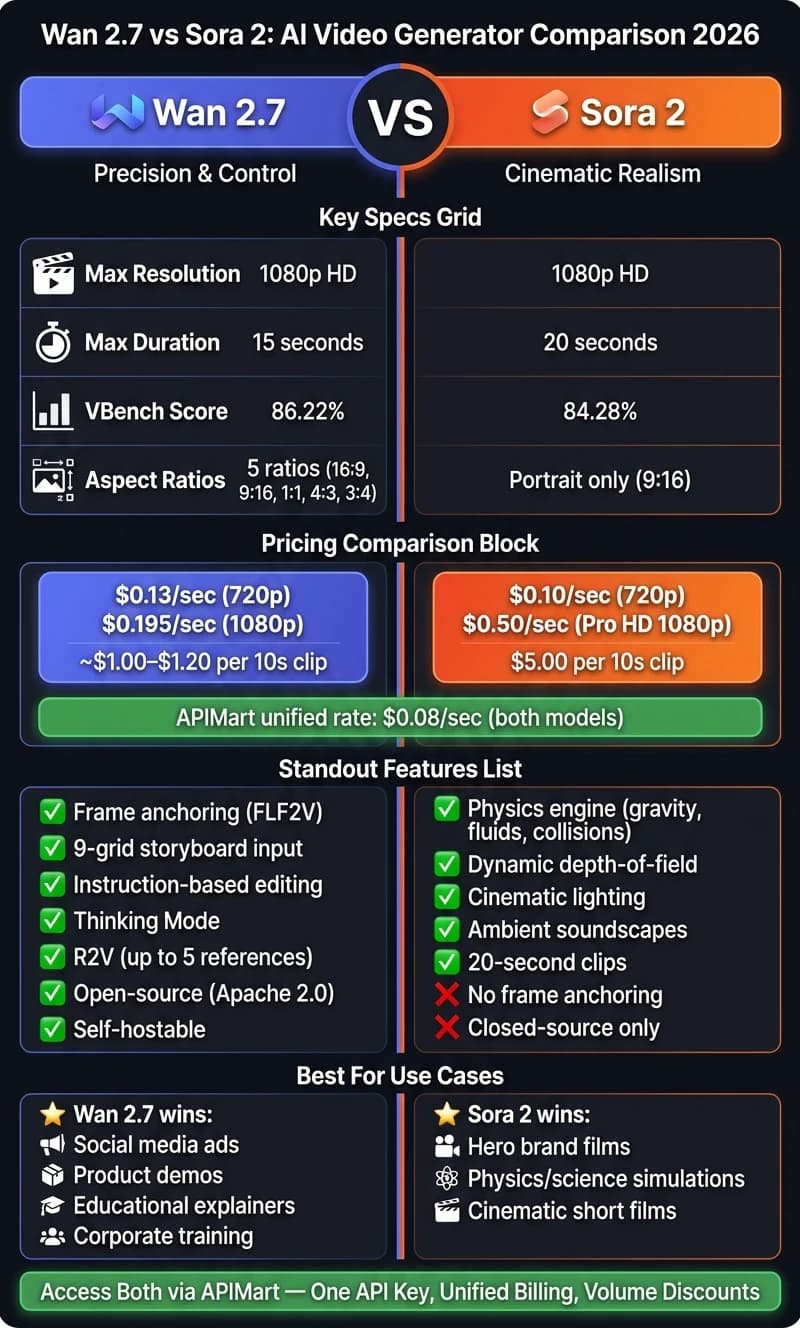
Wan 2.7 vs Sora 2: compare quality, control, pricing, and use cases. Wan 2.7 wins on consistency and cost; Sora 2 on cinematic realism. Both run via APIMart.
Wan 2.7 and Sora 2 represent two standout AI video generators in 2026, each excelling in different areas. If you need consistent, structured videos for marketing or education, Wan 2.7 is your best bet. For cinematic, visually stunning clips, Sora 2 leads the pack. Other high-end options like Veo 3.1 also provide professional-grade cinematic control. Here’s a quick breakdown:
- Wan 2.7: Focuses on precision and control. Offers frame anchoring, 9-grid storyboarding, and multi-shot consistency. Ideal for repeatable workflows like ads, tutorials, or training videos. Cost-effective with $0.13/second for 720p and $0.195/second for 1080p.
- Sora 2: Prioritizes visual realism with a physics engine for lifelike motion and environments. Best for high-impact, cinematic projects like brand films or science simulations. Pricing starts at $0.10/second for 720p and $0.50/second for Pro HD 1080p.
Quick Comparison:
| Feature | Wan 2.7 | Sora 2 |
|---|---|---|
| Max Resolution | 1080p HD | 1080p HD |
| Max Duration | 15 seconds | 20 seconds |
| Core Strength | Structured, repeatable outputs | Cinematic, visually rich outputs |
| Pricing (1080p) | ~$0.195/second | $0.50/second |
| Best For | Ads, training, tutorials | Films, visual storytelling |
| Alternative | Kling V3 | High-quality cinematic video |
Both tools are accessible via APIMart, which simplifies workflows by providing a single API for both models. Choose Wan 2.7 for reliability and cost-efficiency or Sora 2 for breathtaking visuals.

Core Video Capabilities and Output Quality
Wan 2.7: Core Strengths

Wan 2.7 is designed with reliability in mind, delivering 1080p HD video in clips up to 15 seconds long. It supports five native aspect ratios - 16:9, 9:16, 1:1, 4:3, and 3:4 - making it versatile for different platforms and use cases [3]. Its 27-billion-parameter Mixture-of-Experts architecture ensures high-quality output while keeping computational costs in check by activating only the necessary parameters per generation [9].
One of Wan 2.7's standout features is its ability to maintain temporal consistency. Subjects remain accurate across frames, and the model's first-and-last-frame control creates seamless loops and smooth transitions. This makes it particularly valuable for marketers and educators who need structured, repeatable video content. Additionally, it provides synchronized audio-visual features, including integrated lip-sync, foley effects, and music.
"Wan 2.7 flips that equation - you define the boundaries, the model fills the motion." - Wan2-7.net [4]
In independent tests, Wan 2.7 achieved a VBench score of 86.22%, leading its competitors by 1.94 points in subject consistency and aesthetic quality [9]. Its strengths lie in delivering consistent, production-ready videos.
Sora 2: Core Strengths

Sora 2 takes a different path by simulating the physical world with a built-in physics engine capable of modeling gravity, buoyancy, fluid dynamics, and material collisions [2]. It produces 1080p clips up to 20 seconds long, offering more room for narratives and scenes that demand extended durations - ideal for entertainment and premium marketing projects.
What sets Sora 2 apart is how its physics-driven approach translates visually. The output feels cinematic, with dynamic depth-of-field, vibrant lighting, and realistic environmental motion. These features create a sense of natural phenomena, adding a layer of visual richness. Sora 2 also generates fully synchronized ambient audio and soundscapes, enhancing its immersive quality.
"Sora 2 is especially compelling... because it can produce a stronger impression of raw physical richness." - Wan27ai.com [2]
While its VBench score of 84.28% reflects a slight compromise in subject consistency, Sora 2 excels in maintaining a coherent and stable world state across its longer clips [9]. This makes it a strong choice for creating visually stunning, immersive experiences.
Core Video Capabilities: Side-by-Side Comparison
| Feature | Wan 2.7 | Sora 2 |
|---|---|---|
| Max Resolution | 1080p HD | 1080p HD |
| Max Duration | 15 seconds | 20 seconds |
| VBench Score | 86.22% [9] | 84.28% [9] |
| Motion Approach | Stable, directable, production-ready | Physics-driven, emergent, realistic |
| Aspect Ratios | 16:9, 9:16, 1:1, 4:3, 3:4 | 9:16 (portrait only) |
| Native Audio | Lip-sync, foley, and music sync | Ambient soundscapes, cinematic audio |
| Frame Control | First/last-frame anchoring | Not available |
| Best For | Commercials, social content, narrative work | High-end visual showcases, cinematic spectacle |
Control, Workflow Features, and Integration
Wan 2.7: Control and Workflow Tools
Wan 2.7 is built for creators who need precision. Its frame anchoring (FLF2V) feature lets you lock the exact start and end points of a clip - perfect for creating seamless loops or chaining clips into longer sequences effortlessly [8]. Another standout tool is its 9-grid storyboard input: a 3×3 image grid that the model transforms into a continuous, multi-angle video. For instance, you can provide nine reference perspectives in one go to generate a smooth multi-shot sequence, cutting down on manual stitching [8][7].
On top of that, Wan 2.7 offers instruction-based editing, where you can make adjustments - like changing styles, swapping backgrounds, or editing specific areas - using plain-English commands without regenerating the entire video.
A Thinking Mode adds another layer of functionality. Before generating content, it performs a reasoning pass, turning short prompts into detailed cinematographic instructions. This helps reduce visual flaws and enhances spatial consistency [8][11]. The model also features a Reference-to-Video (R2V) mode, which accepts up to five mixed references (images, video clips, and audio). This ensures consistent character identity and voice across scenes, eliminating the need for costly fine-tuning for each subject [8].
While Wan 2.7 provides frame-level control, Sora 2 focuses on broader scene dynamics.
Sora 2: Prompt-Driven Creative Control
Sora 2 takes a different approach, prioritizing high-level cinematic direction over precise frame control. Instead of tools like frame anchoring, it responds to prompts about camera movement, lighting, and mood, using a simulation engine to handle physical details [2][10]. This makes it ideal for quick concept exploration - just describe the scene, and the model handles how objects interact, how light behaves, and how the environment feels.
However, Sora 2 does have limitations. It lacks frame anchoring and offers only basic editing options, such as re-prompting or using image-to-video modes. If a clip doesn’t match your vision, you’ll need to refine it through additional prompts, which can slow down structured workflows. That said, Sora 2 shines when you need visually stunning results quickly, especially for creative brainstorming or one-off projects [2][10].
Despite their different workflows, both models integrate seamlessly through the unified APIMart platform.
Accessing Both Models via APIMart

APIMart simplifies access by offering a single REST API for both Wan 2.7 and Sora 2. This eliminates the need to juggle multiple accounts or deal with separate rate limits [10].
"Instant access with no waitlist was a game-changer for our agency. We can now prototype Sora 2 video concepts for clients in hours instead of days." - Marcus Chen, Creative Director [10]
"One API key for Sora 2 Pro, Claude 4.5, and 500+ models simplifies our workflow dramatically. The ultra-high concurrency support handles our enterprise workload effortlessly." - Rachel Foster, Enterprise Architect [12]
APIMart also supports team collaboration with shared API keys and automated volume discounts [10][12]. This unified system is especially helpful for teams using both models - Wan 2.7 for structured production and Sora 2 for creative visual concepts - under the same billing account.
Features and Integration: Side-by-Side Comparison
| Feature | Wan 2.7 | Sora 2 |
|---|---|---|
| Frame-Level Control | Frame anchoring (FLF2V) | Not available |
| Storyboard Input | 9-grid (3×3 multi-angle) | Not available |
| Editing | Instruction-based (plain English) | Re-prompting or image-to-video only |
| Character Consistency | High - up to 5 mixed references (R2V) | Moderate - image-to-video reference |
| Reasoning Pass | Thinking Mode (prompt expansion) | Not available |
| License | Open-source (Apache 2.0) | Closed-source |
| Self-Hosting | Yes - local deployment, LoRA fine-tuning | No - API access only |
| APIMart Integration | Single REST API via APIMart | Single REST API via APIMart |
| Workflow Role | Structured production pipelines | Cinematic concept exploration |
This comparison highlights how Wan 2.7 and Sora 2 cater to different creative needs, making them complementary tools for various production workflows.
Pricing, Performance, and Total Cost
Wan 2.7 Pricing Model
Wan 2.7 uses a credit-based pricing system, starting at $9.90 for 100 credits that never expire, making it a flexible option for teams with fluctuating production needs. For larger-scale operations, pricing scales up to $99.90 for 1,250 credits with support for 10 concurrent jobs[1][15].
For API users, costs are measured per second: $0.13/second for 720p and $0.195/second for 1080p[8]. This keeps the cost of most clips well below $1.00.
On the other hand, Sora 2 employs a straightforward per-second billing system, directly linking costs to usage.
Sora 2 Pricing Model
Sora 2 offers three pricing tiers for per-second billing:
- Standard 720p: $0.10/second
- Pro 720p: $0.30/second
- Pro HD 1080p: $0.50/second
For example, a 10-second Pro HD clip costs $5.00 per export. However, the actual cost can rise significantly due to multiple iterations.
"The real cost of Sora 2 is iteration, not the final export. Most teams generate multiple versions before approving a final video, which can increase actual production costs significantly." - Runbo Li, CEO, Magic Hour[13]
Professional teams often go through 20 or more iterations before finalizing a clip. At Pro HD rates, this means the cost of a single approved 10-second clip can climb to $100. Additionally, the ChatGPT Plus plan at $20/month limits users to short, watermarked clips, while full Pro HD access requires a $200/month subscription[14].
Both pricing models become more streamlined when accessed through APIMart.
Unified Pricing via APIMart
APIMart consolidates billing for both Wan 2.7 and Sora 2, offering a single API endpoint. Sora 2 Preview is priced at $0.08/second, which is lower than the direct-access Standard tier rate of $0.10/second[13][14]. This pay-as-you-go model provides access to Pro-quality output without requiring costly monthly commitments. Additionally, automated volume discounts make it easier to scale production efficiently.
This unified pricing system is particularly useful for industries like marketing, education, and entertainment, where streamlined workflows are essential.
Pricing and Costs: Side-by-Side Comparison
| Wan 2.7 | Sora 2 | |
|---|---|---|
| Pricing Model | Credit-based (no expiration) | Per-second / Subscription |
| Entry Cost | $9.90 for 100 credits | $20/month (Plus) or $0.10/second |
| 720p API Rate | $0.13/second | $0.10/second (Standard) |
| 1080p API Rate | $0.195/second | $0.50/second (Pro HD) |
| 10-s 1080p Clip | ~$1.00–$1.20 | $5.00 (Pro HD) |
| APIMart Rate | ~$0.08–$0.13/second | $0.08/second (Preview) |
| Free Tier | Yes (daily credits) | No |
| Subscription Cap | None | $200/month for full Pro access |
Wan 2.7's credit-based system and lower API rates make it a cost-effective choice, especially for high-resolution projects. In contrast, Sora 2's iteration costs can quickly add up. For instance, creating 1,000 15-second Pro HD clips via API could cost approximately $4,500 per month[14]. For teams managing large-scale production, these differences can result in substantial savings.
Use Case Fit: Marketing, Education, and Entertainment
Marketing and Advertising
When it comes to marketing, Wan 2.7 serves as a dependable production tool, while Sora 2 excels as a visual powerhouse [2]. For everyday campaigns like social media ads, product demos, or multi-scene storyboards, Wan 2.7 shines with its reliable output. Its 9-grid mode creates cohesive, multi-angle promotional sequences, and the R2V mode ensures brand characters and visual styles remain consistent across multiple outputs [7][8]. This kind of reliability is crucial when producing numerous ad variations on a weekly basis.
On the other hand, Sora 2 is better suited for high-budget projects where cinematic realism takes center stage. It's ideal for launch films or brand anthems that rely on a single, breathtaking visual to make an impact [2].
Education and Training
For educational content, consistency in character portrayal and dialogue delivery is key. Wan 2.7 offers phoneme-level lip synchronization, multi-person dialogue support, and R2V mode, making it perfect for dialogue-heavy tutorials or maintaining a cohesive instructor persona across different courses - all without needing fine-tuning for each subject [6][8]. This is particularly useful for corporate training or language learning, as it significantly cuts down on post-production time.
Meanwhile, Sora 2 finds its niche in STEM education. Its advanced world simulator capabilities - handling fluid dynamics, gravity, and complex material interactions - deliver a level of physical accuracy that Wan 2.7 cannot match [1][5]. For subjects like chemistry or physics that require realistic lab simulations, Sora 2 emerges as the better option.
Entertainment and Social Content
Entertainment projects often prioritize visual impact and immersive storytelling over structured production. For episodic content or presenter-style social videos, Wan 2.7 is a solid choice. Its built-in audio synthesis and frame control provide a reliable workflow, and its polished output - featuring vibrant colors, stable cinematic lighting, and native sound effects - often requires no additional editing [1][2][16].
In contrast, Sora 2 is best for standalone cinematic sequences where visual spectacle and environmental detail take precedence over narrative control [2]. If you need a jaw-dropping 20-second clip rather than a consistent series, Sora 2 is the tool to use.
"Wan 2.7 wins for controllability, consistency, and production‑oriented usability." - wan27ai.com [2]
"Sora 2 wins for realism, spectacle, and visually rich scene behavior." - wan27ai.com [2]
Use Case Fit: Side-by-Side Comparison
| Use Case | Wan 2.7 | Sora 2 | Best Pick |
|---|---|---|---|
| Social media ads | High - fast, consistent, brand-safe | Moderate - premium look, less control | Wan 2.7 |
| Product demos | High - 9-grid multi-angle support | Moderate - physics-heavy scenes | Wan 2.7 |
| Hero brand films | Moderate - solid quality | High - cinematic realism | Sora 2 |
| Educational explainers | High - consistent personas, lip-sync | Moderate - visual accuracy | Wan 2.7 |
| Physics/science simulations | Moderate - standard physics | High - advanced world simulation | Sora 2 |
| Corporate training | High - repeatable characters, fast | Moderate - style drift risk | Wan 2.7 |
| Cinematic short films | Moderate - narrative control | High - visual emergence | Sora 2 |
This breakdown highlights how to choose between Wan 2.7 and Sora 2 based on the unique demands of each project type.
Stop Using Multiple AI Tools - Wan 2.7 Does Everything
How to Choose the Right Model
Deciding between Wan 2.7 and Sora 2 depends on whether your priority is precision or visual flair. Wan 2.7 is the go-to for consistent, repeatable workflows, while Sora 2 shines in creating visually stunning, cinematic content. Here's a breakdown to help you decide.
When to Use Wan 2.7
Wan 2.7 is perfect for projects that demand high-volume, brand-consistent content. Think marketing campaigns, social media ads, or training materials where predictability and uniformity are key. Its pay-as-you-go pricing model makes it budget-friendly, especially when using 720p drafts to save costs before committing to final 1080p renders [8].
"Wan 2.7 is usually the better choice for creators who care most about controllability and repeatable output." - Wan27ai.com [2]
When to Use Sora 2
Sora 2 is built for creating visually striking, attention-grabbing videos. It's ideal for projects like broadcast-quality brand films, cinematic product launches, or scientific visualizations where realism and physics accuracy are crucial. Plus, its support for 20-second clips provides more room for storytelling compared to Wan 2.7 [1].
"Sora 2 is a high-fidelity world simulator designed to generate physically consistent, multi-style videos." - Atlas Cloud Blog [5]
Using Both Models Together via APIMart
Some teams combine the strengths of both models using APIMart's unified REST API. This workflow involves leveraging Wan 2.7 for storyboarding and iterative production, then switching to Sora 2 for final, high-quality cinematic renders. This method balances precision with visual impact, creating a seamless AI video production process [10].
"Instant access with no waitlist was a game-changer for our agency. We can now prototype Sora 2 video concepts for clients in hours instead of days." - Marcus Chen, Creative Director [10]
FAQs
Which model is easier to keep characters consistent across multiple clips?
Wan 2.7 stands out when it comes to keeping character consistency across multiple clips. With its advanced reference-based identity stability, you can lock in a subject's appearance using up to five references, whether they're images or videos. This feature ensures consistent facial geometry and identity throughout various scenes. While Sora 2 is known for its focus on environmental realism, Wan 2.7 is tailored to avoid identity drift, making it a better choice for narrative-driven projects.
How can I reduce iteration costs when using Sora 2 for Pro HD videos?
When working to reduce iteration costs, start by prototyping in 720p resolution with 4-second clips. Since costs increase with higher resolution and longer clip durations, testing at these lower settings helps you refine prompts and pacing without overspending. Once you've nailed down the details, you can upgrade to 1080p resolution for the final production.
Stick to consistent and structured prompts during testing. This approach allows you to focus on tweaking one variable at a time, cutting down on redundant generations and avoiding extra costs.
Can I use Wan 2.7 for storyboards and then render the final in Sora 2 through one API?
No, you can't directly integrate Wan 2.7 and Sora 2. These are separate models with different architectures and workflows. Since they don’t share a unified API, you’ll need to manually transfer the storyboard output from Wan 2.7 to Sora 2 for final rendering. Each model requires its own set of integrations to work properly.