
How AI APIs Change Software Development
Explore how AI APIs reshape development with faster prototyping, coding automation, multimodal workflows, deployment patterns, security, and unified access.
- Simplified Integration: AI APIs handle tasks like NLP, image recognition, and video generation through easy HTTP/REST requests, reducing the need for complex infrastructure.
- Unified Platforms: Tools like APIMart consolidate multiple AI models into a single endpoint, streamlining workflows with one API key and consistent interfaces.
- Faster Prototyping: Teams can quickly analyze data, generate specifications, and create MVPs, cutting development time from months to days.
- Enhanced Coding and Testing: AI APIs automate repetitive tasks and testing, improving efficiency and reducing errors.
- Deployment Challenges: Issues like latency and cost variability are addressed with caching, circuit breakers, and monitoring tools.
- Multi-Modal Capabilities: New APIs combine text, image, and video generation, enabling seamless workflows for content creation and marketing.
Key Takeaway:
AI APIs are reshaping how software is built, making it faster and more efficient to integrate advanced features like chatbots, video generation, and analytics. Unified platforms simplify management, while multi-modal APIs open new possibilities for combining text, images, and videos in a single integration.
How AI APIs Support Each Stage of Software Development
Speeding Up Product Discovery and Prototyping
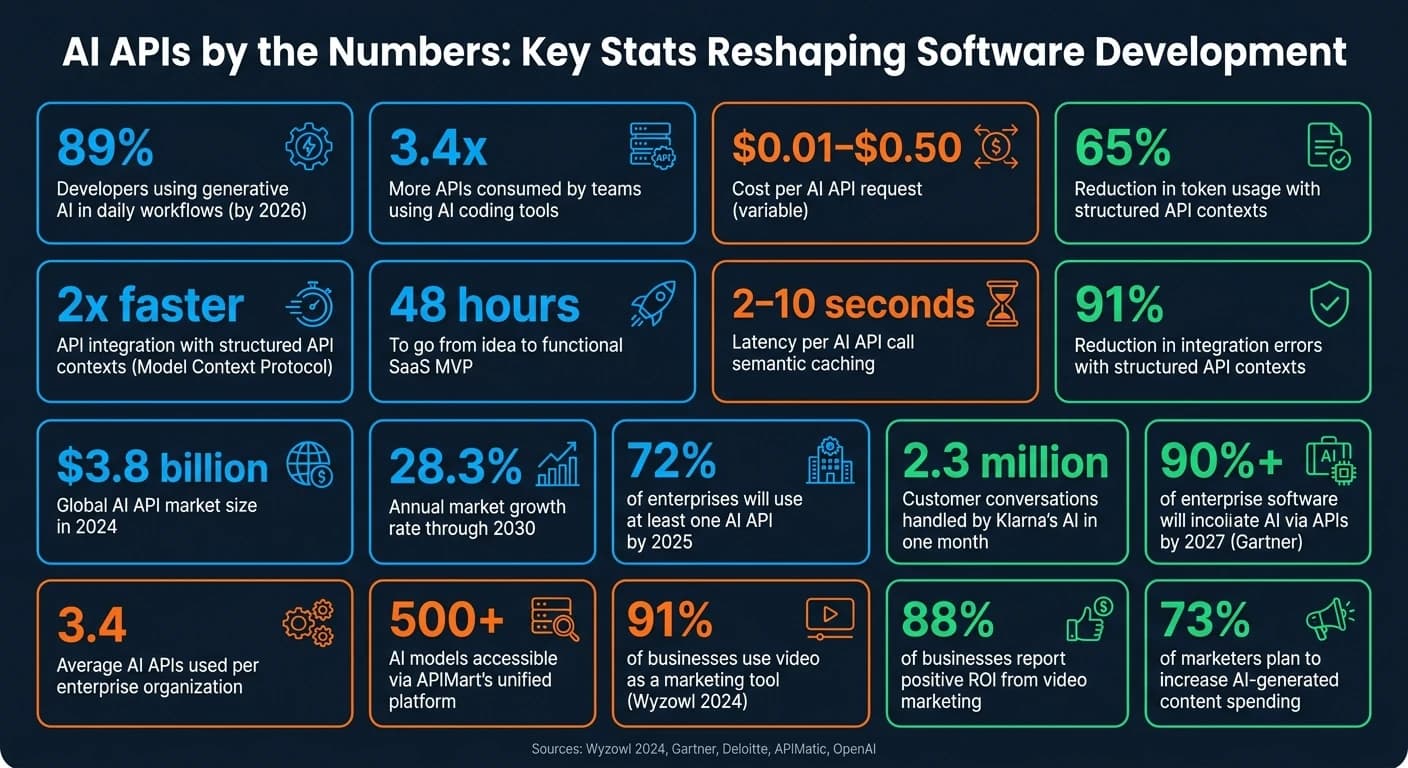
Product discovery used to be a slow and expensive process. But with AI APIs, it's much faster. Teams can now analyze vast amounts of data - like support tickets, user reviews, or survey responses - using tools like sentiment analysis and summarization APIs. This makes it possible to uncover user needs in just a few hours [1].
Developers can also generate complete OpenAPI 3.1 specifications from plain-language descriptions. These include CRUD endpoints, authentication schemes, and more. From there, they can instantly create server stubs, client SDKs, and mock servers. This allows frontend and backend teams to start working in tandem right from the beginning [3].
The result? A functional SaaS MVP can go from an idea to a working prototype in as little as 48 hours [2]. By 2026, 89% of developers, architects, and executives reported using generative AI in their daily workflows, showing just how common AI-driven discovery and prototyping has become [4].
Once the prototype is ready, AI APIs also make coding and testing much smoother.
Improving Coding and Testing Workflows
After the prototyping phase, developers use AI APIs to speed up coding and testing. These tools can handle repetitive tasks like generating REST endpoints, Express.js handlers, database schemas, and webhook handlers. This frees up developers to focus on more critical parts of the project, like the core business logic [5].
Interestingly, teams using AI coding tools consume 3.4 times more APIs than those that don’t [6]. Structured API contexts, enabled by tools like Model Context Protocol servers, make integration twice as fast. They also cut token usage by 65% and reduce errors by 91% [7][8].
As Sohaib Tariq from APIMatic pointed out, "When an AI agent has to simultaneously research an API and implement the integration, the quality of both suffers." [8]
AI tools also take care of testing. They can create comprehensive test suites, including unit tests, integration scenarios, and even fuzz testing with unusual inputs like Unicode strings or SQL injection patterns. These tools also scan for vulnerabilities, such as Broken Object Level Authentication, ensuring software is secure [3].
Once development wraps up, deploying and operating AI-driven applications comes with its own set of challenges.
Supporting Deployment and Operations
After coding and testing, deploying AI-powered software requires careful attention. Unlike traditional APIs, AI endpoints behave unpredictably. Responses can vary, latency ranges from 2 to 10 seconds per call, and costs can fluctuate between $0.01 and $0.50 per request [9].
Semantic caching helps address some of these issues by using vector embeddings to identify similar queries and return cached data. This approach can cut LLM API costs by 60–90% [9][12]. But reliability remains a concern. For example, OpenAI reported 11 incidents in just 28 days during January 2026. AI/ML APIs were also ranked as the least reliable among over 215 tracked services in early 2026 [10].
To mitigate these challenges, teams are implementing circuit breakers that activate during latency spikes - not just outright failures. These systems can switch to faster, more cost-effective models before users even notice a problem [9][10].
As Vinit Shahdeo, Backend Engineer, remarked, "The unit of scarcity changed. It's no longer requests. It's tokens." [9]
Monitoring metrics like cost-per-request, latency, error rates, and throughput has become a priority for teams deploying AI features on a large scale [9].
Multi-Modal AI APIs: Combining Text, Image, and Video in One Integration
What Is Multi-Modal AI?
In the past, AI APIs were designed for single tasks. Now, multi-modal AI has changed the game by combining text, images, and video into a single, unified interface. These advanced models, like OpenAI's GPT-4o and Google's Gemini 1.5, are trained across multiple data types - text, images, audio, and video - allowing them to seamlessly interact with and generate content across different formats.
The standout feature here is shared context across modalities. For example, these models can analyze a text prompt and a visual input together, ensuring details like color, style, or scene composition are accurately aligned in the output. From a developer's perspective, this means you can send one request - whether it’s for generating an image from a product description or creating captions for a video - and get a cohesive result. This streamlined process not only simplifies workflows but also opens up new possibilities for creating and managing content, especially in video production.
Video Generation with AI APIs
Video generation is one of the most exciting areas where multi-modal APIs are making a noticeable impact. These APIs are tailored to meet real-world production needs, offering efficient and cost-effective solutions for creating and repurposing video content.
- Text-to-video: Developers can input a short script (100–200 words) and receive a polished MP4 video ready for platforms like TikTok, Instagram Reels, or YouTube Shorts.
- Image-to-video: Starting with a product photo, the API can generate a 15–30 second clip showcasing the item in motion or in different settings, eliminating the need for expensive manual video shoots.
- Repurposing content: Upload a webinar recording, and the API can automatically create chapter markers, subtitles, vertical clips, and shareable social media snippets.
The demand for video content is undeniable. According to Wyzowl's 2024 Video Marketing report, 91% of businesses now use video as a marketing tool, with 88% reporting a positive return on investment. Historically, the hurdles have been the time and cost of production, but video generation APIs are tackling both challenges head-on. A 2023 Deloitte Digital survey even found that 73% of marketers plan to increase their spending on AI-generated content, including video, over the next year.
These video generation workflows are designed to handle long-running tasks efficiently. Developers submit a job request, receive a job_id, and poll the API asynchronously until the video is ready. This approach avoids timeouts and ensures a smooth user experience. Once complete, assets can be saved directly to cloud storage, making the process even more seamless.
Multi-Modal Access Through APIMart
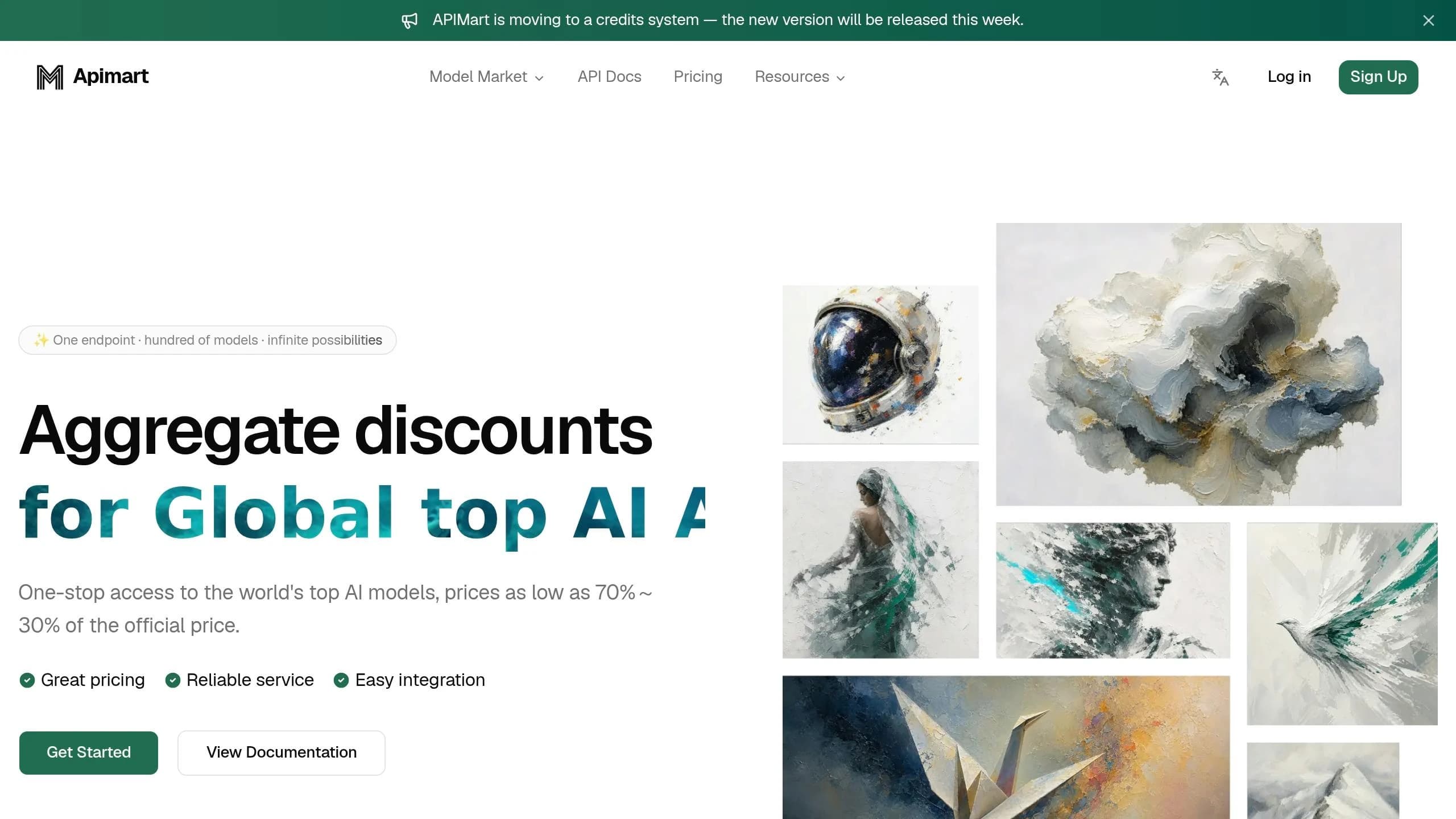
APIMart takes the concept of unified AI APIs to the next level, offering a single platform for accessing 500+ AI models across text, image, and video. With APIMart, you only need one authentication setup, one SDK, and one usage dashboard to handle everything from content generation to video production.
The platform provides a variety of models optimized for different video needs, whether you're creating quick, short-form clips or high-quality cinematic videos. All of this is accessible through a single API endpoint, so you don’t have to juggle multiple platforms or contracts.
Consistency is another major advantage. When your text, image, and video content are generated by the same platform, it’s easier to maintain a unified tone and branding across all formats. This level of coherence can be hard to achieve when working with multiple vendors, but APIMart simplifies the process by consolidating everything into one ecosystem.
How to Integrate AI APIs Effectively into Your Development Process
Why Unified APIs Work Better Than Standalone Models
Juggling separate integrations for every AI model can quickly become a logistical nightmare. Think about it: different SDKs, authentication processes, billing systems, and rate limits for each provider. This not only complicates your workflow but also increases the chances of errors and contractual headaches. A unified API platform simplifies all of this into a single endpoint, one set of credentials, and one centralized dashboard for tracking usage.
But the benefits aren't just about convenience. A unified API offers flexibility. If a provider changes their pricing or experiences downtime, switching to another model becomes a simple configuration update instead of a full-blown code rewrite. This provider-agnostic approach shields your system from vendor lock-in and ensures long-term stability. Platforms like APIMart, which support over 500 models for text, image, and video processing, operate on this principle. With a single integration, your team can focus on building, not constantly reworking integrations every time a new model launches.
Managing Performance and Cost
Once you've adopted a unified API, the next step is making sure you're getting the best performance without overspending. Using a high-powered model like GPT-5 for basic tasks is like using a sledgehammer to crack a nut - overkill and unnecessarily expensive. To stay efficient, match the model to the complexity of the task. For example, simpler models are great for straightforward tasks like classification, while advanced models should be reserved for more intricate problems.
"One model for everything is dead. Pick the right tool for each request, and your AI bill drops 40–70%." - Akshay Ghalme, AWS DevOps Engineer, BytePhase Technologies [11]
You can also cut costs by adopting smart operational practices. Cache frequently used queries to avoid redundant calls, and use asynchronous polling for long-running tasks to reduce latency and avoid timeouts. On top of that, implement a circuit breaker pattern to handle provider issues. If a model starts returning errors or slowing down, automatically pause requests to prevent cascading failures across your system.
Keeping API Usage Secure and Compliant
Security is non-negotiable when working with AI APIs, but many issues stem from simple mistakes. One of the most common? Hardcoding API keys directly into your source code. Keys stored this way often end up in public repositories by accident, exposing your system to unauthorized access. Instead, use environment variables or a secrets manager like AWS Secrets Manager or HashiCorp Vault, and make sure to rotate your keys regularly.
Handling user data also requires careful attention. If your application processes user-submitted content, make sure to scrub Personally Identifiable Information (PII) locally before sending it to an external provider. This is particularly important for U.S.-based applications and is a must for meeting HIPAA requirements in healthcare. For critical outputs like legal disclaimers or medical advice, don't rely on the model to generate them directly. Take a page from Toyota's playbook: their vehicle information platform uses AI to identify which disclaimer is needed, but the actual text is injected by the application layer to ensure compliance [11].
Finally, protect your prompts from malicious inputs. Prompt injection attacks - where users craft inputs to override your system's instructions - are a genuine threat. Using structured formats like JSON schemas for prompts can significantly reduce this risk. Combine this with centralized audit logs and short-lived presigned URLs for media assets, and you'll have a strong security foundation that can withstand scrutiny.
AI APIs in Practice: Use Cases Across Key Industries
Marketing and Advertising
Marketing teams often face the challenge of producing diverse content quickly for multiple platforms. With AI APIs, this process becomes far more efficient. For example, a U.S. retailer can input product metadata, audience details, and campaign objectives into an AI-powered workflow. From there, the system can generate different video formats - like a 15-second vertical clip for Instagram Reels and a 30-second horizontal version for YouTube Ads - all starting from the same core content [14].
What makes this approach scalable is an orchestration layer that combines tools for copywriting, image creation, and video production through a single API. APIMart's unified integration streamlines this process, connecting text, image, and video models to cut campaign development time from days to just hours. Personalization APIs further enhance campaigns by tailoring ad copy, product highlights, and calls-to-action based on individual browsing habits and purchase histories. These systems ensure prices are displayed in USD and promotional dates align with major U.S. shopping events, such as Black Friday or the Fourth of July.
Education and E-Learning
AI APIs are also transforming education, particularly in e-learning. One of the biggest hurdles for e-learning platforms has been converting raw lecture recordings into structured, digestible content for students. Speech-to-text and natural language processing (NLP) summarization APIs now handle this task automatically. They transcribe lectures, break them into sections, and summarize key points. These summaries can then be fed into video-generation APIs to create short, 2–3 minute explainer videos complete with narration and on-screen text, eliminating the need for manual editing [14].
Localization adds another layer of value. The same pipeline can apply U.S.-specific formatting, such as using imperial units (miles, feet), Fahrenheit for temperature, and MM/DD/YYYY for dates. It can even include examples that feel relevant to American learners. APIMart's multi-modal capabilities make this seamless, while centralized routing helps manage API usage limits and costs effectively.
E-Commerce and Retail
Retailers, especially in the U.S., face challenges like managing vast product catalogs, tight budgets, and increasing demand for high-quality visuals. AI APIs simplify these workflows by transforming static product photos into dynamic lifestyle videos. For instance, an outfit can be digitally styled for a casual day out, or furniture can be showcased in a virtual living room - all without the need for expensive studio shoots. These videos can then be tailored for platforms like TikTok, Instagram, or even product detail pages with minimal extra effort.
Personalization APIs take this a step further by analyzing shoppers' browsing and purchase histories to recommend products with customized descriptions and USD pricing. These recommendations can also be timed to align with key retail periods like back-to-school shopping or holiday gifting. APIMart’s unified gateway allows seamless model switching within the same pipeline. For example, a cost-efficient model can handle routine tasks like categorizing products, while a premium model like GPT-5 can generate polished, customer-facing content. This integrated approach boosts efficiency throughout the retail workflow.
How Generative AI Uses APIs: A Developer's Mental Model | Ryan Day
Conclusion: What AI APIs Mean for the Future of Software Development
By 2025, 72% of enterprises will use at least one AI API, with an average of 3.4 APIs per organization [13]. Looking ahead, Gartner predicts that by 2027, over 90% of enterprise software will incorporate AI features through external API calls [13]. These shifts highlight how developers' roles are changing dramatically.
Instead of creating models from scratch, developers are now focused on building intelligent, scalable pipelines. This involves selecting the right models for specific tasks, managing costs, and ensuring reliability as applications grow. With the global AI API market estimated at $3.8 billion in 2024 and expected to grow at a 28.3% annual rate through 2030 [13], the tools, models, and software capabilities are advancing at breakneck speed.
The impact of AI APIs is already evident. Take Klarna, for example: in February 2024, they launched an AI-powered customer service assistant using OpenAI's API. In just one month, it managed 2.3 million customer conversations, reducing average issue resolution time from 11 minutes to just 2 minutes. This system effectively replaced the workload of 700 full-time agents and is projected to boost profits by $40 million for fiscal year 2024 [13]. Such results come from carefully integrating multiple models through a unified API, not relying on a single solution.
Platforms like APIMart simplify this integration process. By offering a single OpenAI-compatible endpoint, APIMart provides access to over 500 models, eliminating the hassle of juggling multiple SDKs, authentication processes, and billing systems. Switching models is as easy as updating a configuration, avoiding the need for extensive code rewrites. With built-in failover ensuring 99.9% uptime, and intelligent routing optimizing tasks between cost-effective and premium models, developers can focus on delivering results.
Early adopters of these tools not only accelerate their development timelines but also create software that adapts automatically as models improve. This seamless integration paves the way for faster innovation and continuous advancement in software development.
FAQs
When should I use a unified AI API instead of separate model integrations?
Managing multiple AI models can be a headache, but using a unified AI API changes the game. With a single endpoint, SDK, and authentication flow, development becomes much simpler. No more juggling different SDKs, error models, or billing systems - it’s all streamlined into one cohesive setup.
This method isn’t just about convenience. It’s perfect for cutting costs, ensuring reliable performance with automatic failovers, and even testing new models without needing to overhaul your code or infrastructure. It’s an efficient way to stay adaptable while keeping everything running smoothly.
How can I reduce AI API latency and keep costs predictable in production?
To keep latency low and manage costs effectively, consider adopting an AI Gateway pattern. Here are some strategies to implement:
- Semantic caching: Save responses for frequently repeated or similar queries. This reduces the need to process the same requests repeatedly, improving response times and lowering expenses.
- Intelligent model routing: Direct simpler tasks to smaller, more affordable models, while reserving the more advanced models for handling complex tasks.
- Leverage tools from providers, such as prompt caching, and set clear budget limits to prevent unexpected costs.
These approaches can help streamline operations while keeping your AI usage efficient and cost-effective.
What are the must-have security steps for using AI APIs with user data?
To keep AI APIs secure while dealing with user data, start by using OAuth 2.0 tokens with carefully defined scopes to control access. Always validate aud (audience) and iss (issuer) claims to confirm tokens are being used correctly. Ensure data is safeguarded with TLS encryption, and use a transparent proxy to centralize validation and detect anomalies.
For high-privilege tasks, require human approval to add an extra layer of safety. Additionally, maintain detailed audit logs to monitor activity, track changes, and support compliance efforts. These steps help protect sensitive user data and reinforce trust.
Choose the model you want in the model marketplace
Try chat, image and video models in the APIMart model marketplace, and experience model capabilities quickly with one unified API.