
MAI-Code-1-Flash Microsoft Coding Model
Review MAI-Code-1-Flash, Microsoft’s coding model with sparse MoE architecture, adaptive thinking, 256K context, SWE-Bench results, pricing, and API access.
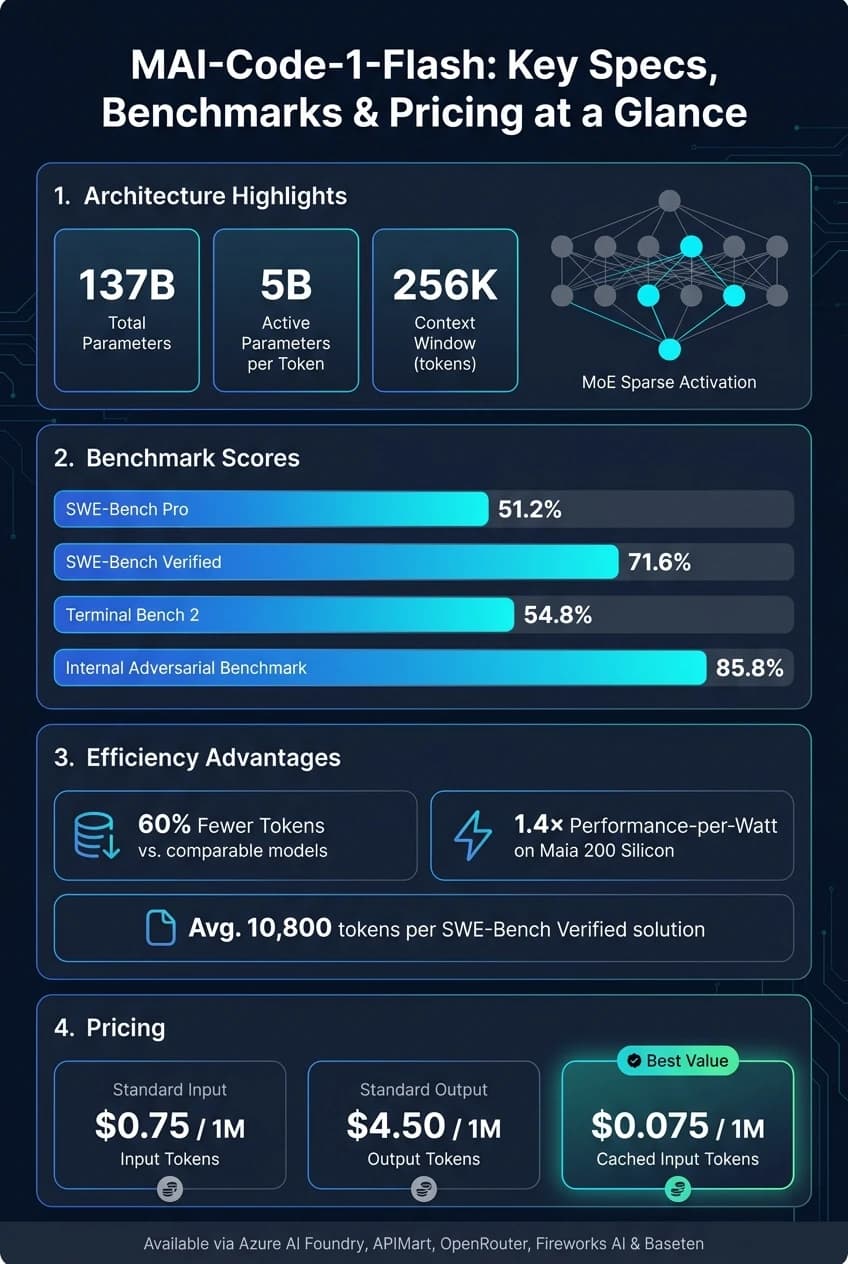
Microsoft’s MAI-Code-1-Flash is a next-gen AI model designed for coding tasks, combining efficiency and precision. With 137 billion parameters (activating only 5 billion at a time), it delivers fast performance while reducing costs. Its 256,000-token context window can process large codebases or documents in a single pass. Key features include:
- Sparse Mixture-of-Experts (MoE) architecture for cost-effective scaling.
- "Adaptive Thinking" adjusts output complexity based on task difficulty.
- Integrates with tools like GitHub Copilot and Visual Studio Code.
- Trained in real-world coding environments for practical use.
- Cost: $0.75 per 1M input tokens and $4.50 per 1M output tokens.
This model powers Microsoft’s broader MAI ecosystem, including tools for image editing, voiceovers, and transcription. It’s accessible via Azure AI Foundry and third-party providers, offering businesses flexibility and customization options. MAI-Code-1-Flash excels in coding, video generation, and educational workflows, making it a versatile tool for developers and organizations.
Voice Coding Demo: MAI-Code-1-Flash | Microsoft AI Models
Core Features and Capabilities
MAI-Code-1-Flash powers Microsoft's MAI multimodal family, introduced in June 2026, and is designed to streamline coding and video content creation. Its advanced design allows it to handle a variety of content creation tasks with impressive efficiency.
Multi-Modal Functionality
At the heart of Microsoft's MAI multimodal family, MAI-Code-1-Flash extends its coding capabilities into broader creative workflows. It acts as the coding foundation for an ecosystem that includes tools like MAI-Image-2.5 for image-to-image editing, MAI-Voice-2, and MAI-Transcribe-1.5 [7][8]. This model is particularly adept at generating code for complex video and visual content workflows, making it an excellent choice for tasks such as video generation and encoding. Its adaptive thinking feature is a standout - it adjusts its reasoning depth based on the complexity of a task. For simpler requests, it operates efficiently, while for intricate tasks like multi-file architecture changes or complex video pipeline integrations, it provides deeper, more comprehensive reasoning [1].
API Integration and Accessibility
MAI-Code-1-Flash is built for seamless integration, offering developers access through Azure AI Foundry and third-party providers like OpenRouter, Fireworks AI, and Baseten [8][9]. This broad availability reduces the risk of being tied to a single cloud vendor. It adheres to the OpenAI Chat Completions API specification, allowing teams to integrate it into existing workflows with minimal adjustments [8][9].
Additionally, it is Copilot-native, trained with tools like VS Code to ensure compatibility with real-world development environments [7][8]. For businesses with unique requirements, the model can be customized using Microsoft Frontier Tuning and Reinforcement Learning Environments (RLEs). For example, in June 2026, Microsoft collaborated with McKinsey & Company to fine-tune a MAI model tailored to their needs, achieving the highest win rates for McKinsey's tasks while cutting costs by a factor of 10 [9].
Performance and Scalability
MAI-Code-1-Flash employs a sparse Mixture-of-Experts (MoE) architecture, enabling it to scale efficiently while maintaining low latency - a crucial feature for handling extensive video pipelines or large codebases [4][5]. By using only 5 billion active parameters per operation, it balances speed and cost without sacrificing performance. This makes it particularly effective for video encoding workflows, where rapid and cost-effective processing is essential.
Here’s a quick breakdown of its key specifications:
| Specification | Detail |
|---|---|
| Architecture | Sparse Mixture-of-Experts (MoE) |
| Total / Active Parameters | 137B / 5B |
| Context Window | 256,000 tokens |
| SWE-Bench Pro Accuracy | 51.2% |
| Input Pricing | $0.75 per 1M tokens |
| Output Pricing | $4.50 per 1M tokens |
On Microsoft’s internal adversarial coding benchmark - which includes challenges like impossible tasks and inverted logic - the model achieved an adjusted accuracy of 85.8% [1]. This high level of performance demonstrates its ability to handle even the toughest coding challenges effectively.
Practical Applications of MAI-Code-1-Flash
MAI-Code-1-Flash combines advanced problem-solving, efficient token usage, and multimodal capabilities, making it a versatile tool across various industries.
Marketing and Advertising
Marketing teams often face tight deadlines and budget constraints when creating video content. MAI-Code-1-Flash simplifies this process by automating key aspects of video production. It can handle tasks like resizing assets, generating captions, and sequencing clips by interacting seamlessly with file systems, terminals, and production tools.
Its token efficiency is a game-changer, using up to 60% fewer tokens compared to similar models, which translates to significant cost savings. Tyson Cung, Data & Cloud Tech Lead, emphasized this point:
"A model that knows when to be brief saves real money at scale." [6]
When integrated with other models in the same family, such as MAI-Image-2.5 for image editing and MAI-Voice-2 for multilingual voiceovers, marketing teams gain a complete toolkit for producing video ads. This setup eliminates the need to juggle multiple, unrelated tools, streamlining the entire production process[3].
Education and e-Learning
MAI-Code-1-Flash is also making waves in education by enabling scalable, personalized content creation. With its 256,000-token context window, the model can process entire course repositories or large datasets in a single pass. This capability is perfect for educational platforms looking to update or generate content efficiently without overburdening their resources[5].
The model’s adaptive logic tailors responses to the complexity of the task. For instance, it can deliver concise answers to simple syntax questions or apply deeper reasoning for more complex challenges, like reorganizing a multi-module coding curriculum. Paired with MAI-Voice-2 and MAI-Transcribe-1.5, which supports 43 languages and operates up to five times faster than similar transcription models, institutions can automate the creation of localized video lessons with accurate voiceovers and transcripts.
Mustafa Suleyman, CEO of Microsoft AI, captured the essence of this approach:
"State of the art AI capabilities that are explicitly designed to serve people and organizations, and not to replace them." [3]
Entertainment and Media
In the entertainment industry, technical hurdles often slow down creative projects. MAI-Code-1-Flash addresses these challenges by streamlining complex workflows. For example, it can manage script-to-video pipelines, handle asset organization across large-scale projects, and automate interactive media logic[1].
The model’s Frontier Tuning feature allows studios to tailor the tool to their specific workflows, keeping proprietary production methods secure[2]. Additionally, its competitive token pricing ensures that even large-scale projects remain cost-effective[4].
Performance Benchmarks and Competitive Advantages
Benchmark Performance
The benchmark results for MAI‑Code‑1‑Flash highlight its ability to deliver efficient, large-scale coding performance. On SWE‑Bench Pro, it scored 51.2%, while on SWE‑Bench Verified, it achieved an impressive 71.6%. These numbers represent a notable leap in coding efficiency. The model’s design, which uses a sparse Mixture‑of‑Experts architecture with 137 billion total parameters (but only 5 billion active per token), ensures remarkable token efficiency. On SWE‑Bench Verified, it averages just 10,800 tokens per solution, enabling it to tackle complex coding tasks effectively.
Here’s a quick breakdown of its key performance metrics:
| Benchmark | MAI‑Code‑1‑Flash Performance |
|---|---|
| SWE‑Bench Pro | 51.2% |
| SWE‑Bench Verified | 71.6% |
| Terminal Bench 2 | 54.8% |
| Avg. solution tokens | 10,800 tokens |
These results underscore the careful design choices that allow the model to excel in both efficiency and performance.
Competitive Edge
Beyond its benchmark achievements, MAI‑Code‑1‑Flash stands out due to two major design innovations.
First, the model’s training environment mirrors real-world conditions. From day one, it has been trained to work with actual file systems, terminals, and linters, ensuring it’s equipped to handle practical coding scenarios seamlessly [1].
Second, MAI‑Code‑1‑Flash has been fine-tuned to operate on Microsoft's Maia 200 silicon, delivering a 1.4× performance-per-watt improvement over standard hardware setups [3]. Mustafa Suleyman, CEO of Microsoft AI, emphasized this advantage, stating:
"Silicon-model co-design is a key advantage, helping us deliver you the most efficient thinking and coding agents out there." [3]
This combination of energy efficiency and real-world readiness makes MAI‑Code‑1‑Flash an ideal solution for teams managing large-scale, automated workflows.
How to Get Started with MAI-Code-1-Flash
Accessing the API
Ready to dive into MAI-Code-1-Flash? Here’s how to get started quickly and efficiently.
The easiest way to begin is by using APIMart's unified API gateway at https://api.apimart.ai/v1. Since APIMart is designed with an OpenAI-compatible interface, you won’t have to overhaul your existing code. Just update your base_url and API key, and you're good to go.
The pricing structure is simple: $0.75 per 1M input tokens and $4.50 per 1M output tokens. Plus, for cached input, the cost drops to just $0.075 per 1M tokens - a cost-effective option for repeated queries or lengthy reference materials [4].
Once you’ve set up access, follow these tips to integrate MAI-Code-1-Flash effectively.
Integration Best Practices
Here are some key practices to ensure a smooth integration process:
- Secure your credentials. Store your APIMart API key in a
.envfile and load it usingos.getenvin Python orprocess.envin Node.js. Avoid hardcoding your keys to prevent potential security breaches. - Use a model alias. Instead of scattering the full model ID across your codebase, define a single alias in a central configuration file (e.g.,
"code-fast"). This makes it easy to switch models later by updating just one line of code. - Optimize with the "Cascade" approach. For high-volume, repetitive tasks like autocomplete, quick refactoring, or repository Q&A, route them to MAI-Code-1-Flash. Save more resource-intensive models for complex operations. This strategy helps reduce costs and keep latency low.
- Plan for selective fallbacks. Set up automatic fallbacks for
429(rate limit) and5xx(server error) responses. Monitor P95 latency, and if response times go beyond 30 seconds, trigger a failover to maintain workflow continuity.
Conclusion
MAI-Code-1-Flash reshapes the way coding and video generation workflows are handled, offering a blend of speed, precision, and cost-effectiveness.
With its sparse Mixture-of-Experts architecture, featuring 137 billion total parameters but only 5 billion active at any given time, it achieves exceptional performance while keeping token usage low. This translates into tangible benefits, like a 51.2% pass rate on SWE-Bench Pro and the ability to tackle complex tasks with up to 60% fewer tokens compared to similar models [1]. For teams managing large-scale workflows in industries like media, marketing, or education, these efficiencies can lead to significant cost savings.
What sets MAI-Code-1-Flash apart is its combination of raw power and user-focused design. Microsoft's Superintelligence team encapsulated it perfectly:
"Higher accuracy and greater efficiency are no longer a trade-off." [1]
The model’s 256,000-token context window, adaptive solution-length control, and seamless integration with essential developer tools make it a game-changer for those working on video generation and encoding pipelines.
Available via APIMart at $0.75 per 1M input tokens and $4.50 per 1M output tokens, MAI-Code-1-Flash offers a cost-effective and efficient solution for teams looking to streamline their workflows and elevate their results.
FAQs
What does “adaptive thinking” change in real projects?
MAI-Code-1-Flash uses adaptive thinking to tailor its response depth to the complexity of the task. For straightforward tasks, such as renaming variables, it keeps explanations brief and to the point. On the other hand, for more intricate tasks like multi-file refactoring, it provides detailed reasoning and expanded responses.
This approach has several advantages: it cuts down latency, reduces token usage by up to 60%, and delivers quicker responses. Plus, shorter outputs mean less time spent scrolling through lengthy explanations. The result? A more efficient workflow that saves both time and inference costs.
When should I use the 256,000-token context window?
Using a 256,000-token context window is ideal when working with extensive datasets like lengthy documents, detailed long-form content, or even multi-file codebases. This large context window enables the model to reference all the provided material at once, leveraging in-context learning to deliver accurate and thorough analysis.
By keeping all relevant information readily available within the model's working memory, it eliminates the need for manual retrieval or splitting data into smaller chunks, streamlining the entire process.
How do I control token costs in video workflows?
To keep token costs in check, align the complexity of tasks with the appropriate model. Simpler tasks can be routed to lower-cost models, which can lead to savings of 60%-80%. Use unified dashboards to keep an eye on usage patterns and spending trends in real time.
When working with text, image, and audio inputs, treat them as separate channels within a single API call. This approach helps you avoid unnecessary extra costs. Additionally, make use of integrated cost tracking tools and consolidated billing to gain a clear and complete view of your expenses.
Choose the model you want in the model marketplace
Try chat, image and video models in the APIMart model marketplace, and experience model capabilities quickly with one unified API.