
The Future of Physics-Based AI Video Generation
AI video is shifting from frame prediction to physics-aware models. Compare world models and simulation-in-the-loop on fidelity, cost, and near-term robotics.
AI video still fails at basic physics. Top systems score just 32.6% on joint physics-and-meaning tests, and many generated clips show close to 40% violations of conservation rules.
If I had to sum up the field in one line, it’s this: video models are moving from “make the next frame look right” to “predict what should happen next.” That shift matters most in robotics, driving, training data, product demos, and game-like 3D scenes where motion errors can ruin the output.
Here’s the short version:
-
Plain video models are good at appearance, but often bad at motion, collisions, and object permanence.
-
Physics-aware systems track scene state like position, speed, mass, and material before rendering frames.
-
World models offer a middle path: more control than plain diffusion, but less cost than full simulation.
-
Simulation-in-the-loop systems give the best physics, but they are slower and heavier to run.
-
Main blockers are low accuracy, drift after 5–10 seconds, high GPU cost, and weak evaluation standards.
A few numbers stand out:
-
Robots trained with action-based simulation data may need up to 10x fewer samples from physical testing.
-
Standard video systems can see a 45% drop in tracking when objects stay hidden for more than 50 frames.
-
Systems like Newton pushed joint physics-and-meaning accuracy from 21.4% to 29.7% on LTX-Video.
If you’re building with this tech, the near-term play is simple: start with world models for testing, then move to simulator-backed pipelines when physics errors are not acceptable. The rest of this article explains where that works, where it breaks, and what is likely next.
How Physics-Based AI Is Changing Video Generation
What Physics-Based AI Video Generation Means in Practice
Physics-based video generation predicts the state of a scene - positions, velocities, masses, and materials - and then renders the next frame. The goal isn't just to make video that looks right. It's to make video that stays physically consistent from one frame to the next.
That matters because this type of system can model things standard video tools often struggle with, including rigid-body collisions, fluid viscosity, cloth deformation, sand dynamics, and other contact interactions [2][7].
The gap shows up fast in plain text prompts. Take a prompt like "a glass falls off a table." It says what happens, but it leaves out the details that shape the motion: mass, starting velocity, friction, and material properties. As one researcher notes, text prompts omit the physical parameters that determine dynamics, so scaling alone cannot recover them [5]. Physics-aware systems deal with that problem by using a structured scene model that carries those missing details.
This is where the line between pretty video and usable simulation becomes hard to ignore. If the video is meant for training, planning, or control, physical consistency isn't a nice extra. It's the whole game.
Why Virtual Environments Need Physical Consistency
In virtual environments, even small physics mistakes can snowball. One object clips through another, motion drifts a bit, a collision lands wrong - and the whole simulation starts to lose value.
That creates a serious problem in robotics, autonomy, and other simulation-heavy workflows, where bad physics can poison the training data. A warehouse robot trained on video where boxes pass through each other is learning the wrong rules of motion. And getting those rules right pays off: robots pretrained on action-conditioned simulation data can need up to 10x fewer real-world samples to reach baseline skill on physical tasks [1].
The same issue shows up in autonomous driving. Standard video models see a 45% drop in tracking accuracy when objects stay occluded for more than 50 frames [1]. A physics-aware world model handles that differently. Instead of treating the hidden object like it vanished, it keeps an internal model of where that pedestrian is likely to be, even while out of view.
This also matters outside robotics and driving. In immersive education, architectural visualization, and product demos, motion has to hold together under scrutiny. If objects move in a way that feels off, people notice. In those cases, reliable interaction - not just cinematic output - is what makes the simulation hold up . For those prioritizing high-quality visual results, models like Grok Imagine Video offer advanced text-to-video capabilities [2].
Grounding Visual AI Models in Real-World Physics
Technologies Behind Physics-Accurate AI Video Today
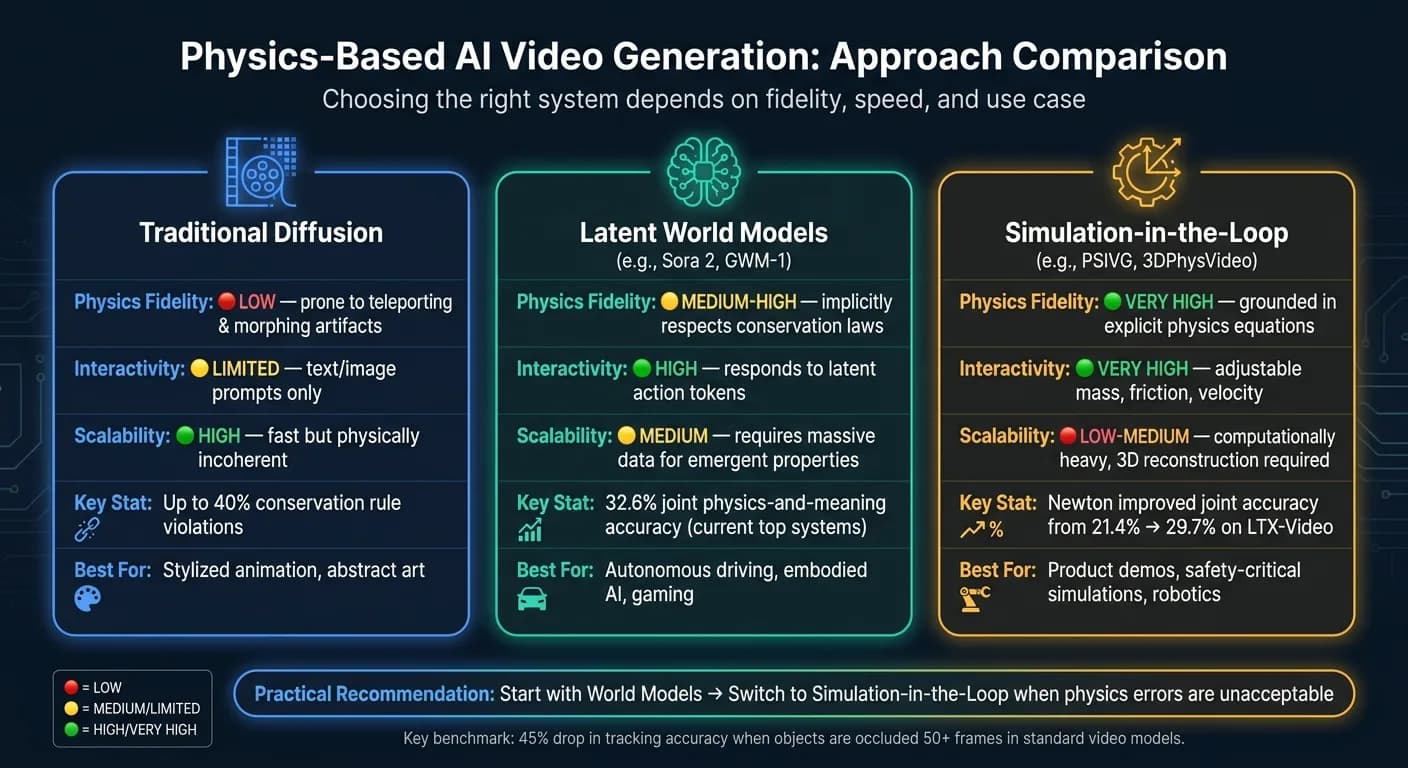
World Models, Physics-Informed Learning, and Differentiable Simulation
Today’s physics-accurate video systems usually sit on three layers: learned world models, physics-guided training, and simulation in the loop. Instead of only predicting the next pixels, world models keep an internal state for things like object position, velocity, and material traits. That gives them a shot at simulating what would actually happen in a scene [2].
Two methods are helping close the gap between plain pattern matching and something closer to physical reasoning.
The first is physics-informed learning. Here, models train with loss functions that punish outputs that break physical rules. Phantom is a good example. It models visual content and physical state together with V-JEPA2 embeddings, which can represent intuitive ideas like object permanence. The model delivered a 50.4% improvement in Physical Commonsense (PC) on the VideoPhy benchmark compared with its base model [6]. PhyWorld follows a similar path with Direct Preference Optimization (DPO), reaching 0.769 on VBench and 3.09 on physical consistency benchmarks while beating prior baselines [8].
The second method is differentiable simulation. In this setup, a physics engine becomes part of the generation process itself. Frameworks like PSIVG and 3DPhysVideo connect explicit simulators such as Genesis, MuJoCo, and PyBullet to the diffusion pipeline, so reconstructed trajectories and scene constraints can steer what gets rendered. That changes the job from guessing motion to enforcing dynamics grounded in physics.
The next piece is turning that latent state into a 3D scene a simulator can work with directly.
Dynamic Scene Representations and Simulation Engines
Modern pipelines use methods like 3D Gaussian Splatting (3DGS) and point-cloud unprojection to lift 2D inputs into 3D scenes that change over time and can be simulated in a consistent way.
Once the scene exists in 3D, the simulator can fix motion instead of merely approximating it. In May 2026, researchers from KAIST introduced 3DPhysVideo, a training-free pipeline that reconstructs 3D point trajectories with the Genesis physics engine. Using Consistency-Guided Flow SDE, which enforces adherence to physics-guided trajectories while preserving photorealism, the system generated physically accurate videos of macarons falling onto a plate and sand castles collapsing, outperforming prior baselines on physical realism scores [7].
In March 2026, a team including Google and the Max Planck Institute developed PSIVG, which extracts 3D meshes from a template video and feeds them into an MPM-based simulator. That setup let the model fix a physically wrong bowling ball collision into a plausible one with proper momentum transfer [4].
Engine choice matters. Some scenes need rigid-body solvers, others need fluid simulation, and others depend on deformable-object behavior. Genesis stands out here because it combines rigid-body, Material Point Method (MPM), and fluid dynamics solvers in one platform. That makes it easier to handle mixed materials inside a single pipeline.
How Unified API Access Can Speed Up Experimentation
| Approach | Physics Fidelity | Interactivity | Scalability | Primary Use Case |
|---|---|---|---|---|
| Traditional Diffusion | Low - prone to teleporting and morphing artifacts [2][3] | Limited to text/image prompts | High - fast but physically incoherent | Stylized animation, abstract art [2] |
| Latent World Models (e.g., Sora 2, GWM-1) | Medium-High - respects conservation laws implicitly [2] | High - can respond to latent action tokens [9] | Medium - requires massive data for emergent properties [2] | Autonomous driving, embodied AI, gaming [9] |
| Simulation-in-the-Loop (e.g., PSIVG, 3DPhysVideo) | Very High - grounded in explicit physics equations [4][7] | Very High - adjustable mass, friction, and velocity [7] | Low-Medium - computationally heavy due to 3D reconstruction [4][7] | Product demos, safety-critical simulations, robotics [2][4][7] |
For teams weighing these paths, a single API can cut down experimentation time. APIMart's single API for 500+ models reduces integration overhead.
A practical middle ground is to begin with world model approaches through a unified API, then switch to simulation-in-the-loop when the project needs tighter physical fidelity.
Trends Shaping the Future and Where Physics-Based Video Will Be Used
Research Directions That Will Define the Next Generation
The next shift is moving from better-looking video to controllable simulation. Right now, the clearest pattern in research is a move away from models that merely guess how a scene should look. Instead, newer systems aim to simulate the dynamics underneath the scene. That change is showing up in a few concrete directions at the same time.
One of the biggest is action-conditioned modeling. Instead of reacting only to text prompts, next-generation architectures also take action vectors as inputs. That lets them predict how a scene changes as a direct result of force or movement. Put simply, action-conditioned models improve control because they use motion inputs, not just text.
Another active area is 4D scene generation. Research like Phys4D works on lifting 2D video diffusion into full 4D world representations so models can support long-horizon physical plausibility [10]. Closely related are simulation-in-the-loop and agentic, in-the-loop planning. In these setups, systems such as PSIVG and Newton bring physics engines or other external tools into the generation process before pixels are rendered [4][5]. That extra step can matter a lot. Newton, for example, improved joint physical and semantic accuracy on LTX-Video from 21.4% to 29.7% [5].
These shifts only matter if they fix the failures that break downstream workflows.
Industry Workflows With Near-Term Value
Near-term value will likely show up first in workflows where physics mistakes hurt reliability right away.
Robotics and embodied AI are near the top of that list. Physics-aware video can act like a scene simulator, giving robots a way to plan movements and test edge cases without paying for expensive real-world trials. Warehouse logistics and other semi-structured settings look like a strong early market, especially where long-horizon planning and occlusion handling matter [1].
Synthetic data generation is another area with strong near-term use. The PhysInOne dataset includes 2 million videos across 153,810 dynamic 3D scenes and 71 physical phenomena [11]. That gives a sense of the scale at which physics-grounded training data is being built. Teams working on perception models for manufacturing, construction, or supply chain automation can use physics-accurate synthetic video to cover rare failure modes that real footage often misses.
For creative teams, the draw is simpler: more consistency, with fewer object merges, gravity errors, and flickering surfaces [2].
In production, diffusion tends to favor speed, world models sit closer to the middle ground between control and realism, and in-the-loop systems provide the strongest physical guarantees.
Challenges That Still Limit Physics-Based AI Video Generation
Physical Realism, Compute Cost, and Evaluation Gaps
Even with better world models and simulators, three bottlenecks still stand in the way of production use. Progress is happening, but today’s models still miss physical and semantic correctness too often.
The biggest problem is simple to describe and hard to fix: models still don’t cleanly separate physical state from visual appearance. When that line gets blurry, physics mistakes show up fast, especially in contact-heavy scenes. You see fluids changing volume when they shouldn’t, rigid bodies passing through each other, and objects drifting or disappearing altogether. In many cases, the model is learning patterns it has seen before instead of learning physical rules it can reuse in new situations [6][5].
Compute is another major roadblock. These systems often need large GPU clusters, and latency is still too high for real-time uses like robotics control loops [1][2]. That makes a big difference. A model that looks good in an offline demo may still be too slow when timing matters.
Evaluation is messy too. Common metrics like FID and FVD mostly judge visual quality, not whether the scene makes physical sense. So they can miss failures tied to energy conservation or object permanence. That’s why newer benchmarks such as PhyWorldBench and VideoPhy-2 matter: they start testing the part that older metrics often skip [1][12].
Production Integration, Generalization, and Reliability
Getting physics-aware generation into production brings a separate set of headaches. Contact dynamics - how objects touch, bounce, slide, or compress - are still brittle. And a model that works in one setting can fall apart in another, even when the underlying physics should be close [1]. That gap shows up in evaluation too. Some proprietary models still score poorly on physical realism tests, which says a lot about where the field stands right now.
Long-horizon reliability is still open as well. Small mistakes in latent dynamics don’t stay small for long. They stack up, and after only a few seconds, a simulated scene can drift away from physical reality [1].
The tradeoffs are easiest to see side by side.
| Challenge | Current Approaches | Known Limitations | Likely Future Directions |
|---|---|---|---|
| Physical Realism | End-to-end diffusion; implicit learning | Violates gravity, inertia, and conservation laws | Simulator-in-the-loop; physics-informed dynamics models |
| Compute Cost | Large GPU clusters; offline rendering | Too slow for real-time robotics control loops | Real-time world models; latent-space physical reasoning |
| Evaluation Gaps | FID/FVD perceptual scores | Ignore conservation laws and object permanence | PhyWorldBench, VideoPhy-2, MemoBench benchmarks |
| Generalization | Scaling data and model size | Brittle contact dynamics; weak domain transfer | Action-conditioned priors; transferable dynamics |
| Reliability | Frame-by-frame prediction | Small errors accumulate; scenes drift | Persistent state memory; iterative re-planning |
One practical near-term fix is a verify-correct loop: score the output, then re-plan. That’s why verification loops keep showing up in systems built with production in mind.
Conclusion: What the Future of Physics-Based AI Video Generation Looks Like
The field is moving away from simple frame prediction and toward simulating how scenes behave over time. In the near term, that shift will likely be hybrid.
Hybrid systems that pair physics engines or agentic planners with diffusion models look like the clearest next step. They add physical grounding without forcing teams to retrain an entire model from scratch [4][5].
After that, adoption will likely show up first in use cases where physical consistency matters most. Think robotics, autonomous driving, and warehouse logistics. In those settings, small errors don't just look odd - they can break the whole system. And the payoff can be big: robots pretrained on action-conditioned visual dynamics can reach baseline proficiency with up to 10x fewer real-world samples [1].
Still, three bottlenecks are holding the field back:
Those limits are why the space isn't fully production-ready yet.
For teams testing these systems today, access matters almost as much as model choice. APIMart can help speed iteration through a single API for trying video models like Sora 2 Preview and Kling V3. But the hard part hasn't changed: physical consistency still needs to be built into the system.
FAQs
::: faq
What is a world model in AI video generation?
A world model in AI video generation is an internal picture of how a scene shifts over time. It helps the system guess what should happen next based on earlier context and any actions that may affect the scene.
Instead of just guessing pixel-to-pixel changes, it tries to model the physical and causal rules underneath the video. That includes things like gravity, object permanence, and collisions. To do that, the system tracks internal variables such as object positions and velocities before it renders each frame. :::
::: faq
When should I use simulation-in-the-loop instead of diffusion?
Use simulation-in-the-loop when physical accuracy matters. It's a strong fit for product demos, sports content with exact motion, architectural visualization, and educational material that explains how the physical world works.
Diffusion models can work well for artistic or stylized animation. But they often have trouble with gravity, inertia, and collisions. For physics-critical use cases, simulation-in-the-loop is the safer pick. :::
::: faq
Why do physics-based video models still drift after a few seconds?
They drift because tiny mistakes in predicting the next frame stack up over time. Rather than modeling physics in any deep way, these systems often lean on visual imitation or statistical pixel patterns.
Prompts also tend to leave out core physical details like mass, friction, or velocity, so the model has to fill in the blanks. And without explicit state tracking or closed-loop correction, long sequences can become unstable and start breaking physical laws. :::
Choose the model you want in the model marketplace
Try chat, image and video models in the APIMart model marketplace, and experience model capabilities quickly with one unified API.