Multi-Modal AI Testing Frameworks Compared
Compare multimodal AI testing frameworks — FlagEvalMM, MAEV, AILuminate, CityBench, and healthcare benchmarks — for general, safety, and domain evaluation.
If I had to sum it up in one line: no single framework covers everything, so I’d use one broad benchmark for tracking and one domain test for release checks.
Here’s the short version:
- FlagEvalMM fits broad image, video, and text testing
- MAEV checks audio-video-text fusion and shows how far models still lag humans
- AILuminate Multimodal is for safety risk testing across 12 hazard categories
- CityBench is built for urban scene and geospatial reasoning
- Healthcare frameworks focus on clinical risk, multi-turn reasoning, and imaging-heavy validation
A few numbers stand out right away:
- MAEV uses 2,556 questions from 700 videos
- Humans score 92.8% on MAEV, while top models are near 64%
- AILuminate includes 7,000+ text-image prompts
- CityBench spans 8 urban tasks across 13 cities
- GMAI-MMBench covers 39 medical image modalities
- MedBench v5 spans 63 clinical tasks
What this means for me is simple: broad tools help with regression tracking, while domain tests catch high-risk failures that generic benchmarks miss. If I need fast release checks, I’d lean on numeric scoring first. If I need a closer read before launch, I’d add judge-based review and domain testing.
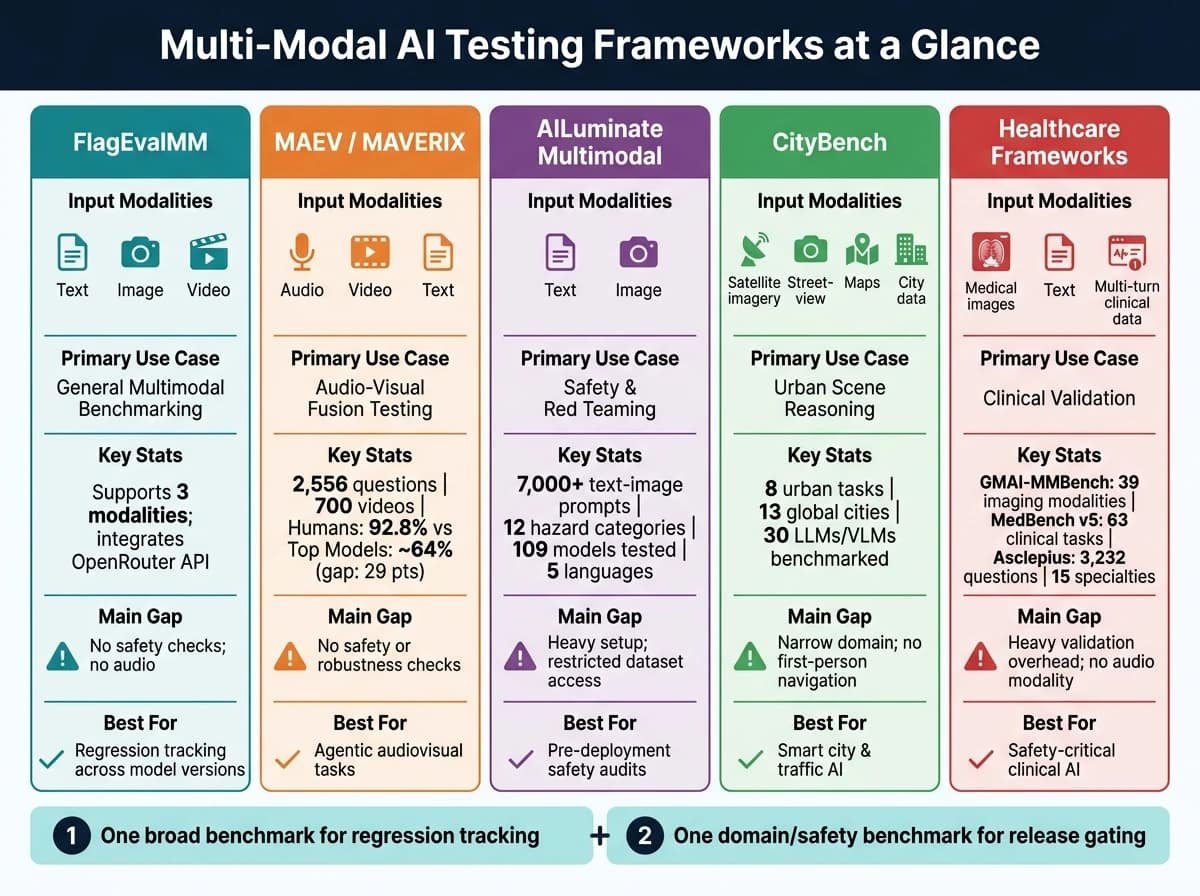
Beyond Text - Multimodal AI Evaluations
Quick Comparison
| Framework | Main input types | Main use | Main gap |
|---|---|---|---|
| FlagEvalMM | Text, image, video | General multimodal benchmarking | No built-in safety checks; no audio |
| MAEV | Audio, video, text | Audio-visual fusion testing | No safety or stability checks |
| AILuminate Multimodal | Text, image | Safety and red teaming | Heavier setup; dataset access limits |
| CityBench | Street view, satellite, maps, city data | Urban reasoning and decision tasks | Narrow domain scope |
| Healthcare frameworks | Medical images, text, multi-turn clinical data | Clinical validation | Heavy review work; audio still missing |
So if you’re choosing fast, I’d think in two layers:
- General benchmark for version-to-version tracking
- Domain or safety benchmark for ship/no-ship decisions
That’s the core takeaway from this article.
1. FlagEvalMM
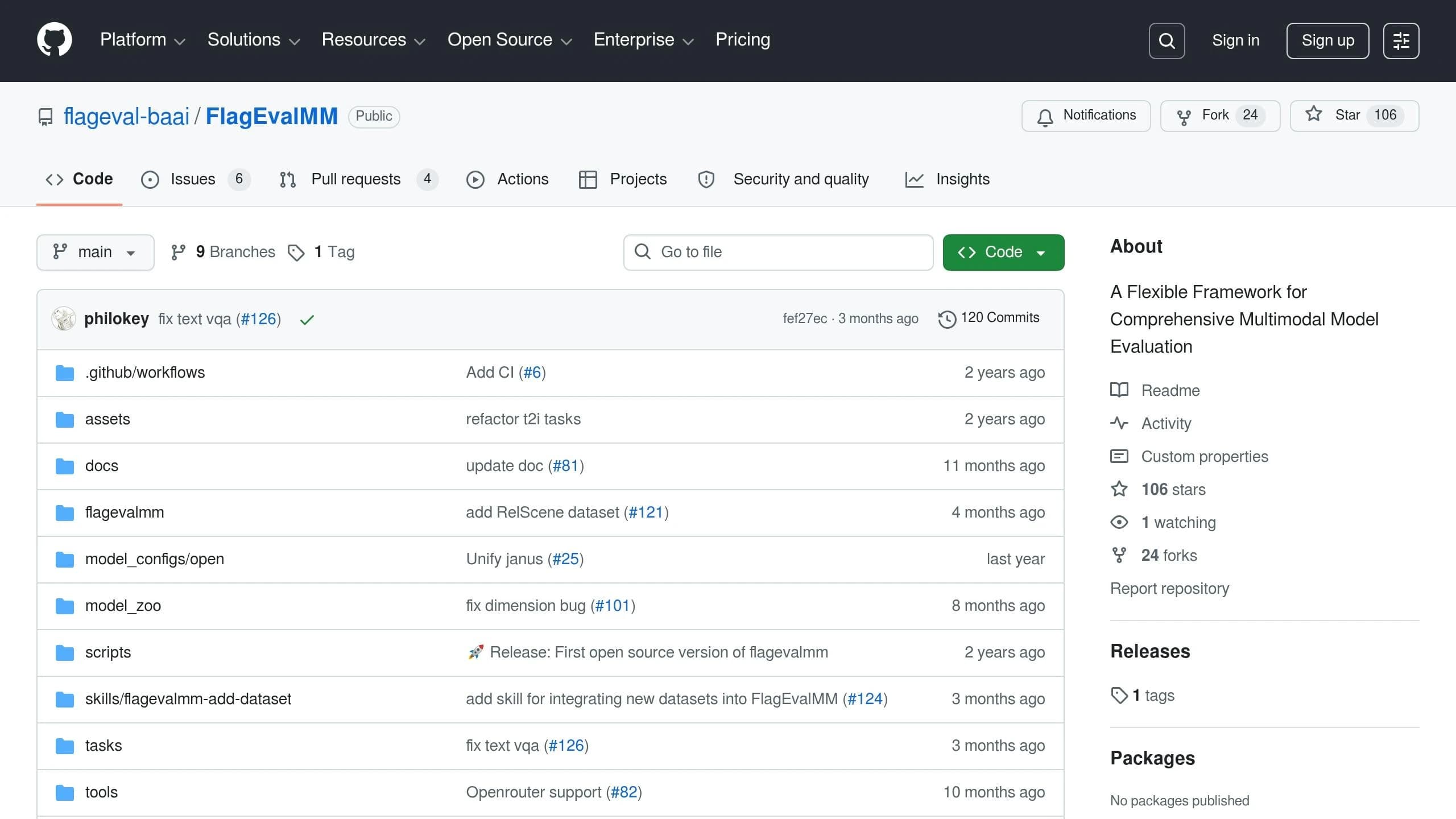
FlagEvalMM is BAAI’s open-source framework for multimodal evaluation. It works with text, images, and video. Core tasks include VQA, image retrieval, text-to-image generation, and ROME-based diagram evaluation. Audio isn’t part of the package, so audio-first workflows sit outside what it can handle.
Evaluation Focus
When the job leans hard into reasoning, FlagEvalMM also supports LLM-judge evaluation for diagram reasoning. It includes RelScene and LRM-Eval too, which extend its reach into scene understanding and reasoning-heavy assessment.
Safety and Fairness Coverage
On trust and policy checks, there’s a gap: it doesn’t come with built-in safety, fairness, or hallucination checks.
Deployment Fit
FlagEvalMM’s model zoo supports local inference for open-source models like QwenVL, LLaVA, and Janus. It also supports API-based evaluation for models such as GPT, Claude, and HuanYuan. On top of that, it added OpenRouter support, which gives teams more API options in one place.
That setup works well for teams that want to benchmark both local and hosted multimodal models inside a single framework. If your team also needs audio evaluation or built-in safety testing, you’ll want extra tooling alongside it.
2. MAEV
MAEV extends evaluation past vision-only setups by testing audio-video-text fusion.
Modality Coverage
MAEV, also called MAVERIX, was published on March 14, 2026. It tests video, audio, and text together. The dataset includes 2,556 questions from 700 videos, and it uses both multiple-choice and open-ended formats [2]. To get the right answer, a model has to combine what it sees with what it hears.
Evaluation Focus
The benchmark looks at cross-modal understanding in agentic tasks. In plain terms, the model can't just spot objects or transcribe speech. It has to fuse audio and video signals to make a decision.
That gap is still pretty large. Human experts score 92.8% on MAEV, while top models like Qwen 2.5 Omni and Gemini 2.5 Flash-Lite land at about 64%. That's a difference of nearly 29 percentage points [2]. Because of that, MAEV is useful for spotting where audiovisual fusion starts to fail.
Safety and Fairness Coverage
MAEV does not include dedicated checks for safety, fairness, or robustness.
Deployment Fit
MAEV comes with a public toolkit and standardized protocols, which helps teams run the benchmark the same way each time [2]. It fits agentic video tasks that depend on audio-visual context. It's less useful for domain-specific evaluation [2].
3. AILuminate Multimodal
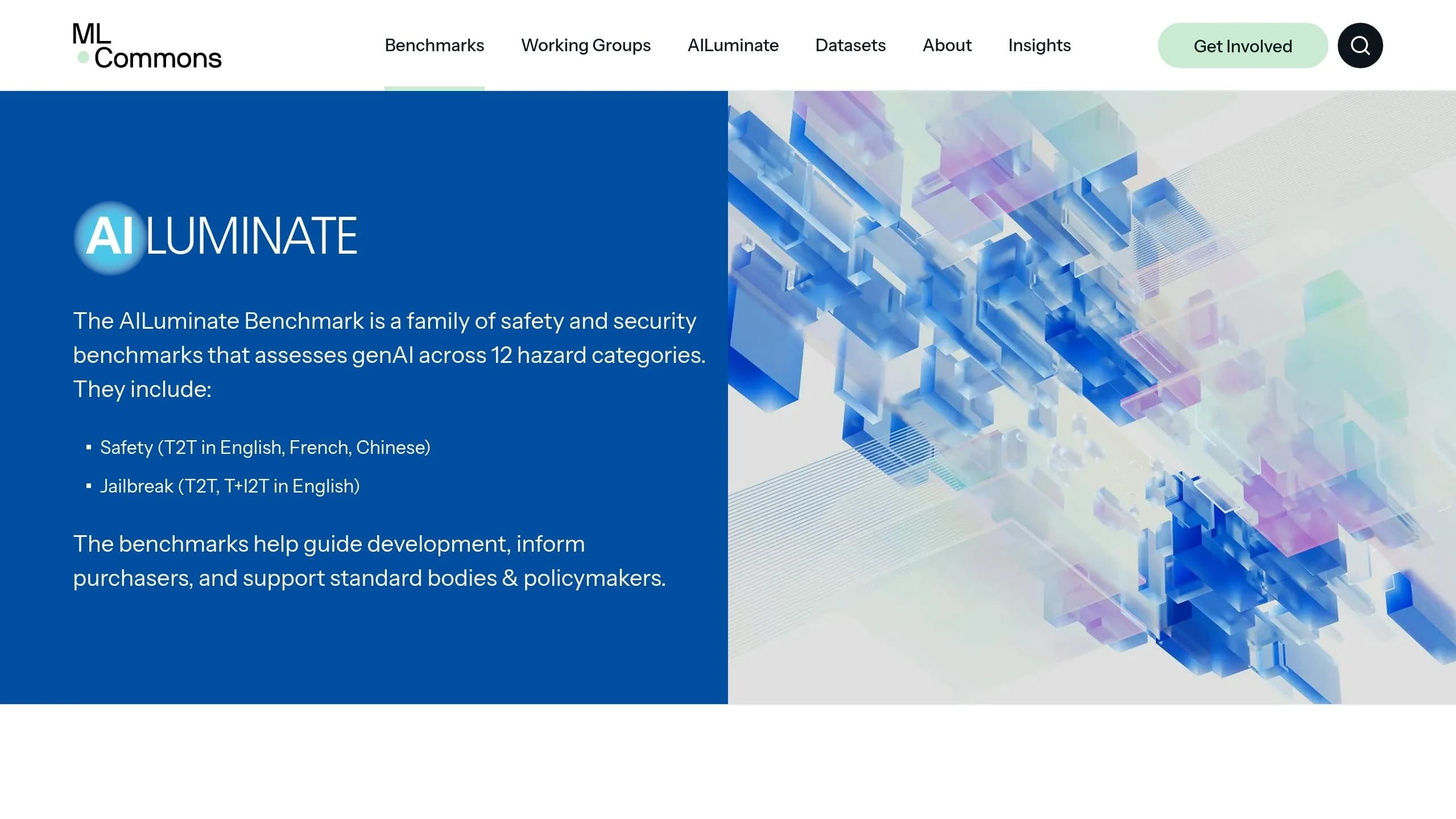
Unlike the earlier benchmarks, AILuminate looks at whether multimodal models are safe, not just whether they perform well.
Modality Coverage and Evaluation Focus
AILuminate Multimodal checks text-image safety risk across 12 hazard categories. These range from violence and self-harm to hate speech, privacy, and context-sensitive cases like health or election advice. The multimodal pilot dataset includes 7,000+ text-image prompts [4], and the benchmark has already been used to test 109 different models.
One thing that sets it apart is how it handles language. Instead of leaning on translation, AILuminate uses prompts written for local relevance and then checked by native speakers in Hindi, Tamil, Malay, Korean, and Japanese [4]. That matters. A prompt that works in one language can land very differently in another, especially in safety testing.
So while this benchmark can produce scores, it’s more useful for red teaming than for broad benchmark comparisons.
Safety and Reliability Coverage
AILuminate is built for red teaming and pre-deployment safety audits, especially for consumer chatbots and vision-language assistants used in global markets. Its method builds on MSTS research from 2025 [4].
In plain terms, this is the kind of framework you use when safety failure has a real cost. If a model gives risky advice, mishandles a private image, or responds badly in a high-stakes setting, this benchmark is built to surface those weak spots before launch.
Deployment Fit
Using AILuminate takes more work than a light validation tool. Scoring requires Modelbench and an ensemble of safety evaluators, and full datasets are limited to MLCommons members [5]. That makes the framework heavier and slower to put into practice.
It fits best in safety-critical settings, where deeper checks matter more than speed. For version-by-version safety review, it’s a strong option, but it’s less practical when teams need fast testing across many model updates.
4. CityBench
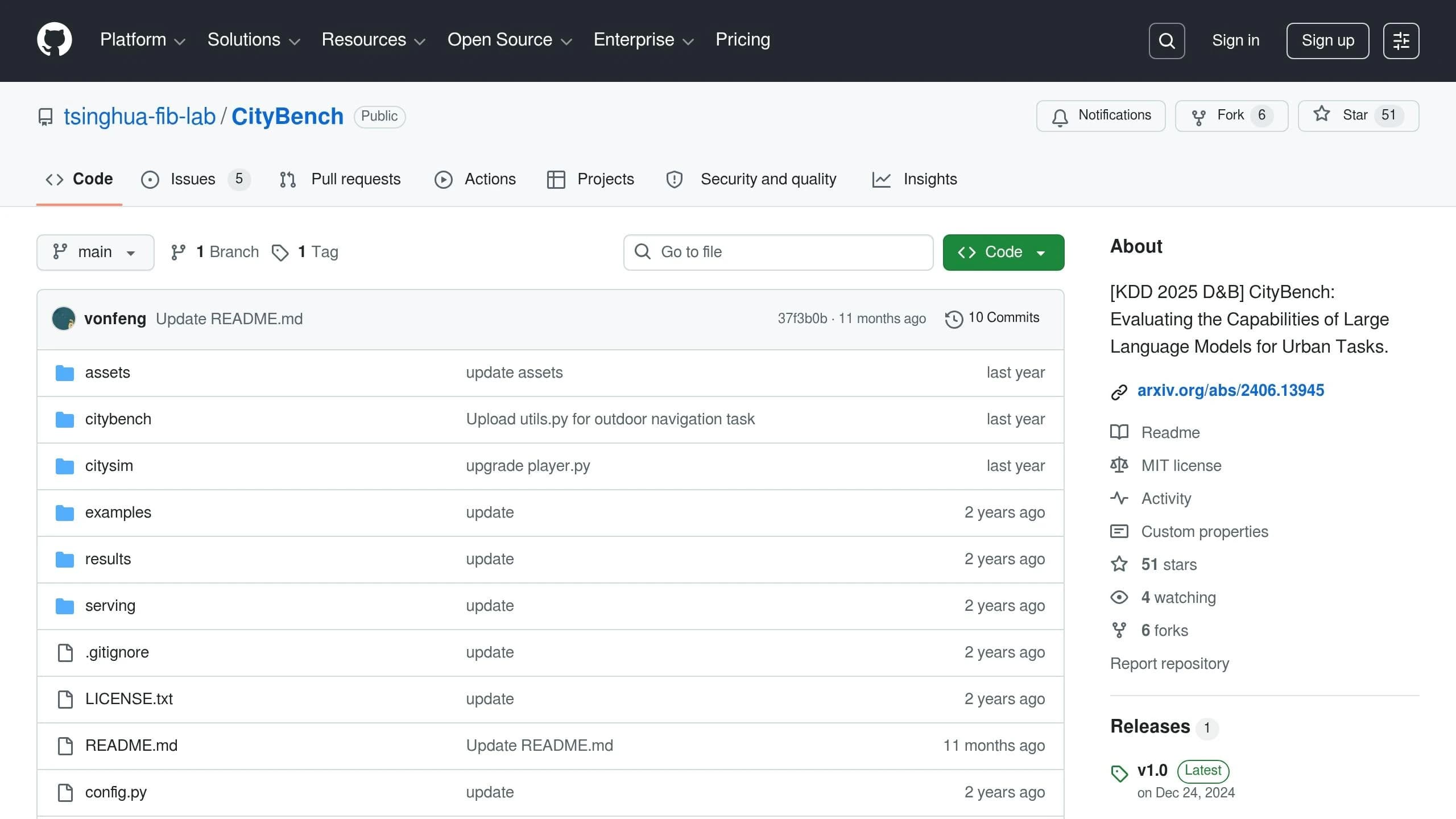
Where the earlier frameworks look at broad multimodal performance and safety, CityBench zooms in on urban reasoning.
Modality Coverage and Evaluation Focus
CityBench checks whether a model can read urban scenes, reason over geospatial data, and make decisions in fast-moving city settings. Its strength is city-scale reasoning, not broad multimodal range.
To do that, CityBench brings together satellite imagery, street-view images, road networks, POIs/AoIs, origin-destination flows, and check-in records to test visual and geospatial reasoning [7]. It covers 8 urban tasks across two groups: perception and decision-making [7]. That includes tasks like GeoQA, geolocalization, mobility prediction, and traffic signal control [7].
Its CityData/CitySimu setup goes a step further. It models detailed urban dynamics and supports closed-loop testing for decision-making tasks [7]. In plain English, that means you can test how a model responds when city conditions keep changing instead of judging it on static inputs alone. The benchmark has also been run against 30 LLMs and VLMs to set baseline performance [7].
Safety and Fairness Coverage
Pair it with separate safety and fairness review.
Deployment Fit
CityBench fits urban AI research and smart-city work well, including traffic optimization, mobility forecasting, and urban planning [7]. It also spans 13 global cities [7], which gives teams a broader test base than a single-city setup.
Still, this is a specialized benchmark. It is built for city-scale tasks, not day-to-day human tasks. It also does not cover first-person motion-based navigation. And there’s another gap worth noting: existing urban benchmarks like CityBench are often limited to single-view inputs and do not fully test cross-view reasoning between street-level and satellite imagery [6].
So the best way to use CityBench is as a domain-specific layer. It works well when added to a larger evaluation stack, but it should not be your only multimodal benchmark.
5. Healthcare-Oriented Integrated Multimodal Evaluation Frameworks
After general and domain-specific benchmarks, healthcare models need tougher tests for clinical risk, longitudinal reasoning, and modality fusion. In healthcare, mistakes don't just lower a score. They can affect diagnosis and treatment. So several frameworks were built for clinical use, and each one goes after a different kind of failure.
Modality Coverage and Evaluation Focus
For imaging coverage, GMAI-MMBench is the broadest framework in this set. It spans 39 medical image modalities across 18 clinical departments and draws from 285 datasets [10]. It scores models at four perceptual levels: image, box, mask, and contour [10].
MedAtlas goes after a common weak spot in medical benchmarking: many benchmarks still focus on single-image, single-turn tasks instead of longitudinal, multimodal clinical reasoning [8]. It tests reasoning across visits and multi-turn visual Q&A, asking whether a model can combine imaging findings with patient history to support diagnosis [8].
MedBench v5 covers language, vision-language, and agent systems across 63 clinical tasks [9]. What stands out is its stress testing. It inserts missing or contradictory findings to see whether a model spots the mismatch or just keeps going [9]. Asclepius adds breadth across specialties, with coverage of 15 medical specialties, 8 diagnostic capacities, and 79 body parts, based on 3,232 original multimodal questions [11].
Safety and Fairness Coverage
MedBench v5 includes a SafetyAgent that checks for medical misinformation, dangerous tool commands, privacy leakage, and ethics violations [9]. It also tracks unsupported claims that carry over across turns [9]. Its stress tests mainly target contradiction detection, diagnosis updates, and hallucination control [9].
GMAI-MMBench points to a different safety problem: some models refuse to answer clinical questions because of built-in safety protocols, which can reduce clinical use in practice [10].
One gap shows up across all four frameworks: audio is still missing as a primary integrated modality [8][9][10][11].
Deployment Fit
Each framework lines up with a different clinical failure mode, so the right choice depends on the job at hand.
| Framework | Best-Fit Workload |
|---|---|
| GMAI-MMBench | Interactive diagnostic assistants needing box-, mask-, or contour-level scoring [10] |
| MedAtlas | Cases requiring multi-image and patient-history integration [8] |
| MedBench v5 | Safety-critical decision support and clinical agents [9] |
| Asclepius | Specialty-specific validation in radiology and pathology [11] |
The tradeoff is straightforward: the more ground a framework covers, the heavier the validation work tends to be.
Pros and Cons
The table below sums up the main tradeoffs: coverage, scoring style, and domain fit. Those tradeoffs matter most when a team needs to gate new model versions fast without giving up too much coverage. Think of this as a release-gating guide, not a general-purpose tool list.
| Framework | Pros | Cons | Best For |
|---|---|---|---|
| FlagEvalMM | Broad multimodal coverage; separates inference from evaluation | Automated generation scoring is still imperfect - VQAScore correlates with human judgment at 0.76 for prompt consistency [12] | Teams running understanding and generation benchmarks in the same pipeline |
| MAEV | Tests audio-video-text fusion in agentic tasks; standardized protocols support reproducible runs [2] | No dedicated safety, fairness, or robustness checks [2] | Agentic video tasks that depend on audiovisual context |
| AILuminate Multimodal | Covers 12 hazard categories across 7,000+ text-image prompts; native-speaker prompt review in 5 languages [4] | Requires Modelbench and an ensemble of safety evaluators; full datasets limited to MLCommons members [5] | Pre-deployment safety audits and red teaming for vision-language models |
| CityBench | Tests 8 urban tasks across 13 global cities; supports closed-loop decision-making evaluation [7] | Specialized for city-scale tasks only; does not cover first-person motion-based navigation [7] | Urban AI research, traffic optimization, and smart-city applications |
| Healthcare-oriented frameworks | Built for regulated clinical validation | Heavy validation overhead; reduced coverage when models refuse clinical prompts | Safety-critical clinical validation |
The biggest split comes down to fast numerical scoring versus slower semantic judgment.
Numerical metrics are fast and reproducible, which makes them a good fit for CI checks. But speed has a catch: these metrics can miss compositional errors. A model may look fine on paper while still failing in ways that matter once outputs get more open-ended.
Frameworks that rely on LLM-as-Judge do a better job with open-ended semantic judgment [1][3]. That makes them more useful when you need to inspect nuance, not just count correct answers. The downside is pretty plain: they add cost, and they can still bring evaluation error into the process.
For teams that need both speed and deeper review, a split setup usually makes the most sense:
- Use numerical metrics for CI checks
- Use semantic scoring before major releases
That way, you get fast pass/fail signals early, then a closer read before the version goes out.
Conclusion
Put side by side, these frameworks make one thing clear: multimodal testing falls into four main buckets - general, safety, urban, and clinical use cases.
FlagEvalMM and MAEV are the strongest picks for broad multimodal evaluation. AILuminate Multimodal is built for safety testing. CityBench is the right fit for urban reasoning. And the healthcare frameworks focus on clinical validation.
The tradeoff stays the same across all of them: broad coverage is easier to scale, but specialized benchmarks are better at catching higher-risk failures.
A practical setup is simple:
- Use one broad benchmark for regression tracking
- Use one domain-specific benchmark for release gating
The best setup comes down to matching the benchmark to the failure mode you need to catch.
FAQs
How do I choose between a general benchmark and a domain-specific one?
Don’t pick one and ignore the other - use both.
Start with general benchmarks to narrow the field and set a baseline. They’re a good first pass.
Then build a custom evaluation set using your own data. For specialized workflows, that test set - especially when it includes edge cases and failure modes - gives you a much better read on how a model will perform in production than benchmark scores alone.
When should I use numerical scoring instead of judge-based review?
Use numerical scoring when you need a fast, repeatable system in an automated pipeline. It fits CI/CD gating well because you can make pass/fail calls without stopping for human review. This approach works best for semantic alignment and standard benchmarks, where accuracy can be measured in a clear, objective way.
Use judge-based review for work that depends on nuance. That includes things like aesthetics, tone, or domain-specific decisions in medicine, law, and finance, where expert judgment still matters.
Which framework is best for testing audio-enabled multimodal models?
It depends on what you're testing.
AU-Harness is the better fit for audio-to-text evaluation in Large Audio Language Models. lmms-eval is the broader choice. It supports audio, text, image, and video tasks, so it's handy when your testing goes beyond audio alone.
For audio-visual reasoning, AVI-Bench and MAVERIX are built to check how well models combine sound and visual input. If you want one layer to tie these models into your testing setup, APIMart can help unify access across the pipeline.
Choose the model you want in the model marketplace
Try chat, image and video models in the APIMart model marketplace, and experience model capabilities quickly with one unified API.