Seedance 2.0 vs Wan 2.7: Chinese Video AI Compared
Seedance 2.0 vs Wan 2.7 compared: architecture, character consistency, audio, max duration, pricing, and self-hosting, plus how to access both via APIMart API.
Seedance 2.0 and Wan 2.7 are two top-tier AI video systems from China, launched in 2026. Both excel in different areas:
- Seedance 2.0: ByteDance's model focuses on precise, multimodal video generation with advanced control over text, images, audio, and video inputs. It’s ideal for polished, face-focused content like ads and cinematic shorts.
- Wan 2.7: Alibaba's system prioritizes character consistency, storyboarding, and flexibility with its open-source framework. It’s best for scalable projects, multi-clip workflows, and editing tasks.
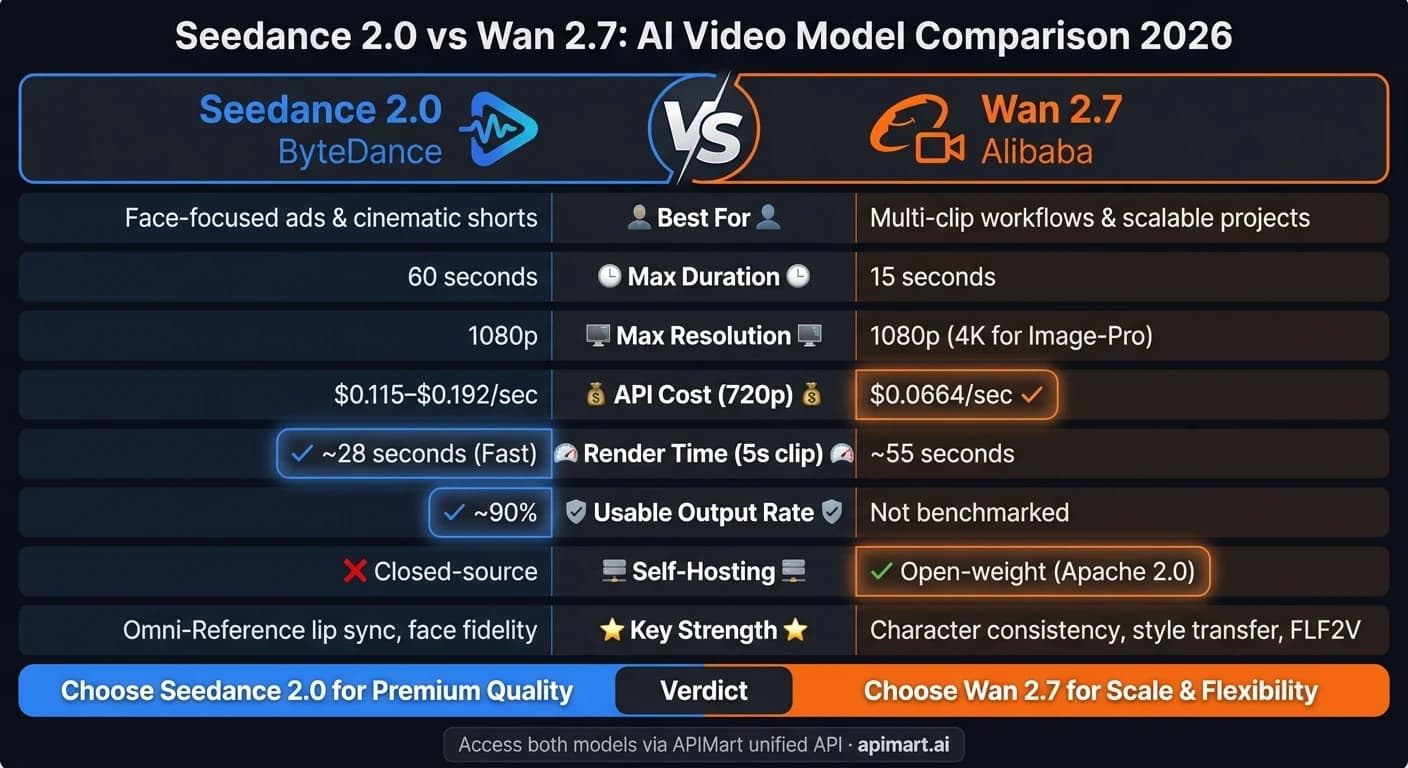
Quick Comparison
| Feature | Seedance 2.0 | Wan 2.7 |
|---|---|---|
| Strength | Face fidelity, multimodal control | Character consistency, open-source |
| Max Duration | 60 seconds | 15 seconds |
| Editing Features | Limited | Style transfer, start/end control |
| Cost (720p) | $0.115–$0.192/sec | $0.0664/sec |
| Self-Hosting | No | Yes |
For premium-quality videos, go with Seedance 2.0. For scalable, multi-clip workflows, Wan 2.7 is the better choice. Many creators combine both for optimal results.
Seedance 2.0: Features and Strengths
Core Capabilities
Seedance 2.0, created by ByteDance's SEED Lab, is a 4.5B parameter Dual-Branch Diffusion Transformer that generates video and audio simultaneously, eliminating the need for post-production tweaks.
What sets this model apart is its Omni-Reference System, which offers precise, tag-based control over every reference asset in your prompt. Users can input up to 9 images, 3 video clips, and 3 audio clips, tagging each asset directly in the prompt using commands like @image1 or @video1. This allows for detailed control over elements like character design, wardrobe, camera angles, and even the rhythm of movements. Segmind highlights this capability, stating:
"Seedance 2.0's clearest differentiation is the omni-reference system. Where most models treat reference images as loose style hints, Seedance 2.0 lets you tag them explicitly in your prompt and control exactly where and how they appear." [2]
In addition, Seedance 2.0 supports multi-shot scripting, enabling users to define entire shot lists with specific timing (e.g., "Shot 1 | 0s–3s: wide establishing shot, dolly in"). This is seamlessly executed alongside the generation of dual-channel stereo audio, covering ambient sounds, foley effects, music, and lip-syncing in over 8 languages.
These features combine to provide a powerful tool for creators, although they come with certain limitations, as outlined below.
Strengths and Limitations
The model's performance metrics highlight its capabilities. For instance, it achieves an ELO score of 1,272 and a Subject Consistency score of 93.4 on VBench, outperforming competitors like Kling 1.6 (92.1) and Wan 2.1 Fast (90.7). The Fast variant is particularly efficient, generating a 5-second 720p clip in about 35 seconds, which is 61% faster than its predecessor.
Despite these strengths, there are some constraints. Maintaining consistent visuals across multiple characters can be inconsistent. The model is capped at generating 15-second clips (10 seconds for the Fast variant), though video extension can be used for longer scenes. Direct access outside of China is limited, often requiring proxy API layers for international users. Additionally, all outputs embed a C2PA metadata watermark, which may be a concern for client-facing projects.
| Variant | Max Duration | Max Resolution | Generation Time (5s clip) | Price (per second) |
|---|---|---|---|---|
| Standard | 15 seconds | 1080p | ~90 seconds | $0.10–$0.25 |
| Fast | 10 seconds | 1080p | ~35 seconds | $0.08–$0.10 |
Wan 2.7: Features and Strengths
Core Capabilities
Wan 2.7 is powered by a 27-billion-parameter Mixture-of-Experts architecture, with 14 billion parameters active per inference [9]. It handles four generation modes - T2V (Text-to-Video), I2V (Image-to-Video), R2V (Reference-to-Video), and Instruction-Based Editing - all through a single Diffusion Transformer backbone, ensuring smooth integration across tasks.
Some standout features include the 9-Grid I2V mode, which accepts a 3×3 layout of images. This is especially useful for creating multi-angle product displays or sequential scenes. The First and Last Frame Control (FLF2V) feature lets users specify the clip's start and end frames, with the model seamlessly generating the motion path in between to minimize temporal inconsistencies. R2V mode supports up to five mixed references - images, videos, or audio - enabling it to maintain character identity, voice, and camera style without the need for additional fine-tuning. Additionally, the model handles prompts of up to 5,000 characters and delivers clear, long-form text in 12 languages [9][11].
These features work together to ensure consistent and coherent scene generation, bolstered by robust pre-generation planning.
Thinking Mode and Scene Consistency
One of Wan 2.7's defining features is its Thinking Mode, which uses a Chain-of-Thought reasoning process to pre-plan videos. This feature maps out prompt semantics, determines subject placement, selects camera angles, and ensures logical consistency before rendering begins.
"Thinking Mode... executes Chain-of-Thought reasoning before generation, allowing the model to logically analyze and plan the prompt before creating the output." - Kai Kou, AI Engineer [12]
This pre-planning step makes Wan 2.7 particularly effective for complex, multi-character scenes. By addressing spatial relationships and lighting before rendering, it helps reduce common issues like morphing or object distortion. For story-driven productions, the combination of Thinking Mode and FLF2V ensures more stable and visually coherent outputs.
Strengths and Limitations
Wan 2.7's advanced planning and features translate into several strengths, though it does come with a few limitations.
One of its key strengths is character consistency, as highlighted by independent animator Wei Zhang:
"The consistency of WAN 2.7 is amazing! Character images remain stable across multiple clips, which was previously hard to achieve." - Wei Zhang [10]
The model received an 8.5/10 editorial score for its reliability, creative flexibility, and audio-in-the-loop workflows [8]. Its Instruction-Based Editing feature is particularly efficient for targeted scene modifications - like changing backgrounds, altering clothing colors, or applying style transfers - using simple text commands, without requiring full clip regeneration.
However, there are some constraints. Output resolution is capped at 1080p, and clip durations are limited to 15 seconds for T2V and 10 seconds for I2V or R2V modes [8]. Additionally, while it performs well in most scenarios, extreme close-ups of faces may lack the photorealism seen in some closed-source models. As Jay Kim from Miraflow AI noted:
"It won't beat Seedance 2 or Kling 3 on raw visual quality, but no other model matches its creative freedom and workflow completeness. It's the best open-source option in 2026." - Jay Kim, Miraflow AI [9]
Wan 2.7 is fully open-source under the Apache 2.0 license, offering teams the flexibility to deploy it locally or fine-tune it for specific needs.
Seedance 2.0 vs. Wan 2.7: Side-by-Side Comparison
Input Modes and Generation Options
Both Seedance 2.0 and Wan 2.7 accept a variety of inputs - text, image, audio, and video - but their approaches to processing them are quite different. Seedance 2.0 uses a Universal Reference system, allowing up to 15 files to be processed simultaneously. This includes 9 images, 3 video clips, and 3 audio clips, all in one pass, which enables it to replicate composition, camera movements, and character actions seamlessly [3]. Wan 2.7, on the other hand, organizes up to 9 reference images into a 3×3 grid, ensuring consistent character appearance and style across clips [3].
When it comes to generation modes, Wan 2.7 offers seven options, including a dedicated video editing mode for style transfer and a first-and-last-frame control feature. Meanwhile, Seedance 2.0 focuses on text-to-video, image-to-video, and its Universal Reference workflow, which emphasizes tighter multimodal integration within each generation [3]. These distinctions set the stage for how each model handles control, fidelity, and consistency.
Control, Fidelity, and Consistency
The differences in input handling extend into how these models manage control, fidelity, and consistency. Seedance 2.0 excels in face fidelity and precise motion control, offering phoneme-level lip sync in over 8 languages [3]. Wan 2.7, however, shines in maintaining recurring character consistency across multiple clips, thanks to its 3×3 grid system and R2V (Reference-to-Video) workflow. It also features an instruction-based editing mode, allowing users to restyle footage without regenerating the entire clip [3].
As the Atlas Cloud Blog puts it:
"Seedance 2.0 wins on multimodal control and face fidelity... Wan 2.7 wins on flexibility, open-weight economics, and video editing." [3]
| Control Parameter | Seedance 2.0 | Wan 2.7 |
|---|---|---|
| Character Consistency | High (via reference images) | Best (via 3×3 grid & R2V) |
| Motion Control | Precise (via reference video) | Moderate (via text/start-end frames) |
| Video Editing | Limited (selective edits) | A dedicated mode for style transfer |
| Audio Integration | Phoneme-level lip sync (8+ languages) | Native audio conditioning |
| Face Fidelity | Best-in-class | Less emphasized |
Performance and Practical Constraints
Performance metrics further highlight the differences between Seedance 2.0 and Wan 2.7. One key distinction is clip length: Seedance 2.0 supports videos up to 60 seconds, while Wan 2.7 maxes out at 15 seconds for text-to-video [3]. While 15 seconds is ideal for short-form content like social media posts, longer durations are often necessary for product demos or training materials.
Another major factor is output usability. Seedance 2.0 boasts a 90% usable output rate [3], which can significantly reduce production costs:
"The 90% usable output rate is not a marketing number to dismiss... At 90% usability, you need 1,111 generations [to get 1,000 usable clips]. That's a 4.5x difference in actual API spend." - Atlas Cloud Blog [3]
Cost and speed also vary. At the same 720p, 5-second spec, Seedance 2.0 Fast costs around $0.16 per clip and takes about 28 seconds to render. Wan 2.7, in comparison, costs roughly $0.30 and requires 55 seconds [5]. However, Wan 2.7's open-weight model offers the option for self-hosting on private GPU infrastructure, which can eliminate per-generation API costs - a flexibility Seedance 2.0 cannot provide due to its closed-source nature [3][5].
| Metric | Seedance 2.0 | Wan 2.7 |
|---|---|---|
| Max Duration | 60 seconds | 15 seconds |
| Max Resolution | 1080p | 1080p (4K for Image-Pro) |
| Render Time (720p/5s) | ~28 seconds (Fast) | ~55 seconds |
| Cost per 5s clip (API) | ~$0.16 (Fast) | ~$0.30 |
| Self-Hosting | No (closed-source) | Yes (open-weight) |
| Usable Output Rate | ~90% | Not publicly benchmarked |
| Model Access | API only | API + self-hosted |
Watch: Seedance 2.0 vs Wan 2.7 Video Generator Comparison
API Access via APIMart

When it comes to deploying APIs effectively, seamless integration can make all the difference. For U.S.-based developers working with Chinese AI models, the usual barriers - like CNY billing, Alipay/WeChat payments, and local phone verification - can be a headache. APIMart simplifies this process by offering a single, unified endpoint: https://api.apimart.ai/v1/videos/generations. Switching between models like Seedance 2.0 and Wan 2.7 is as easy as adjusting the model parameter in your JSON request. It’s that straightforward.
The API is built with developers in mind, following OpenAI-style conventions. It uses Bearer Token authentication and standard JSON POST requests with parameters such as model, prompt, resolution, and seed. Both models operate asynchronously: once you submit a request, you’ll receive a task_id to poll for the final video URL. Generation times vary - Wan 2.7 typically takes 30 to 90 seconds, while Seedance 2.0 can take up to 120 seconds [10].
"As a developer, I appreciate the clean API and fast response times. Doubao Seedance 2.0 integrates seamlessly into our pipeline."
- Alex Wang, Full-Stack Engineer [14]
Flexible Pricing and Unified Billing
APIMart offers pay-as-you-go pricing in USD, making it easier for developers outside of China to manage costs. Rates are billed per output second, depending on resolution. A single APIMart account covers both models, so you won’t need to juggle multiple credit systems. For example, Wan 2.7 costs $0.0664 per second at 720P and $0.1096 per second at 1080P, which is about 20% lower than the official rates [10]. Seedance 2.0 follows a similar pricing structure, offering competitive rates.
| Feature | Wan 2.7 | Seedance 2.0 |
|---|---|---|
| Endpoint | /v1/videos/generations | /v1/videos/generations |
| Model Name | wan2.7 | doubao-seedance-2.0 |
| Auth | Bearer Token | Bearer Token |
| 720P Price | $0.0664/sec | $0.0712/sec |
| 1080P Price | $0.1096/sec | N/A |
| Generation Time | 30–90 seconds | 30–120 seconds |
| Commercial Use | Yes | Yes |
Advanced Features and Reliability
Seedance 2.0 supports asset:// URLs, allowing you to reference pre-approved virtual avatars or real-person assets without needing to upload files repeatedly [15]. With a 99.9% SLA and low-latency infrastructure, APIMart is built to handle both large-scale production needs and smaller experimental projects. Whether you’re working on a commercial pipeline or testing new ideas, APIMart provides the tools to get the job done efficiently.
Use Cases by Industry
Marketing and Advertising
In the marketing world, the choice of model often depends on the production stage. Take Seedance 2.0, for example - it shines when creating high-conversion hero ads. Its precise lip-sync and consistent facial detail make it a go-to for e-commerce brands that rely on human models. Even minor inconsistencies can harm trust in such scenarios, so its face fidelity is a major advantage [3].
On the other hand, Wan 2.7 is perfect for crafting multiple versions of content from a single clip. Its Video Edit mode allows agencies to create platform-specific variants, like a snappy TikTok version or a polished Instagram cut, at a cost of around $0.625 to $0.9375 per clip [16]. Many teams combine the strengths of both models, using Wan 2.7 for storyboarding and Seedance 2.0 for the final polished output [1].
"The video editing mode [in Wan 2.7] is purpose-built for agencies that need multiple visual variants of the same source footage without re-shooting." - Atlas Cloud [3]
These capabilities aren’t limited to advertising - they extend into areas like education and training.
Education and Training
Seedance 2.0 excels in virtual learning environments, thanks to its phoneme-level lip-sync across eight or more languages. When courses feature an on-screen instructor, its ability to deliver lifelike facial expressions helps maintain student engagement [3][7]. Another standout feature is its quad-modal input, which syncs pre-recorded voiceovers directly to the generated video, removing the need for time-consuming audio post-production [4].
Meanwhile, Wan 2.7 caters to scenario-based training, where consistency in a character’s appearance across multiple modules is key. Its 9-grid reference system ensures a locked-in look from start to finish, and its first-and-last-frame control is ideal for technical demos - like showing a machine transitioning from "off" to "running" states [3][13]. For large-scale e-learning platforms conscious of API costs, Wan 2.7 offers an open-weight version that supports self-hosting, eliminating per-second charges entirely [3]. These features align perfectly with the demands of educational content creators.
Beyond education, these tools also empower creators in entertainment and short-form content.
Entertainment and Short-Form Content
In entertainment, these models cater to different creative needs. Seedance 2.0 specializes in cinematic storytelling, with tools for dolly zooms, tracking shots, and expressive facial performances. Its phoneme-level audio sync makes it a top choice for music videos or character-driven shorts, offering a 90% usable output rate - much higher than the industry average [3].
Wan 2.7, however, is the go-to for serialized content where character consistency is critical. Its style-transfer feature allows creators to transform visuals into formats like anime, cyberpunk, or even oil painting, all while preserving motion fluidity [3][16].
"Wan 2.7 and Seedance 2.0 are built for completely different types of creators." - Jacky Wang [6]
Conclusion: Which Model Should You Use?
Each model shines in its own way, depending on your goals. Seedance 2.0 is perfect for creating high-quality, face-focused videos like hero ads, music videos, or cinematic shorts. With a 90% usable output rate [3] and the ability to generate up to 60 seconds of content, it’s ideal for premium creative projects. On the other hand, Wan 2.7 is your best bet for projects requiring scale, repeatability, and consistent characters across multiple clips, such as high-volume ad campaigns or e-commerce catalogs.
| Factor | Seedance 2.0 | Wan 2.7 |
|---|---|---|
| Face Fidelity | Best-in-class | Good |
| Character Consistency (multi-clip) | Limited | Excellent (9-grid reference) |
| Max Duration | 60 seconds | 15 seconds |
| Editing Flexibility | Motion cloning, video extension | Style transfer, start/end frame control |
| API Cost (720P) | $0.115–$0.192/sec via APIMart | $0.0664/sec via APIMart |
| Self-Hosting Option | No | Yes (open-weight) |
These side-by-side comparisons make it clear that both models excel in different areas. For many creators, blending the strengths of both models is the smartest approach. Use Wan 2.7 for testing and scaling, then switch to Seedance 2.0 for polishing your premium content. As Jacky Wang from Wan27AI aptly put it:
"The best creators don't pick one. They use both. Wan 2.7 for volume & testing; Seedance 2.0 for premium content." [6]
Whether you’re crafting high-impact ads, educational videos, or imaginative storytelling, APIMart's unified API streamlines the process with simplified billing and a 99.9% SLA for reliability. Plus, the APIMart Playground allows you to test prompts before diving into production. Ultimately, the right choice depends on your project’s specific needs and workflow priorities.
FAQs
Which model is better for longer videos without stitching clips?
Seedance 2.0 is designed to handle longer videos effortlessly, eliminating the need for manually stitching clips together. It supports video durations ranging from 4 to 60 seconds, a notable improvement over Wan 2.7, which is limited to 2 to 15 seconds. Plus, Seedance 2.0 includes a handy feature where you can set the duration to -1. This allows the system to automatically determine the best video length for a smoother and more cohesive narrative.
How do I keep the same character consistent across multiple scenes?
To maintain consistent character appearances across scenes, follow the specific reference workflows for each model.
For Wan 2.7, activate Character Locking and provide reference materials - such as images or clips - using the R2V feature. For better accuracy, utilize a multi-angle 9-grid setup and stick to the same seed number throughout.
For Seedance 2.0, take advantage of the omni-reference control by working with tagged images (e.g., @image1) and detailed design sheets. Ensure your prompts remain consistent to minimize any shifts in character identity.
Can I self-host Wan 2.7, and what GPU setup would I need?
Yes, Wan 2.7 can be self-hosted since it's an open-weight model. This means you can skip per-generation API fees if you have the necessary hardware. For production-level inference, using an A100 or H100 GPU is recommended. Although consumer GPUs like the RTX 4090 (with 24GB VRAM) can handle it, cloud-based A100 setups are much quicker. For example, generating a 5-second 1080p clip takes about 90 seconds with an A100.
Choose the model you want in the model marketplace
Try chat, image and video models in the APIMart model marketplace, and experience model capabilities quickly with one unified API.