
Seedance 4.5 vs Sora 2: AI Video Showdown 2026
Seedance 4.5 vs Sora 2 compared: resolution, clip duration, physics realism, audio sync, pricing and use cases to help you pick the right AI video tool.
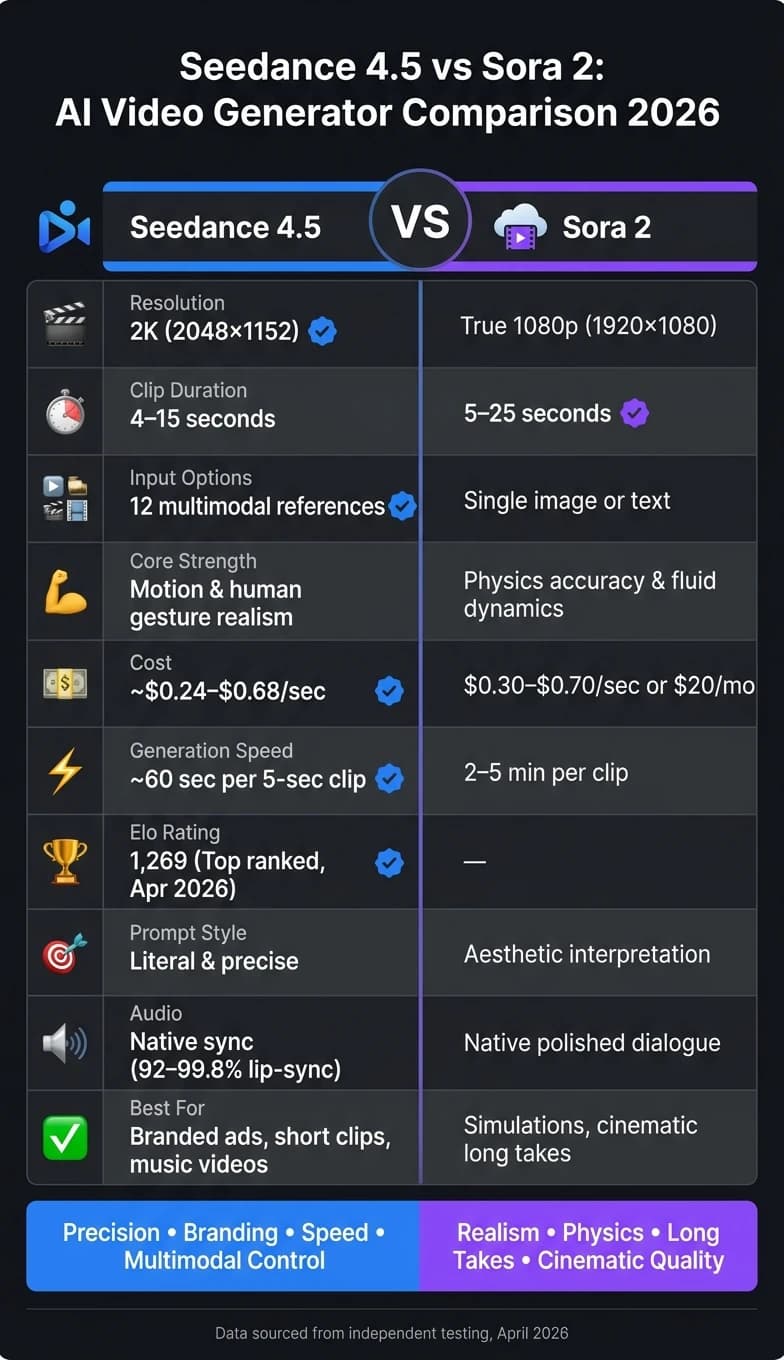
Seedance 4.5 and Sora 2 are two leading AI video generation tools in 2026, each excelling in different areas. Seedance 4.5 offers precise control with up to 12 multimodal inputs, native 2K resolution, and synchronized audio-video generation, making it ideal for branded content and short, polished clips. In contrast, Sora 2 focuses on physics-based realism, longer continuous takes (up to 25 seconds), and cinematic visuals, perfect for simulations and extended storytelling.
Key Takeaways:
- Seedance 4.5: Best for high-quality, short clips with precise motion and brand consistency. Costs ~$0.24–$0.68/sec.
- Sora 2: Best for realistic physics, longer videos, and seamless storytelling. Costs $0.30–$0.70/sec or $20/month subscription.
Quick Comparison
| Feature | Seedance 4.5 | Sora 2 |
|---|---|---|
| Resolution | 2K (2048×1152) | True 1080p (1920×1080) |
| Clip Duration | 4–15 seconds | 5–25 seconds |
| Input Options | 12 multimodal references | Single image or text |
| Strength | Motion realism | Physics accuracy |
| Cost | ~$0.24–$0.68/sec | $0.30–$0.70/sec |
| Best For | Branded ads, short clips | Simulations, long takes |
Choose Seedance 4.5 for precision and speed, or Sora 2 for realism and extended shots.
Seedance 4.5: Features, Strengths, and Limitations
Core Features of Seedance 4.5
Seedance 4.5 is powered by a dual-branch diffusion transformer with a hefty 4.5 billion parameters. It supports up to 12 multimodal inputs, including a mix of 9 images, 3 video clips, and 3 audio files, all working together to guide a single generation [3].
One standout feature is its ability to generate synchronized audio and video in a single pass. Dialogue, sound effects, and music are processed together, ensuring everything lines up seamlessly. Its lip-sync accuracy is impressive, ranging between 92% and 99.8% [2][5][7]. Add to this its director-level camera controls - like dolly shots, pans, and orbits - and its first/last-frame anchoring, which makes chaining shots smooth and professional [3][7].
Where Seedance 4.5 Excels
Seedance 4.5 truly shines when it comes to capturing natural human motion. Thanks to its training on extensive short-form video datasets, such as TikTok and Douyin, it has a knack for producing lifelike dance moves, gestures, and even crowd dynamics [4][6].
"Seedance is the model to use when motion coherence, dance synchronization, or human gesture realism matter more than English-language prompt nuance." - Boris Dittberner, Founder, SixSides Academy [4]
In a test conducted by SixSides Academy in April 2026, Seedance stood out by generating salsa dance movements that matched the rhythm of its own audio. Competing models, by contrast, delivered motion that felt more generic or overly ballet-like [4]. For those seeking alternative cinematic AI video generation, models like Kling V3 offer different motion profiles. It also outputs video in native 2K resolution (2160p), which surpasses the 1080p limit of models like Sora 2. Plus, its RayFlow architecture makes it about 30% faster [8]. As of April 2026, Seedance 4.5 holds the top spot in the Artificial Analysis Video Arena with an Elo rating of 1,269 [2][4].
However, even with these strengths, the model has its share of drawbacks.
Seedance 4.5 Limitations
Seedance 4.5 is not without its constraints. For starters, it has a 15-second limit on clip duration [3][8]. Pricing can also be a concern, with variable token costs averaging $0.04 per second for 1080p video and an additional $0.01 per second for audio when accessed through the Volcano Engine API [4].
Another issue lies in its handling of in-frame English text. Signs, labels, and screens often appear as garbled glyphs, making it unreliable for scenarios that require legible text [4][6]. Additionally, the model occasionally generates recognizable brand logos unintentionally, which may pose legal risks for marketing teams [3]. Lastly, international users might face hurdles such as API access restrictions, including the need for a Chinese mobile number or detailed business verification (KYC) [4].
Sora 2: Features, Strengths, and Limitations
Core Features of Sora 2
Sora 2 takes a unique approach by simulating real-world physics, focusing on elements like gravity, momentum, fluid dynamics, and material deformation. This sets it apart from models that prioritize motion style or audio synchronization.
From a technical standpoint, Sora 2 offers several key features:
- Fixed durations ranging from 4 to 20 seconds (up to 25 seconds on Pro).
- 1080p output for Pro users (720p for Standard users).
- A Storyboard Mode for sequencing shots.
- A Pro-exclusive Character ID system for maintaining consistent character appearances.
- A built-in safety parameter to block known intellectual property.
These features create a solid foundation for its performance, which shines in specific areas.
Where Sora 2 Excels
Sora 2 stands out for its physical accuracy, scoring high marks in independent testing - 9/10 for physics accuracy and 8/10 for emotional expression, according to Lanta AI Research in February 2026 [9]. This makes it an excellent choice for educational content, such as visualizing mechanical systems, natural phenomena, or other science-based topics where precision is crucial.
"Sora research demonstrations emphasize large-scale scene generation from prompts... [it] is the safer choice for immediate commercial use." - Runbo Li, CEO, Magic Hour [9][10]
Its Character ID system is another standout feature, especially for marketers managing multi-video campaigns. This system ensures consistent character appearances across videos, saving time and effort. Additionally, Sora 2 has resolved early legal challenges, unlike some competitors still grappling with copyright issues, making it a dependable option for commercial production [9].
However, these strengths come with some trade-offs that may impact its overall usability.
Sora 2 Limitations
Despite its strengths, Sora 2 has notable drawbacks. For starters, the cost of generating true 1080p content is steep - $0.70 per second. A 10-second clip costs $7.00, which can add up quickly [1]. On top of that, generation times are slow, ranging from 2 to over 5 minutes per clip, which is 2–5 times slower than other models like MiniMax Hailuo 2.3 available in 2026 [12][1].
Its input options are also limited, as it only supports a single image or text prompt. This pales in comparison to competitors like Seedance 4.5, which can handle up to 12 reference inputs [9][3]. Prompt interpretation is another weak spot:
"Sora 2 treats prompts as inspiration - it uses them as a starting point and adds its own interpretation. The results are often more visually impressive but less predictable." - Sagnik Bhattacharya [13]
This approach can lead to unpredictable outputs, making Sora 2 less suitable for projects requiring precise, repeatable changes. Another limitation is the lack of a 4K output option, which rules it out for premium broadcast or high-end advertising needs that demand ultra-high-definition visuals [11][9].
Seedance 4.5 vs. Sora 2: Direct Comparison
Comparison Table: Key Attributes
| Attribute | Seedance 4.5 | Sora 2 |
|---|---|---|
| Video Quality | Stylized, vibrant, high surface detail | Photorealistic, cinematic lighting |
| Motion Coherence | High (especially for human subjects) | Moderate (occasional frame-blending) |
| Physics Realism | Excellent for everyday motion | Best-in-class (fluid/collision dynamics) |
| Prompt Adherence | Literal and precise (88% multi-character accuracy) | Liberal/aesthetic interpretation (92% multi-character accuracy) |
| Audio Generation | Native; supports audio reference input | Native; polished English dialogue |
| Clip Duration | 4–15 seconds (supports multi-shot) | 5–25 seconds (continuous take) |
| Max Resolution | 2K (2048×1152) | True 1080p (1920×1080) |
| Editing Control | @Reference System (up to 12 files) | Character IDs & Video Remix |
| Pricing | ~$0.24–$0.68/sec | $0.30–$0.70/sec or $20/mo subscription |
The following analysis interprets these key differences.
What the Results Show
The table highlights how these two models cater to different needs. Seedance 4.5 shines in areas like resolution, speed, and flexibility with input references, while Sora 2 focuses on advanced physics, longer continuous clips, and a more artistic approach to prompts.
"For sharpness and export quality, Seedance 2.0. For photographic realism, Sora 2." - JXP Team [8]
Seedance 4.5 stands out for its native 2K resolution, giving it an edge in projects where clarity and detail matter most, such as product advertisements or branded campaigns. Its @Reference System, which supports up to 12 file references, allows for precise creative adjustments. Additionally, Seedance is notably faster, generating a five-second clip in about 60 seconds, compared to Sora 2's 2–5 minutes per clip [15].
On the other hand, Sora 2 excels with its ability to create longer, continuous takes - up to 25 seconds - and offers a robust API ecosystem that developers appreciate. According to Cliprise:
"Sora 2's OpenAI API is more mature and better documented than Seedance 2.0's API ecosystem... For developer applications requiring stable API integration, Sora 2's OpenAI ecosystem is more production-ready." - Cliprise [16]
Each model brings unique strengths to the table, making the choice between them dependent on specific project requirements.
Seedance 2.0 FEELS like old Sora but BETTER. Fight Scenes Are Finally GOOD!
Best Use Cases for Seedance 4.5 and Sora 2
Each model shines in specific scenarios, thanks to their distinct capabilities. Seedance 4.5 excels in delivering high-resolution, visually consistent outputs, while Sora 2 brings advanced physics and seamless long takes to the table. Here's how to pick the right one for your project.
Best Use Cases for Seedance 4.5
Seedance 4.5 is your go-to for projects that demand precision and uniformity. Whether you're working on brand assets like logos, characters, or products, this model ensures consistency across all visuals. Its multimodal input system makes it especially effective for multi-shot commercial projects, keeping brand imagery cohesive.
The model also stands out in producing localized talking-head videos, thanks to its phoneme-level lip-sync in eight languages. This eliminates the need for a separate text-to-speech pipeline, saving time and effort. Additionally, its support for non-standard aspect ratios like 21:9 (cinema) and 1:1 (square) makes it a versatile choice for music videos, e-commerce ads, and high-end marketing campaigns.
"Seedance 2.0 is the multimodal control champion. If you know exactly what you want and have references to show it, Seedance 2.0 will execute your vision with precision." - Digen AI
Best Use Cases for Sora 2
Sora 2 is built for projects that prioritize realism and extended durations. Its advanced physics engine handles complex elements like fluid dynamics, object collisions, and environmental motion, making it perfect for applications such as architectural visualizations, scientific explainers, and VFX background plates.
The ability to produce continuous takes of up to 25 seconds makes it ideal for cinematic hero shots and long-form social media content, eliminating the need for visible cuts. Additionally, its flat-rate pricing simplifies budgeting for campaigns:
"Sora 2's flat-rate pricing streamlines campaign budgeting. You can tell a client, '200 shorts at 8 seconds is $160,' and be done." - Segmind
For smaller teams, Sora 2 offers an affordable integration option through a $20/month ChatGPT Plus subscription, bypassing the complexity of token-based API workflows.
| Scenario | Better Choice |
|---|---|
| Multi-shot branded commercial | Seedance 4.5 |
| Music video with beat-synced audio | Seedance 4.5 |
| Scientific or physics simulation | Sora 2 |
| High-volume social media clips | Sora 2 |
| Localized talking-head content | Seedance 4.5 |
| Cinematic long-take storytelling | Sora 2 |
| E-commerce product motion ads | Seedance 4.5 |
| Architectural visualization | Sora 2 |
Final Verdict: Seedance 4.5 or Sora 2?
Choosing between Seedance 4.5 and Sora 2 ultimately comes down to the specific needs of your project.
Seedance 4.5 is the go-to option for workflows that prioritize consistent branding, large-scale output, and precise creative control. Its multimodal reference system allows you to turn prompts into detailed directives, handling up to 9 images, 3 video clips, and 3 audio tracks per generation [8]. With native 2K rendering that's about 30% faster and costs as low as $0.013 per second via VolcEngine's 2K tier, it provides outstanding efficiency for production-heavy pipelines [17].
On the other hand, Sora 2 shines when physical realism and extended takes are at the forefront. It can produce continuous 25-second clips using a powerful physics engine that ensures cinematic-level realism - perfect for projects requiring intricate physical simulations [8][14]. For teams already using OpenAI tools, Sora 2 offers straightforward pricing through a $20/month ChatGPT Plus subscription [17].
"Seedance 2.0 is engineered for controllability, multimodal input, and repeatable production workflows. Sora 2 is built for cinematic realism and physics-driven simulation." - JXP Team [8]
FAQs
Which tool is easier for consistent brand videos?
Seedance 4.5 is ideal for producing consistent brand videos, particularly for workflows that demand multi-shot continuity and precise reference fidelity. Its structured multi-asset reference system ensures that characters, products, and other brand elements stay uniform across multiple clips and campaigns. On the other hand, Sora 2, which is tailored for single-take sequences, does not offer the same level of precision. For projects where strict branding control is essential, Seedance 4.5 stands out as the better option.
How do I keep characters consistent across clips?
To maintain character consistency in Sora 2, you can use the Cameo feature to create a persistent digital likeness. Alternatively, you can upload reference images through the Image-to-Video workflow. Make sure to include the character ID in your API calls for accurate results.
For Seedance 2.0, characters can be created using the dedicated endpoint and referenced by name. Additionally, you can ensure seamless continuity by chaining shots through Seedance's last-frame return and first-frame input.
Which option is cheaper for high-volume output?
Seedance 4.5 stands out as a budget-friendly option for high-volume tasks, offering API pricing starting at just $0.10 per minute for 720p resolution when used via official channels. Its tiered approach, which includes a Lite version tailored for draft iterations, allows for better budget management. On the other hand, Sora 2’s fixed, duration-based pricing is more aligned with high-stakes, narrative-driven projects rather than large-scale production needs.
Related Blog Posts
Choose the model you want in the model marketplace
Try chat, image and video models in the APIMart model marketplace, and experience model capabilities quickly with one unified API.