
How AI Personalizes Stories with Feedback
Explore how AI uses explicit, implicit, and emotional feedback to personalize stories, adapt plots, update visuals, protect data, and boost engagement.
AI storytelling systems create stories that adjust in real time based on user behavior. By analyzing explicit feedback (like user choices) and implicit feedback (such as reading time or skipped sections), these systems craft narratives tailored to individual preferences. This process relies on feedback loops - observing, interpreting, acting, and re-observing user input to refine the story dynamically.
Key highlights:
- Explicit feedback: Direct user actions like ratings or scene choices.
- Implicit feedback: Behavior patterns like dwell time or skipped content.
- Emotional feedback: Sentiment analysis to adjust tone or atmosphere.
- Tools like APIMart integrate multiple AI models (e.g., GPT-5, Claude) for seamless storytelling across text, visuals, and audio.
For example, the February 2026 prototype Echoes of the Fallen used feedback to dynamically alter character relationships and plotlines, creating highly engaging experiences. Metrics like engagement scores and drop-off rates help measure success, while ethical safeguards ensure fairness and data privacy.
AI storytelling reduces development time, improves user engagement, and shifts audiences from passive viewers to active participants shaping their narratives.
How Feedback Loops Work in AI Storytelling
What Are AI Feedback Loops?
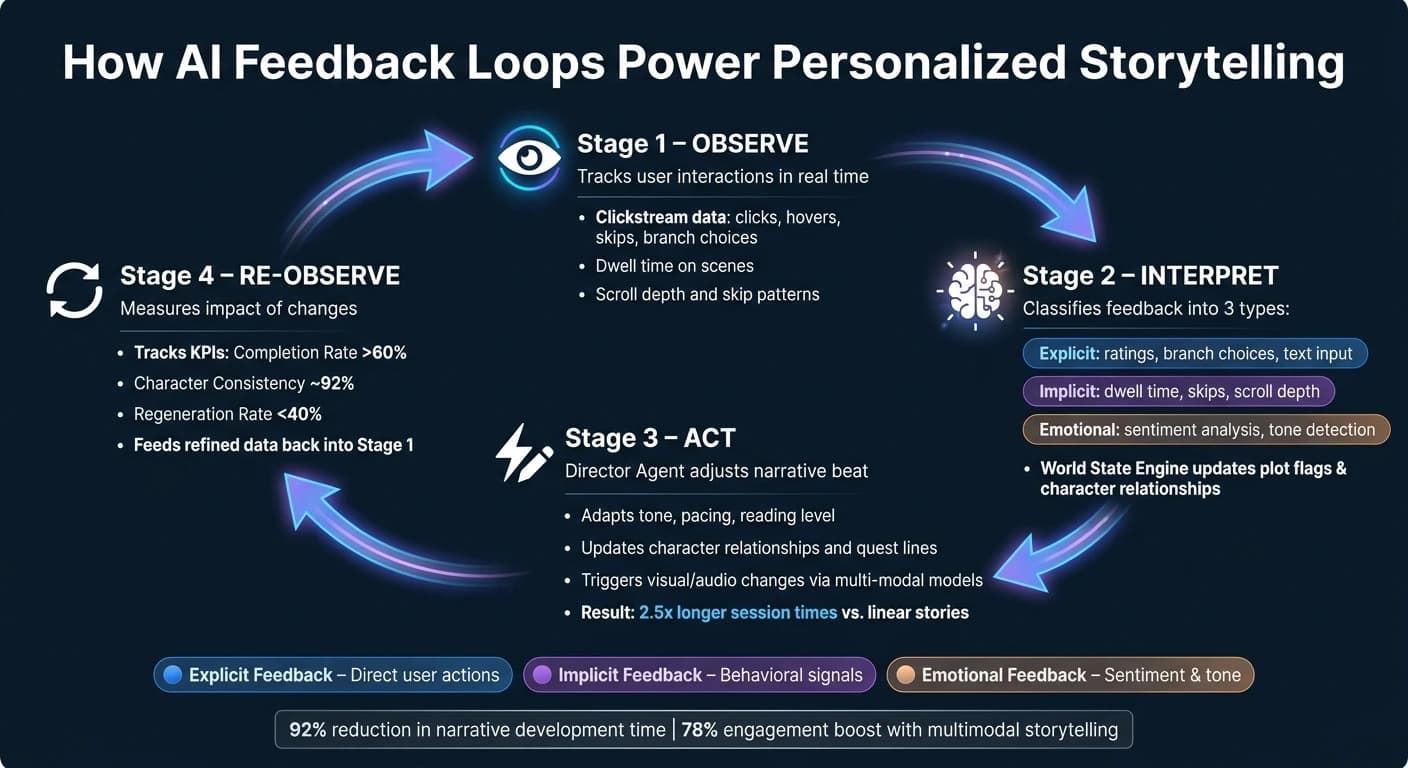
AI storytelling relies on a four-step feedback loop: Observe, Interpret, Act, and re-Observe. Here's how it works: the system keeps track of user interactions, analyzes them, adjusts the narrative based on the findings, and then observes how these changes impact the story. This ongoing process helps refine the storytelling experience as your session progresses.
There are two main kinds of feedback in these loops. Real-time feedback brings immediate changes during your session. For instance, if you make a hostile choice, a non-playable character (NPC) might instantly shift to a more defensive tone. On the other hand, offline feedback collects data across multiple sessions. Instead of altering the story in the moment, it improves the AI model over time, ensuring better storytelling in future interactions.
Next, let’s break down the types of user input these feedback loops rely on.
Types of Feedback Used in Storytelling
AI storytelling systems handle two primary categories of feedback: explicit and implicit.
- Explicit feedback involves direct input from the user. This could be selecting a story branch, rating a scene on a scale, leaving a comment, or using prompts to guide the narrative. It’s straightforward and easy for the system to interpret.
- Implicit feedback is more nuanced. The system picks up on behavioral cues like how long you stay on a scene (dwell time), whether you skip dialogue, or how often you revisit key moments. For example, if you consistently skip combat scenes, the system might adjust the pacing to fit your preferences. Some advanced systems even use emotional feedback by analyzing text sentiment or voice tone to gauge your engagement and emotional state. This allows the story to adapt its mood and atmosphere accordingly.
| Feedback Type | Examples | Narrative Impact |
|---|---|---|
| Explicit | Ratings, branch choices, text input | Directly shapes plot, character development |
| Implicit | Dwell time, skips, scroll depth | Tweaks pacing, difficulty, and narrative timing |
| Emotional | Sentiment analysis, tone detection | Adjusts NPC reactions, mood, and visual elements |
How Feedback Drives Personalization
Feedback loops don’t just tweak events - they shape the entire storytelling experience. For instance, if the system notices you enjoy fast-paced scenes, it can adjust the rhythm of the narrative to match. Similarly, if your dialogue reflects an aggressive tone, NPCs might respond with suspicion or hostility. Even visual elements, like character expressions or backgrounds, can shift to reflect the emotional tone of the story.
A great example of this is Vesper Labs’ February 2026 prototype, Echoes of the Fallen. In this system, if a player betrayed the character Liora early in the game, the AI immediately updated her trust parameters. This change influenced her future behavior, unlocking entirely different quest lines that reflected her mistrust [5]. The result? A narrative that felt fluid and reactive, rather than rigidly pre-scripted.
"The real magic isn't just generating text; it's remembering the details. A character who recalls a shared joke from three scenes ago feels infinitely more real than one who forgets your name." - Dunia Team [8]
This ability to remember and incorporate past interactions is what elevates AI storytelling beyond the traditional "choose-your-own-adventure" style, creating a deeply immersive and personalized experience.
How to Design a Feedback Framework for Personalized Stories
Set Your Personalization Goals
Start by deciding which parts of the story you want to personalize - this could include elements like writing style, pacing, or the focus on specific characters. Establish measurable KPIs such as Character Consistency or Engagement Score to track success [1]. Also, think about how to balance user choices with system-generated inferences, so the story adjusts dynamically while still feeling natural. For experimentation, you might allocate 5%–15% of impressions to test new story paths [6].
Once your goals are clear, identify the specific feedback events that will drive these adaptations.
Define Feedback Events and Data Structures
Every important user action should trigger a data event. This event should capture key information like a choice ID, timestamp, user rating or sentiment, and optional comments. Additionally, behavioral signals such as scroll depth, time spent on a page, or skip patterns can offer valuable insights into user intent.
To maintain continuity, the story needs a centralized repository for its narrative state. A JSON object is a great tool for this, as it can store details like the current stage of the story, active plot conflicts, character relationships, and user history [7]. This serves as the "source of truth", ensuring coherence as the story evolves with each AI interaction.
| Component | Data Structure | Purpose |
|---|---|---|
| Narrative State | JSON object (genre, characters, plotPoints, tone) | Keeps the story consistent across scenes [7] |
| Feedback Event | Choice ID, rating (1–5), comment text | Fuels real-time narrative adjustments [1] |
| Behavioral Signal | Scroll depth, skip rate, time on page | Provides intent insights without direct input [4] |
| User History | Pairwise preferences, prior ratings | Builds a lasting user profile [12] |
These structured data points form the foundation for integrating multiple types of feedback into your system.
Choose Feedback Modalities for Multi-Modal Stories
For stories that span multiple formats - text, images, audio - it's crucial to combine different types of feedback. This includes explicit feedback (like ratings and choices), implicit signals (such as skip rates or replays), and emotional feedback (like sentiment analysis or tone of voice). Together, these inputs help the system adapt the story in real time [1][6].
To make this work across different AI models, you’ll need tools that can unify these inputs. For example, APIMart offers access to over 500 AI models, including popular ones like GPT-5, Claude, and Kling V3, all through a single integration point. This allows you to channel feedback - like text sentiment - into updates for visuals or audio without managing multiple APIs.
"Personalized storytelling reshapes narrative engagement, fostering unique experiences that deepen emotional connections through AI-driven interactions." - Justin Willis, Author [3]
The most important part is ensuring all feedback types - whether it's a skipped scene, a comment's sentiment, or a direct rating - feed into the same unified narrative state. When these signals align, they provide a clear direction for how the story should evolve.
How to Collect and Process Feedback in Real Time
Track User Interactions
To understand how users engage with content, start by tracking their interactions in real time. This includes gathering clickstream data, such as clicks, hovers, skips, and branch choices, as well as measuring dwell time on specific scenes to assess engagement levels [14][15]. Simple prompts, like thumbs-up/down buttons or 1–5 star ratings, can be used immediately after a scene to capture emotional reactions while they’re still fresh [13]. For more advanced setups, tools like eye-tracking can reveal exactly where attention drops off [14].
"Interactive video turns communication into a two-way process where the viewer influences what they see." - ReelNReel [15]
To identify problem areas, use heatmaps or analytics tools like Mixpanel or Looker to monitor drop-off points. If users consistently exit at the same scene, it often points to structural issues - such as pacing or clarity - rather than individual preferences [13][14]. These real-time signals are essential for building a feedback system that can adapt quickly.
Build a Feedback Processing Pipeline
Once feedback is collected, it needs to be organized into actionable insights. This is where a feedback processing pipeline comes into play. Such a pipeline consists of several stages: collecting input, updating a central world state, managing narrative decisions, summarizing conversation history, and filtering outputs.
At the core of this process is the World State Engine, which is often implemented as a JSON object or stored in a vector database. This engine tracks key elements like plot flags, character relationships, user history, and pacing preferences [9]. Every piece of feedback updates this engine, ensuring the AI system always has the latest context before generating the next scene. This constant updating is what allows the narrative to adapt seamlessly to the user’s journey.
| Pipeline Stage | What It Does |
|---|---|
| Input Capture | Collects clicks, voice inputs, sentiment, and user decisions [1][15] |
| World State Engine | Updates plot flags, relationships, and user history [9] |
| Director Agent | Decides the next narrative beat based on the current state [9] |
| Summarization Chain | Condenses conversation history to save tokens while keeping context [9] |
| Output Filter | Ensures generated content is coherent, safe, and appropriately sized [7] |
Summarizing conversation history regularly helps reduce token costs while maintaining context, which improves consistency to 94% [7]. Once the feedback is processed, the system uses these insights to fine-tune the story in real time, creating a more engaging and responsive experience.
Connect Multi-Modal Models Using APIMart

To take it a step further, multi-modal inputs - like text, video, and audio - can be integrated through APIMart’s unified API. This allows feedback from different sources to come together for a cohesive narrative update. For example, if a user’s text sentiment shifts, the system can trigger a visual change in the video model, creating a more immersive experience. By combining visual, audio, and text signals, the storytelling becomes more tailored and engaging.
Using API function calls also allows for immediate updates. For instance, when a user interacts with a specific story element, the system can instantly adjust a relationship score or unlock a new plot branch - no need to wait for an entire model response cycle [9]. This creates a feedback loop that feels responsive and keeps the narrative dynamic.
How to Adapt Stories Based on Real-Time Feedback
Adjust Story Flow and Branching
Real-time feedback can transform how stories unfold, allowing for dynamic updates to the narrative through techniques like prompt chaining and state management. Essentially, every choice a user makes influences the narrative state, shaping the direction of the story while maintaining coherence [1].
At the heart of this process is the Director Agent. This tool monitors the World State and uses engagement signals to adjust the story's progression. For example, if a user starts skipping scenes, the Director Agent might introduce a surprising plot twist or conflict to recapture their attention [9].
"Interactive story generation isn't just writing text - it's architecting dynamic narrative systems where player choices shape the story in real-time." - SEELE [10]
The impact is clear: games with AI-driven narratives boast 2.5x longer session times compared to traditional linear stories [10]. Additionally, AI-assisted story creation can cut narrative development time by 92%, offering a major advantage over manual scripting [10].
While structural shifts in the story matter, the way the narrative is delivered is equally crucial, as outlined in the next section.
Personalize Tone and Reading Level
Changing the events of a story is just one piece of the puzzle. How the story is told also plays a critical role in keeping users engaged. AI language models can adapt the tone and complexity of the narrative based on user behavior. For instance, if a user frequently skips lengthy paragraphs or uses simple language, the system can respond by simplifying its phrasing and shortening its sentences.
This adaptability relies on tools like sentiment analysis combined with state-aware prompting. A secondary model can assess user emotions based on their inputs and adjust the tone accordingly. For example, the system might shift to a "tense and urgent" tone during high-stakes moments or adopt a "calm and exploratory" style when the pace slows [1][9]. By integrating a "Story Bible" into the system's prompts, the narrator's voice remains consistent even as the emotional tone shifts.
Platforms that implement these techniques report measurable gains in user engagement and comprehension, demonstrating the effectiveness of tailoring tone and reading level to individual users [4].
To further immerse users, the narrative's visuals can also be updated dynamically.
Update Visuals Using AI Models
Visual elements that align with the story's progression can amplify immersion. Thanks to advancements in AI, video generation models in 2026 can create cinematic-quality scenes on demand, removing the need for pre-recorded branches. By linking the World State Engine to a video generation model, visuals can evolve in real time to match the story's developments [16].
For example, if engagement data shows a preference for action-packed moments, the system can prompt a model like Kling V3 Omni (available via APIMart for $0.0672 per second at 720P) to generate fast-paced, dynamic visuals. On the other hand, a quieter, reflective scene might trigger a slower cinematic model to set the appropriate tone.
To maintain visual consistency, the system can anchor reference images using detailed descriptors (e.g., "charcoal wool coat, silver watch on left wrist"). Additionally, pre-generating likely next visual branches while the current scene plays ensures seamless transitions with no delays [16].
AI-generated visuals are also cost-effective. While traditional pre-recorded interactive scenes can range from $10,000 to $100,000 per scene, AI-generated alternatives typically cost between $0.05 and $2.00, making real-time visual updates a scalable solution [16].
How to Monitor and Protect Feedback-Driven Storytelling Systems
For AI-driven storytelling to stay effective and trustworthy, it’s crucial to keep a close eye on performance and ensure user data is well-protected.
Define Success Metrics
To gauge how well the system is performing, track metrics like engagement, narrative quality, and business outcomes.
For engagement, focus on stats like the average time users spend per scene, the number of choices they make (Engagement Score), and the Drop-off Rate (DR). A high DR in a specific scene often points to a problem - tightening up the scene’s text or rephrasing choice labels can help smooth things out [1][13].
When it comes to narrative quality, measure Character Consistency (CC) - how well the AI sticks to pre-defined character rules - and Narrative Variance (NV), which shows how diverse the plot paths are. Low NV can lead to repetitive storylines, which hurts replayability. Ideally, aim for a story completion rate above 60% while keeping the regeneration rate below 40% [7].
Here’s a quick breakdown of key metrics and their targets:
| Metric | Target | What It Tells You |
|---|---|---|
| Completion Rate | >60% | Users are staying engaged until the end |
| Regeneration Rate | <40% | AI responses are meeting user expectations |
| Character Consistency | ~92% | AI is following narrative rules |
| Drop-off Rate | As low as possible | Highlights friction points in the story |
The business benefits of fine-tuned personalization are clear. For instance, in January 2026, TFG, a specialty retail group, implemented an AI storytelling system that adapted its narratives based on real-time user behavior. The results were impressive: a 35.2% boost in online conversion rates, a 39.8% increase in revenue per visit, and a 28.1% drop in exit rates [4].
Once metrics are in place, it’s equally important to tackle the ethical challenges that come with feedback loops.
Ethical Considerations in Feedback Loops
Ethical oversight is just as important as performance tracking. Feedback loops can be powerful tools, but they also come with risks like bias and over-personalization. If the training data is skewed, the AI might create narratives that favor certain perspectives or emotional tones [3].
To minimize bias and maintain fairness, consider using a secondary model. For example, an LLM-as-a-Judge system like GPT-4o can audit story outputs for fairness, empathy, and consistency [12]. Keep an eye out for over-personalization, which can make the experience feel intrusive or too predictable. Striking a balance between personalized storytelling and broader creative arcs ensures a more natural flow [11].
"The integration of AI into interactive storytelling is revolutionizing narrative experiences, transforming how audiences engage with stories." - TechyConcepts [3]
Transparency is key. Users need to understand how their preferences shape the narrative. Providing clear information and obtaining informed consent builds trust in feedback-driven systems [3].
Protect User Data and Privacy
Ethics and transparency go hand in hand with safeguarding user data. Protecting sensitive feedback data starts with adopting a solid technical strategy. One effective approach is data minimization. Instead of frequently accessing raw user data, use a pseudo-user agent - a representation of user preferences built from interaction history. This method, as demonstrated by the PREFINE framework, allows for personalized storytelling without direct access to user data, reducing privacy risks [12].
Make sure to remove all personally identifiable information (PII) from stored feedback. Use secure databases like PostgreSQL or MongoDB and implement clear data retention and deletion policies [7].
"PREFINE constructs a pseudo-user agent from a user's interaction history... achieving personalized generation without requiring parameter updates or direct user feedback." - Kentaro Ueda, Researcher [12]
Be upfront with users about what data is collected and how it’s used. Clear, easy-to-understand data policies - aligned with U.S. digital privacy standards - are essential. Users expect this level of transparency before fully engaging with personalized experiences [3][11].
Conclusion: Using Feedback to Build Better Stories
Feedback loops have reshaped the way AI storytelling works, turning it into a dynamic, ever-evolving process. By gathering user signals, adjusting content, and refining interactions, these loops enable AI to go beyond simply generating content. Instead, it becomes a narrative partner that learns, adapts, and grows alongside its audience.
"The goal of the media company is no longer simply to generate content quickly, but to create characters and worlds that evolve and allow users to grow over time." - AIJ Thought Leader, The AI Journal [2]
AI-driven platforms excel at maintaining context, surpassing traditional scripting methods [7]. Multimodal storytelling - combining text, images, and other media - boosts engagement by 78% compared to text-only formats, while AI tools drastically reduce development time from over 40 hours to just under 3 hours [7].
However, scaling these systems comes with its own set of challenges, such as managing multiple AI models, ensuring narrative consistency, and handling real-time feedback. Tools like APIMart simplify this process by offering a single API that integrates over 500 models, including language, image, and video technologies like GPT-5, Claude, Sora, and Kling V3. This unified approach addresses the integration and latency issues discussed earlier, illustrating how feedback-based systems can redefine storytelling.
The shift is undeniable: audiences are no longer passive consumers - they actively shape their narratives. By building systems with clear metrics, ethical safeguards, and scalable frameworks, creators can deliver stories that genuinely connect with their audiences. Feedback-driven storytelling isn't just a trend; it's a new standard for meaningful engagement.
FAQs
What’s the difference between explicit and implicit feedback?
In AI-driven storytelling, explicit feedback comes from direct user actions such as liking, downvoting, rating, or leaving comments to express preferences. On the other hand, implicit feedback is collected passively by observing user behaviors like skip rates, replays, time spent on specific scenes, or patterns of abandonment. By combining these insights, APIMart’s integrated models can craft narratives that feel more tailored to individual users.
How does the AI keep the story consistent while changing it in real time?
AI keeps stories consistent by relying on a structured "Story Bible" or a global state stored in a database. This system tracks essential details like character traits, key facts, and plot objectives, ensuring everything stays aligned.
A Director Agent plays a critical role here. It oversees the narrative, prevents contradictions, and keeps the story on track with its overarching goals. As interactions unfold, real-time updates are carefully verified and incorporated into prompts. This process ensures the story evolves naturally while remaining logical and cohesive.
Platforms like APIMart make it easier to support these intricate storytelling workflows, ensuring seamless execution.
How is my data protected when the system tracks my behavior?
Real-time storytelling systems adapt to your interactions, tailoring experiences to suit your preferences. However, this customization raises valid privacy concerns. To tackle these issues, some systems implement federated learning. This approach trains AI models across multiple users while keeping individual data private and secure.
Another approach involves edge-AI techniques, where the AI models operate directly on your device instead of relying on cloud servers. This local processing minimizes the risks associated with handling sensitive data externally. Both methods aim to balance personalization with enhanced privacy.
Choose the model you want in the model marketplace
Try chat, image and video models in the APIMart model marketplace, and experience model capabilities quickly with one unified API.