
10 Best AI Models for E-commerce Automation
Compare the top 10 AI models for e-commerce automation in 2026, from video generation tools like Kling V3 Omni and Sora 2 Preview to LLMs like GPT-5 and Claude.
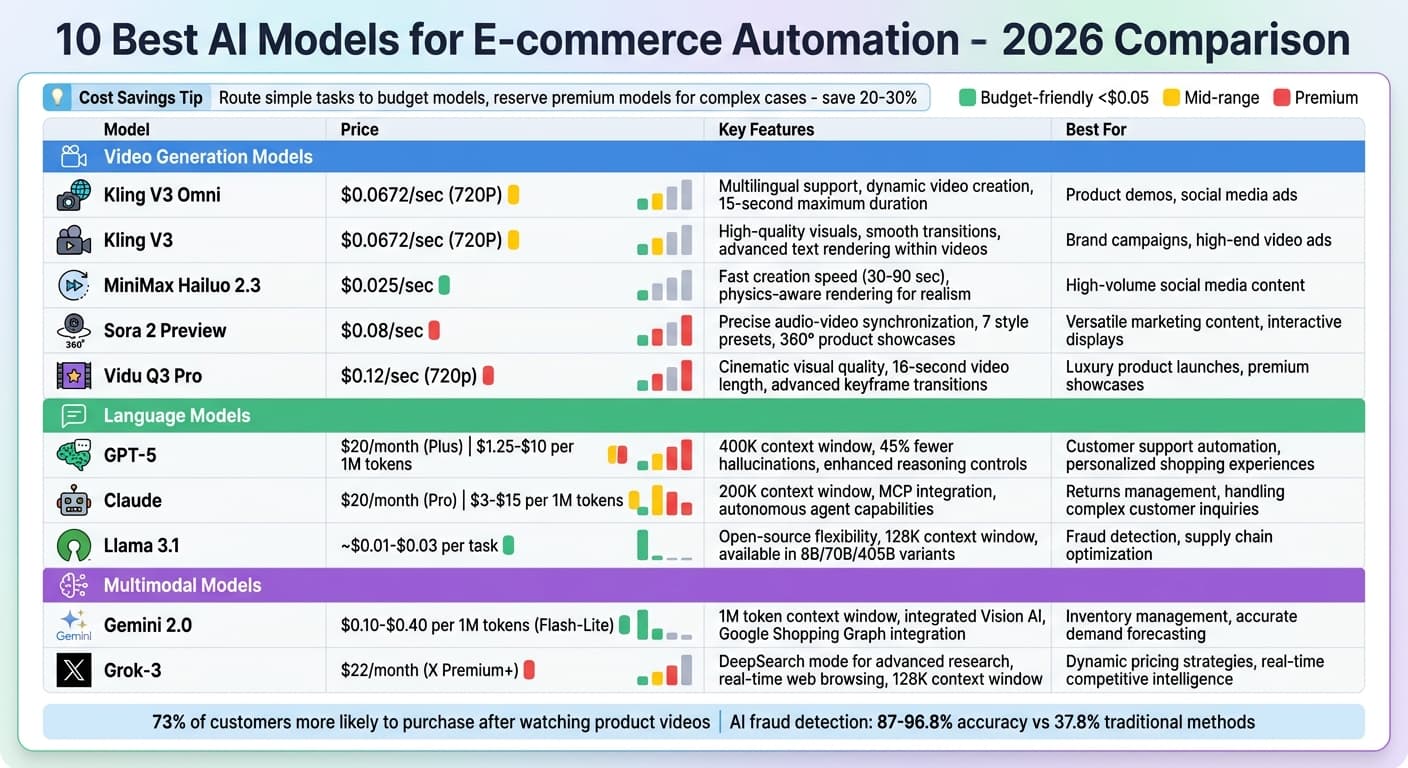
In 2026, e-commerce businesses are leveraging AI tools to automate processes, boost efficiency, and increase revenue. This article highlights the top 10 AI models tailored for tasks like inventory management, dynamic pricing, personalized recommendations, and video content creation. Key takeaways:
- Kling V3 Omni and Kling V3: Affordable video generation tools for creating high-quality product videos with platform integrations.
- MiniMax Hailuo 2.3: Budget-friendly, quick video creation for social media campaigns.
- Sora 2 Preview and Vidu Q3 Pro: Advanced video tools for polished ads and premium product showcases.
- GPT-5 and Claude: Language models for customer support, automation, and multi-step workflows.
- Llama 3.1: Open-source AI for secure, cost-efficient automation.
- Gemini 2.0 and Grok-3: Multimodal AI for inventory, pricing, and market intelligence.
Quick Comparison
| AI Model | Pricing | Key Features | Best Use Case |
|---|---|---|---|
| Kling V3 Omni | $0.0672/sec (720P) | Multilingual, dynamic videos | Product demos, social ads |
| Kling V3 | $0.0672/sec (720P) | High-quality visuals, transitions | Brand campaigns, video ads |
| MiniMax Hailuo 2.3 | $0.025/sec | Fast, cost-effective video creation | Social media content |
| Sora 2 Preview | $0.08/sec | Balanced quality and cost | Versatile marketing content |
| Vidu Q3 Pro | $0.12/sec | Premium visuals, cinematic effects | Luxury product launches |
| GPT-5 | $20/month (ChatGPT Plus) | Advanced reasoning, automation | Customer support, personalized shopping |
| Claude | $20/month (Pro) | Task automation, large context | Returns management, customer inquiries |
| Llama 3.1 | ~$0.01-$0.03 per task | Open-source, secure deployment | Fraud detection, supply chain optimization |
| Gemini 2.0 | Usage-based pricing | Data-heavy analysis, forecasting | Inventory management, demand forecasting |
| Grok-3 | $22/month (X Premium+) | Real-time insights, DeepSearch mode | Dynamic pricing, competitive intelligence |
These AI tools cater to various e-commerce needs, from creating engaging content to automating complex workflows. Businesses can choose based on their budget, goals, and operational requirements.
7 Proven AI Systems Giving Ecommerce Stores an Edge in 2025
1. Kling V3 Omni
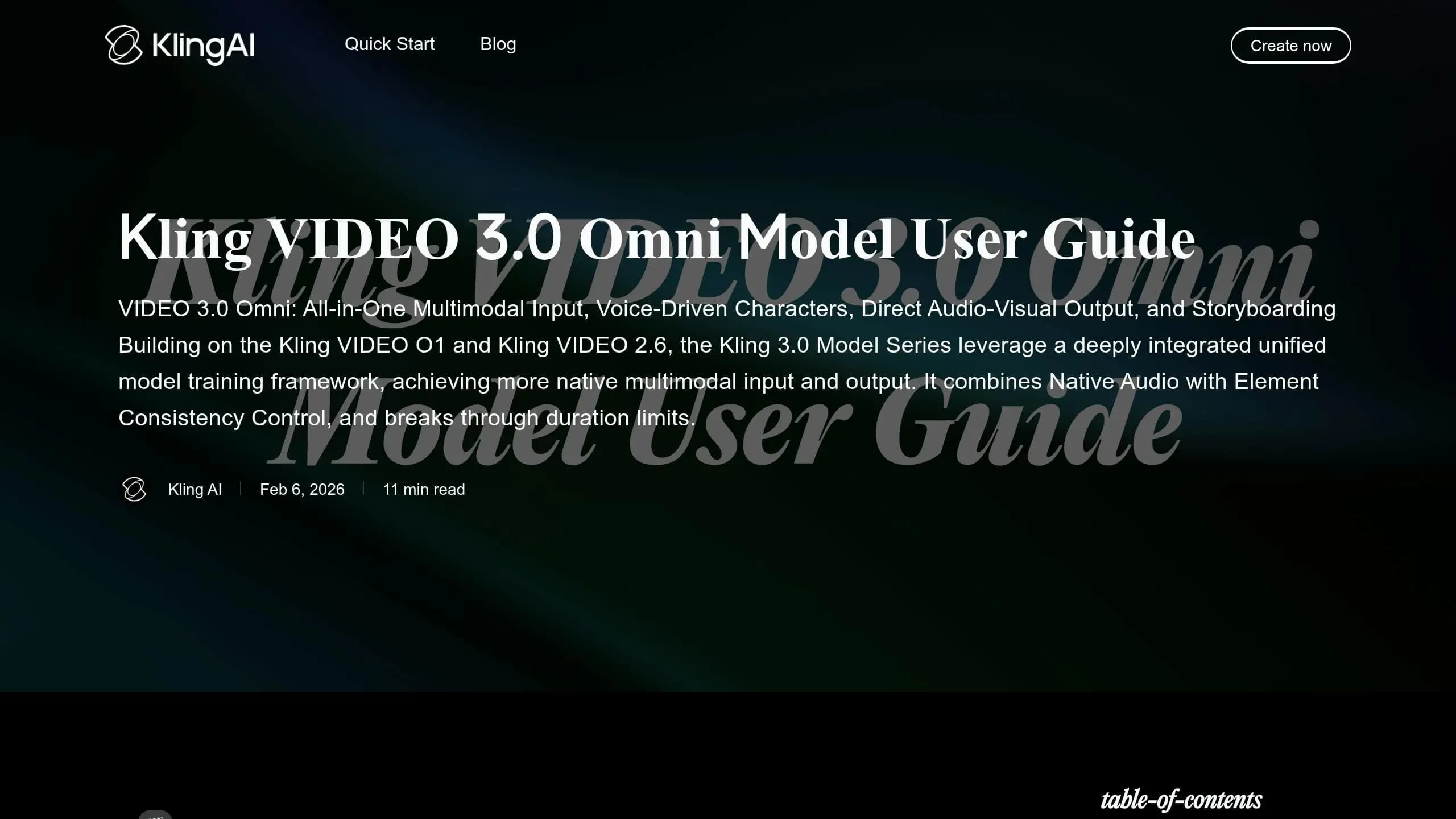
Kling V3 Omni is an AI-powered video generation tool tailored for e-commerce businesses. It’s designed to produce high-quality product videos, marketing materials, and visual merchandising content at a fraction of traditional production costs. Priced at $0.0672 per second for 720P resolution, it offers a cost-efficient way to create professional-grade videos that align with modern business needs.
E-commerce-specific Features
This model transforms static images into engaging, dynamic videos using multi-modal inputs. E-commerce teams can provide images and short text descriptions to generate visually appealing, cinematic-quality videos. This is particularly useful for showcasing products online. Additionally, Kling V3 Omni supports multiple languages, making it a practical solution for businesses targeting global audiences. The built-in multilingual capabilities eliminate the need for separate translation services, saving both time and money.
Seamless Platform Integration
Kling V3 Omni aligns with current industry practices by offering native connectors for platforms like Shopify, BigCommerce, and Salesforce Commerce Cloud. This allows for smooth integration with existing e-commerce systems, enabling real-time updates and streamlined workflows.
Affordability and Scalability
As AI adoption continues to grow, tools like Kling V3 Omni are becoming standard due to their affordability and efficiency. Its pricing model ensures that businesses of all sizes can leverage advanced video generation without breaking the bank. Supporting outputs of up to 15 seconds, it strikes a balance between rich content and processing efficiency. This makes it easier to manage costs while scaling video production for expanding operations[2].
2. Kling V3

Kling V3 is an AI-powered video generation tool tailored for e-commerce brands looking to create high-quality product videos without the hefty costs of traditional production. Priced at just $0.0672 per second for 720p resolution, it offers professional visuals with features like dynamic lighting, depth of field, and seamless transitions. The model supports video clips up to 15 seconds long and delivers output in 1080p resolution at 24fps. It’s a powerful solution designed to meet the unique demands of e-commerce, with specialized features outlined below.
E-commerce-specific Capabilities
One of Kling V3’s standout features is its ability to render on-screen text with exceptional clarity. This ensures that elements like pricing overlays, promotional banners, and product labels appear sharp and professional - eliminating the need for extra post-production editing. For more advanced creative control, tools like AI Canvas allow for further image and video editing. As PiAPI explains:
Kling 3.0 API produces crisp, readable text directly in video frames... supporting high-fidelity use cases such as ecommerce and performance-driven advertising
[3].
Beyond text rendering, the model includes native audio generation in five languages: Chinese, English, Japanese, Korean, and Spanish. This makes it easier for brands to create global campaigns without additional localization efforts.
Integration with Existing Platforms and APIs
Kling V3 integrates effortlessly with existing systems through API endpoints, offering flexibility for custom camera movements and animated effects. Users can submit video requests via POST /v1/videos/generations and monitor progress with GET /v1/tasks/{task_id}. Designed to work with unified API platforms (including OpenAI-compatible endpoints), this feature is perfect for showcasing product details in automated marketing campaigns. These integrations make Kling V3 a practical choice for businesses looking to streamline video creation while keeping costs low.
Cost-effectiveness and Scalability
At $0.0672 per second for 720p resolution, Kling V3 is a budget-friendly option for creating 15-second, high-resolution videos. Its minimum billable duration of three seconds allows brands to experiment with video prompts and refine their messaging before committing to full-scale production. This pricing structure is ideal for agile, data-driven campaigns where testing and iteration are key.
Customization and Personalization Features
Kling V3’s Subject Reference 3.0 technology ensures consistent product visuals across multiple video shots, which is essential for maintaining a cohesive brand image. The model’s image-to-video functionality, with locked first frames, guarantees that product visuals remain uniform across campaigns, reducing the need for extensive quality control. Additionally, the option to assign specific voice tones to characters allows brands to create personalized video content that aligns with their identity. This combination of consistency and customization makes Kling V3 a go-to tool for scaling video content without compromising on quality or branding.
3. MiniMax Hailuo 2.3
MiniMax Hailuo 2.3 takes static product images and turns them into engaging marketing videos. Available through APIMart at just $0.025 per second, it creates 6- to 10-second videos in either 768p or 1080p resolution. The process is quick too - videos are ready in just 30-90 seconds, making it perfect for high-volume social media campaigns.
E-commerce-specific Capabilities
This model is designed with e-commerce in mind. It uses physics-aware rendering to realistically simulate fabric folds, water reflections, and even hair movement - features that are essential for showcasing products in a lifelike way. Its micro-expression modeling adds subtle facial details, which can make character-driven ads feel more authentic. The Media Agent feature simplifies video creation even further. Users can input their preferred scenes and music, and the tool automatically generates a polished advertisement. During beta testing for the "Double 11" shopping festival, creators reported better success rates in producing high-quality e-commerce content [7].
Integration with Existing Platforms and APIs
MiniMax Hailuo 2.3 integrates smoothly with existing systems, thanks to its dedicated Open Platform API. It uses standard API key authentication and provides example code for easy implementation. The image-to-video feature ensures consistency across marketing clips by allowing brands to upload reference images. David Chen, a Full-Stack Engineer, shared his thoughts:
As a developer, I value stability and speed. MiniMax Hailuo 2.3 on APIMart delivers great performance
[8]. With a 99.9% SLA and support for multilingual prompts in English and Chinese, this tool is well-suited for global operations [8].
Cost-effectiveness and Scalability
For brands producing large volumes of videos, the Hailuo 2.3 Fast option offers significant savings, cutting costs for batch creations by up to 50% compared to the standard version [6][7]. Pricing is flexible: standard subscriptions start at around $9.99 per month for 20 to 30 videos, while Pro plans range from $34.99 to $54.99 per month for 100 to 150 videos [4]. This pricing structure makes it accessible for a range of e-commerce needs.
Customization and Personalization Features
MiniMax Hailuo 2.3 also stands out with its customization options. Beyond photorealism, it supports a variety of visual styles, including anime, game CG, and ink-wash painting, catering to niche brand aesthetics [5][6]. Its cinematic motion control feature allows for professional panning and zooming effects without needing an actual camera crew. The image-to-video feature ensures that characters and products remain consistent across campaigns. Wei Zhang, an Independent Animator, noted:
The consistency of MiniMax Hailuo 2.3 is amazing! Character images remain stable across multiple clips
[8]. For mobile-first content, opting for 768p resolution can cut credit costs by about 30% without compromising quality on mobile screens [4].
4. Sora 2 Preview
Sora 2 Preview is a cutting-edge video-audio generation tool designed for creating polished product demonstrations and dynamic advertisements. Available exclusively on APIMart at $0.08 per second, it generates videos with perfectly synchronized audio, including sound effects, ambient tracks, and lip-synced dialogue. This makes it an excellent choice for training materials and product explainers where high-quality visuals and audio are essential. Its advanced audiovisual features make it particularly effective for boosting engagement in e-commerce.
E-commerce-specific Capabilities
Sora 2 Preview is equipped with seven tailored presets specifically designed for online sellers: Unboxing Video, First-Person POV, ASMR Aesthetic, Luxury Ad, Japanese Minimalist, Cinematic Calm, and Viral Trends. Each preset targets different product categories. For example, the Luxury Ad preset is perfect for showcasing jewelry and perfumes, while ASMR Aesthetic adds appeal to food and skincare promotions.
One standout feature is its ability to transform static product photos into dynamic, 360-degree video showcases, eliminating the need for costly studio shoots. Additionally, the "Characters" feature allows users to seamlessly insert a short video of themselves into generated scenes, creating a more personalized advertising experience. Considering that 73% of customers are more likely to purchase after watching product demo videos [10], these features can significantly enhance conversion rates.
Integration with Existing Platforms and APIs
Sora 2 Preview integrates seamlessly through the OpenAI API using the /v1/videos endpoint. Generating high-quality videos takes about 3-5 minutes per clip, with support for Webhooks and WebSocket modes to notify platforms once the task is complete, avoiding session timeouts.
For developers, compatibility with the OpenAI Agents SDK opens up possibilities to build "Video Agents" that automatically generate videos in response to inventory updates or new product listings. The Batch API further simplifies large-scale catalog updates, allowing merchants to handle high-volume video generation efficiently, with rate limits reaching up to 375 requests per minute for Tier 5 users [13].
Cost-effectiveness and Scalability
With a clear pricing model of $0.08 per generated second, Sora 2 Preview offers an affordable solution for video creation. It supports multiple aspect ratios - 9:16 for TikTok and Reels, 1:1 for Instagram and Amazon feeds, and 16:9 for YouTube and websites - making it easy for brands to target various platforms with a single video.
As video ad spending is expected to hit $456 billion by 2025 and social media videos are shared 12 times more often than text or static images [10], automated video creation through Sora 2 Preview provides a practical way to tap into this growing trend.
Customization and Personalization Features
Sora 2 Preview allows brands to fine-tune the model using Vision Fine-tuning, ensuring that all generated videos align with their unique style and branding [13]. Users can specify detailed conditions like "golden hour" lighting or advanced camera movements such as "dolly-in" for added realism. The model's ability to accurately depict human faces - rated at 89% - makes it ideal for ads featuring characters [12].
Jo Lambadjieva, Founder of Amazing Wave, highlighted its potential:
The combination of ChatGPT's research capabilities and Sora's potential for emotional manipulation - I mean, 'engagement' - could create something we've never seen before: an AI ecosystem that might eventually guide you through every type of purchase [9].
To ensure safety and compliance, Sora 2 Preview automatically blocks requests to generate real people, copyrighted characters, or copyrighted music [11]. This ensures brands can confidently use the platform without risking legal or ethical issues.
5. Vidu Q3 Pro
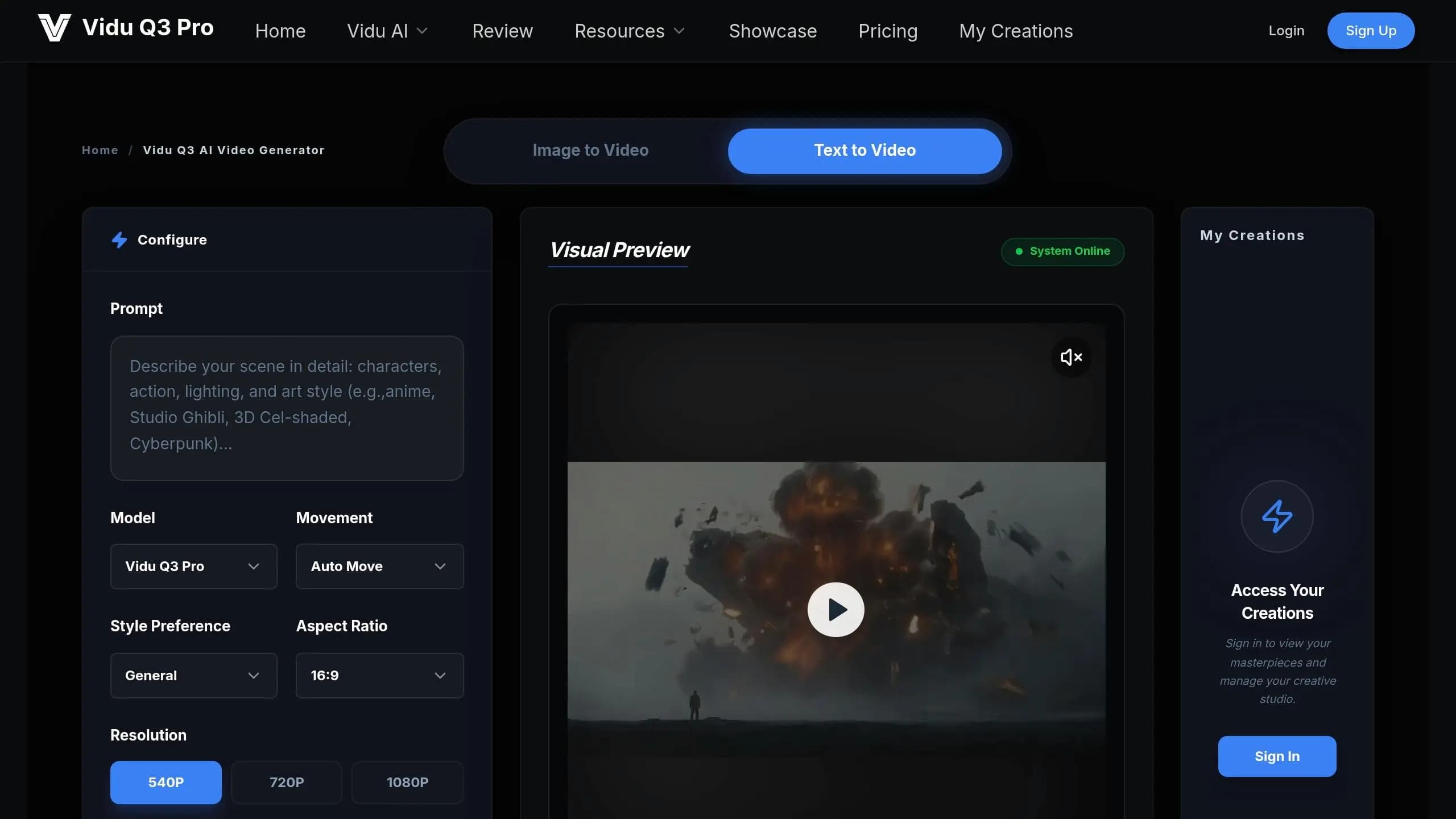
The Vidu Q3 Pro is designed to deliver "Pro Cinematic Quality" videos, complete with professional-grade lighting, composition, and depth of field. This makes it an excellent choice for luxury brands and premium product promotions. Available on APIMart at $0.12 per second for 720p and $0.128 per second for 1080p, the model creates 16-second videos with flawless audio and visual synchronization [14][15].
E-commerce-specific Capabilities
Vidu Q3 Pro brings static product images to life with its Image-to-Video mode, turning still photos into dynamic video showcases. This eliminates the need for costly studio shoots. Its keyframe transition feature ensures smooth visual storytelling, making it ideal for showing product transformations or multiple angles in a single clip. With support for resolutions up to 1080p and advanced temporal modeling for natural motion, it’s particularly effective for high-end products like jewelry, watches, and luxury fashion [14][15]. These features allow e-commerce brands to create visually stunning content while maintaining a consistent and polished brand identity.
The model has achieved global recognition, ranking No.1 on the Artificial Analysis benchmark at its launch and topping SuperCLUE's first global Reference-to-Video leaderboard. Its Reference-to-Video capability enables merchants to upload specific product images as references, ensuring consistent branding across campaigns [19].
Integration with Existing Platforms and APIs
Vidu Q3 Pro is built with a unified API design, making it straightforward for developers to integrate. Alex Kim, a Full-Stack Engineer, praised the API’s simplicity:
As a developer, I love the unified design of the Vidu Q3 API. Pro and Turbo share the same interface - just switch the model parameter. Integration was a breeze
[14].
The API operates asynchronously, allowing users to submit generation requests and retrieve results via a Task Result API. This setup supports non-blocking, high-volume workflows with enterprise-grade reliability, backed by a 99.9% SLA. As of May 2026, the platform serves over 50,000 active users [14][16]. For added cost efficiency, developers can use the "off_peak" flag to reduce generation costs by around 50% for non-urgent batch tasks. The API also supports multilingual prompts in English and Chinese, making it versatile for various markets [14][16].
Cost-effectiveness and Scalability
Starting at $0.056 per second for 540p, the Vidu Q3 Pro allows businesses to produce a 5-second video at 720p for approximately $0.60. APIMart sweetens the deal with a 20% discount compared to the official pricing, making it an affordable solution for high-quality video production [14]. The built-in audio-visual synchronization eliminates the need for manual post-production, saving both time and money. Content creator Sarah Johnson shared her experience:
Pro's cinematic quality is outstanding! And Turbo lets me quickly validate creative directions - using both models together doubles my efficiency
[14].
For brands scaling their content production, the API supports multiple aspect ratios - 9:16 for TikTok and Reels, 1:1 for Instagram, and 16:9 for YouTube. This flexibility allows businesses to create platform-specific content from a single prompt [15].
Customization and Personalization Features
Vidu Q3 Pro offers detailed customization options, enabling users to specify camera movements like "slow dolly shot" or add audio details such as "soft clicking of a watch" for a cinematic touch. It includes six types of visual effects, such as fluid simulations and particle systems, along with five sound categories [19]. The model’s 16-second maximum duration surpasses the usual 10-second limit of many AI video tools, allowing for more complete storytelling in social media reels and commercials without awkward cuts [18]. Additionally, its ability to generate videos in multiple languages - including English, Japanese, and Chinese - makes it a great fit for global e-commerce brands [17][19].
6. GPT-5
GPT-5 is a reasoning-first AI model crafted to handle complex, multi-step e-commerce workflows. It boasts a 45% reduction in factual errors compared to GPT-4o and uses 50-80% fewer output tokens, making it both precise and efficient [20]. With a massive 400,000-token context window, it can process extensive product catalogs, customer histories, and market data in a single request [24]. These capabilities power advanced e-commerce applications, as outlined below.
E-commerce-specific Capabilities
GPT-5 is built to tackle key challenges in e-commerce, offering strategic solutions for finance and market automation. Finance teams, for instance, can simulate pricing changes, forecast market trends, and generate actionable insights within hours. In early 2026, BBVA used GPT-5 to automate a critical technical workflow that previously took weeks, completing it in mere hours. Elena Alfaro, Head of Global AI Adoption at BBVA, remarked:
"GPT-5 is showing real promise, especially when it comes to writing code and handling technical tasks like those needed in order to automate workflows. In one case, the model in ChatGPT even helped us accomplish a very strategic task that would have taken 2-3 weeks to just a couple of hours." [20]
For marketing and go-to-market strategies, GPT-5 excels in generating launch plans, messaging frameworks, and sales content. In May 2026, H&M deployed a GPT-5-powered multilingual chatbot across 70 countries. This chatbot drastically reduced customer wait times from minutes to seconds by automating standard inquiries, significantly enhancing customer service [25]. Additionally, GPT-5's reasoning controls allow businesses to adjust effort levels - from basic customer interactions to intricate financial forecasting - tailored to the task at hand [21].
Integration with Existing Platforms and APIs
GPT-5 integrates seamlessly with existing tools via its new Responses API, which manages stateful conversations without requiring manual tracking of complex histories [23]. It connects directly with platforms like Google Drive, SharePoint, and GitHub. Its Model Context Protocol (MCP) further extends its compatibility, enabling natural language commands to access external systems, databases, and third-party e-commerce services. For cost-conscious developers, the Azure AI Foundry offers a model router that automatically selects between standard, mini, or nano variants, cutting inferencing costs by up to 60% [22].
SAP was among the first to adopt GPT-5 through Azure AI Foundry. Dr. Walter Sun, SVP and Global Head of AI at SAP SE, shared:
"SAP is excited to be among the first to leverage the power of GPT-5 in Azure AI Foundry... GPT-5 will enable our product team and our developer community to deliver impactful business innovations to our customers." [22]
GPT-5 also supports custom tools, allowing API calls through Context-Free Grammar (CFG). This ensures outputs like SQL queries or timestamps meet strict platform standards. Its performance on the τ2-bench telecom tool-calling benchmark, scoring 96.7%, highlights its reliability in managing complex workflows [26].
These integrations make GPT-5 an invaluable resource for enterprise operations.
Cost-effectiveness and Scalability
GPT-5 offers flexible pricing tiers to cater to various business needs. The standard model is priced at $1.25 per million input tokens and $10.00 per million output tokens. For less complex tasks like product tagging or real-time chat translation, the Nano variant starts at just $0.05 per million input tokens and $0.40 per million output tokens. Cached inputs can further reduce costs to $0.125 per million tokens.
| Model Variant | Input Price (per 1M tokens) | Output Price (per 1M tokens) |
|---|---|---|
| GPT-5 (Standard) | $1.25 | $10.00 |
| GPT-5 Mini | $0.25 | $2.00 |
| GPT-5 Nano | $0.05 | $0.40 |
In 2026, Lowe's implemented GPT-5 to assist corporate teams with planning, analysis, and research tasks, achieving faster turnaround times for pricing models and customer service. Seemantini Godbole, CIO of Lowe's, stated:
"With GPT-5, corporate teams now have access to an ideal balance of reasoning and responsiveness for tasks like planning, analysis, research, and multi-step workflows." [20]
Sony also tapped into GPT-5's localization framework in September 2025 to adapt product descriptions across 10 countries. By tailoring content to regional terminology rather than relying on direct translations, Sony shortened localization cycles and reduced customer complaints [25].
Customization and Personalization Features
GPT-5 introduces features that allow businesses to fine-tune outputs to meet specific needs. For example, its response length control ensures that product descriptions or support replies can be adjusted for brevity or detail [21]. Additionally, its structured outputs enhance the accuracy of inventory and order data by enforcing strict output schemas. To optimize personalization, businesses can position static content at the start of prompts and user-specific context at the end, maximizing prompt caching to reduce latency and costs.
Bain & Company integrated GPT-5 into its Private Equity AI Practice in 2026. Gene Rapoport, Partner and Co-Head of the practice, noted:
"ChatGPT enables our teams to enhance their analysis and research, leading us to sharper insights faster with greater confidence." [20]
GPT-5's multi-step task orchestration also allows it to manage complex workflows, such as navigating web apps to complete logistics or claims processing. Its support for high-resolution image inputs - up to 10,240,000 pixels - enables detailed product analysis and visual search capabilities [21].
7. Claude
Claude is transforming e-commerce by automating workflows and seamlessly integrating with platforms in real-time. By February 2026, Claude Code contributed $2.5 billion to Anthropic's annualized revenue run rate, supported by over 300,000 businesses using the Claude Enterprise API [29]. Its impressive 200,000-token context window allows it to handle entire product catalogs and customer histories in a single session, making it a powerful tool for tackling complex e-commerce challenges [28]. This capability extends its usefulness to areas like inventory management, pricing strategies, and customer engagement.
E-commerce Improvements
Claude simplifies real-time inventory tracking by calculating "days-of-supply" using live sales data and supplier lead times instead of relying on static stock thresholds [31]. Through MCP, it autonomously manages inventory across databases, saving merchants 15-25 hours weekly [29]. It also performs competitor analysis using integrated APIs to support dynamic pricing decisions [31].
Merchants rely on Claude for tasks like analyzing Shopify CSV exports to uncover sales trends and accurately calculate profit margins, factoring in costs like COGS and shipping [28]. Additionally, it generates SEO-friendly product descriptions for catalogs with over 50,000 SKUs while maintaining a consistent brand tone [28][30]. Competitive analysis powered by AI reduces research time from 40 hours a week to under 5 hours, while personalized AI-driven customer interactions boost satisfaction scores by 25% [30].
Seamless Integration with Platforms and APIs
Claude's automation features integrate effortlessly with major e-commerce platforms. In April 2026, Shopify launched the Shopify AI Toolkit, a free, open-source connector enabling Claude Code to access store data, execute GraphQL mutations, modify theme files, and run CLI commands directly [27]. This integration has elevated Claude from a simple assistant to an autonomous agent capable of managing inventory, adjusting pricing, and building custom features through natural language commands [29][32].
By March 2026, 75% of developers at small-to-mid-sized firms had adopted Claude Code as their go-to tool [29]. It also connects with platforms like BigCommerce, Medusa, and Adobe Commerce through specialized MCP connectors such as Mirasvit [29][32]. Stormy AI highlighted:
The MCP standard has effectively solved the 'hallucination' problem in e-commerce. By giving the AI direct access to the SQL database, we ensure it never recommends an out-of-stock item. [29]
Claude's agentic infrastructure handles 45% of its 25 billion monthly API calls from enterprise platforms like Shopify and Salesforce [29][32].
Cost Efficiency and Scalability
Claude offers flexible pricing options, including Claude Pro at $20 per month for higher usage limits and an API with usage-based pricing ranging from $3 to $15 per million tokens. On average, API costs are between $10 and $40 per month [28]. Businesses can cut costs by up to 65% through optimization strategies like prompt caching (saving up to 90% on repetitive tasks), batch processing (offering a flat 50% discount), and selecting appropriate models [33].
| Model Variant | Input Price (per 1M tokens) | Output Price (per 1M tokens) |
|---|---|---|
| Claude 3.5 Haiku | $0.25 | - |
| Claude 4 Sonnet | $3.00 | $15.00 |
Kashyap Coimbatore Murali, an AI Engineer at Tribe AI, shared:
Through systematic optimization... we've reduced annual AI costs from $3,960,000 to $1,370,547 - a 65% reduction while maintaining or improving performance. [33]
Claude speeds up tasks by an average of 80%, with document-heavy processes like invoice writing achieving 87% time savings [34]. Automated inventory management also saves up to 90 minutes daily by eliminating manual dashboard checks [31].
Customization and Personalization
Claude's 200,000-token context window ensures consistent branding across large product catalogs [28]. It also uses behavioral insights to perform dynamic email segmentation, identifying trends like customers who shop only during sales or those with declining lifetime value [31]. Additionally, it drafts empathetic, brand-aligned responses for customer service needs like return requests and complaints [28].
The Shopify AI Toolkit enhances functionality with tools for Liquid template validation, Hydrogen (headless) support, and Polaris design system scaffolding [27]. Businesses can also implement Architecture Decision Records (ADRs) to set profit floors - such as never discounting below a 15% margin - and require human approval for significant changes [32].
AdVenture Media Group noted:
Claude Code operates as an autonomous coding agent, not a passive assistant. [31]
Through model distillation, businesses can transfer the capabilities of high-tier models like Claude 4 Sonnet to more efficient options like Claude 3.5 Haiku, maintaining accuracy while significantly reducing costs [33].
8. Llama 3.1
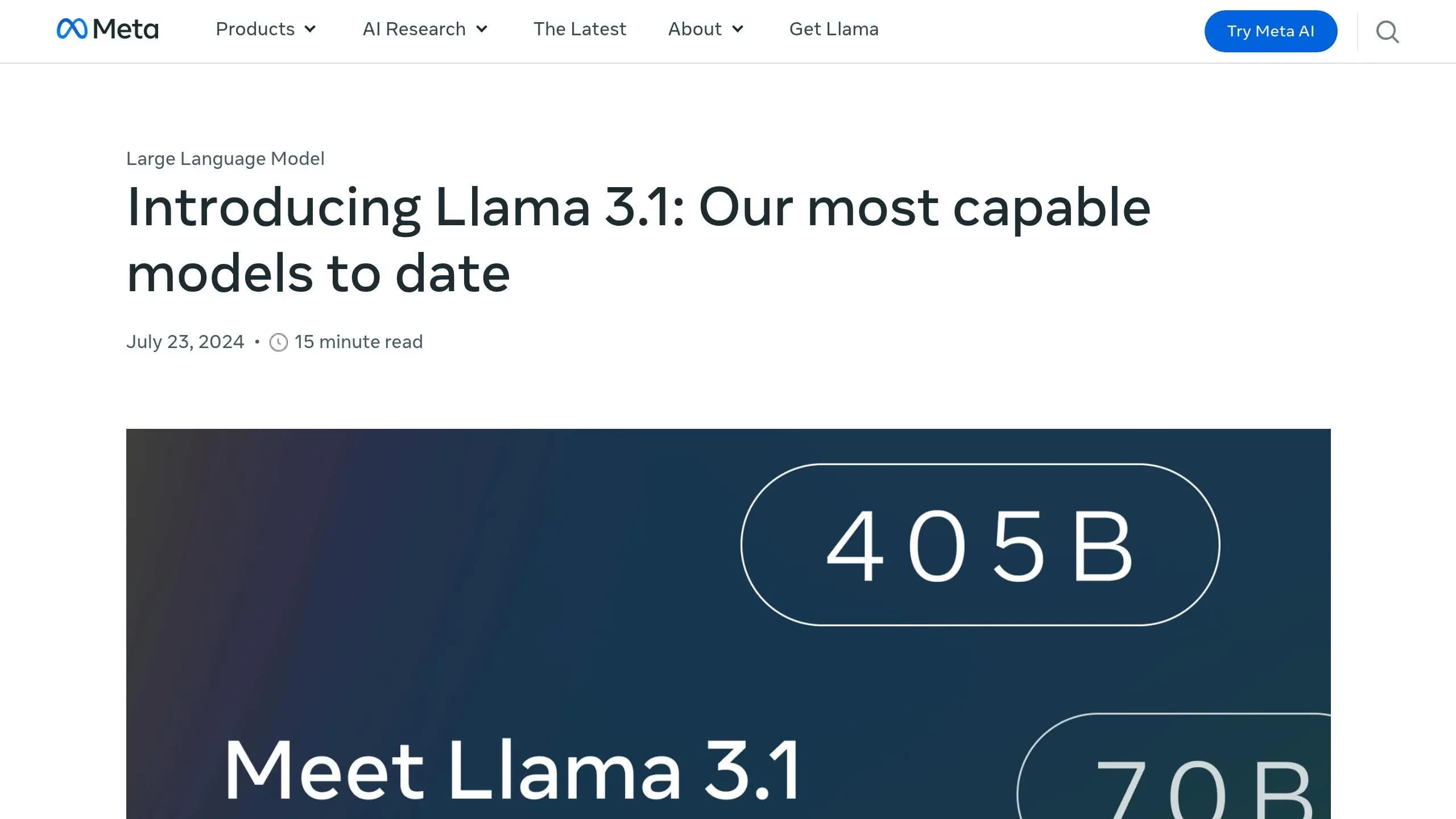
Llama 3.1 follows in the footsteps of other advanced models like GPT-5 and Claude, offering an open-source option tailored specifically for e-commerce needs. This model stands out as a cost-efficient solution, eliminating the recurring expenses tied to proprietary systems. With training on over 15 trillion tokens and a 128,000-token context window, it handles everything from extensive product catalogs to lengthy customer service exchanges with ease [35]. Available in three sizes - 8B, 70B, and 405B parameters - it provides businesses with flexibility to scale and automate their operations effectively.
E-commerce-Specific Capabilities
In January 2025, researchers at eBay Inc. introduced "e-Llama", a version of Llama 3.1 enhanced through additional training on 1 trillion tokens of e-commerce data, such as product listings and customer reviews. Christian Herold and Shahram Khadivi spearheaded this effort, achieving a 25% improvement in English tasks and a 30% boost for non-English tasks on benchmarks. This adaptation excels in tasks like Aspect Prediction (identifying attributes like brand or color from product titles) and Price Prediction, while also surfacing common features for specific product categories [36].
Supporting eight languages - English, German, French, Italian, Portuguese, Hindi, Spanish, and Thai - Llama 3.1 connects directly to inventory systems, CRM tools, and pricing engines. This real-time integration makes it a powerful tool for automating intricate e-commerce workflows [40].
Integration with Existing Platforms and APIs
Shopify has successfully implemented Llama 3.1 for automating tasks like generating product pages, localizing content, and streamlining customer support. This integration resulted in a 76% increase in token throughput and a 33% reduction in compute costs, thanks to its optimized JSON output. Impressively, it achieved a 97.7% accuracy rate in detecting customer query intent [39].
Another example comes from Ian Cadieu, CTO of Altana, who used Databricks' platform to integrate Llama 3.1. This setup allowed his team to deploy generative AI systems 20 times faster than before [38]. Additionally, the Llama Stack API simplifies integration with platforms like Shopify, WooCommerce, and BigCommerce [58, 64].
Guilherme Guisse, Head of Data and Analytics at Orizon, highlighted the benefits of using Llama 3.1:
Mosaic AI and state-of-the-art open models like Llama 3 empower us to create and securely deploy custom models based on our own data and business rules. This is allowing us to build novel GenAI features, automating 63% of tasks.
Cost-Effectiveness and Scalability
Llama 3.1 is not just about performance - it’s also about cutting costs. Self-hosting the model can bring monthly inference costs down to $800-$1,500, compared to the $4,500-$8,000 typically required for proprietary models handling similar workloads [41]. Its open-source nature allows businesses to operate on-premises, avoiding API fees and maintaining full control over their data. Mark Zuckerberg has noted:
Llama models offer some of the lowest cost per token in the industry, according to testing by Artificial Analysis.
| Model Variant | Parameters | Primary E-commerce Use Case |
|---|---|---|
| Llama 3.1 8B | 8 Billion | Ultra-fast product tagging, basic chat |
| Llama 3.1 70B | 70 Billion | Content creation, complex customer support |
| Llama 3.1 405B | 405 Billion | Synthetic data generation, model distillation |
The largest variant, 405B, is particularly useful for generating synthetic data, which can then be used to train smaller models like the 8B or 70B versions. This approach helps maintain accuracy while keeping operational costs low [58, 62].
Customization and Personalization Features
Thanks to its 128K token context window, Llama 3.1 can process entire product catalogs or technical documentation in one go. Developers can use model merging to combine general knowledge with e-commerce-specific expertise, creating tailored solutions for specific tasks without losing broader reasoning capabilities [36]. The model’s JSON output mode also ensures structured data is ready for direct import into e-commerce systems, eliminating the need for manual entry when updating product listings [40].
For businesses with nearly 700 million monthly active users, the Llama 3 Community License requires a separate commercial agreement with Meta. Oleg Prosin of WCR.LEGAL pointed out:
The 700M MAU threshold matters before you reach it. Investors and acquirers identify it in due diligence as an unquantified future liability.
9. Gemini 2.0
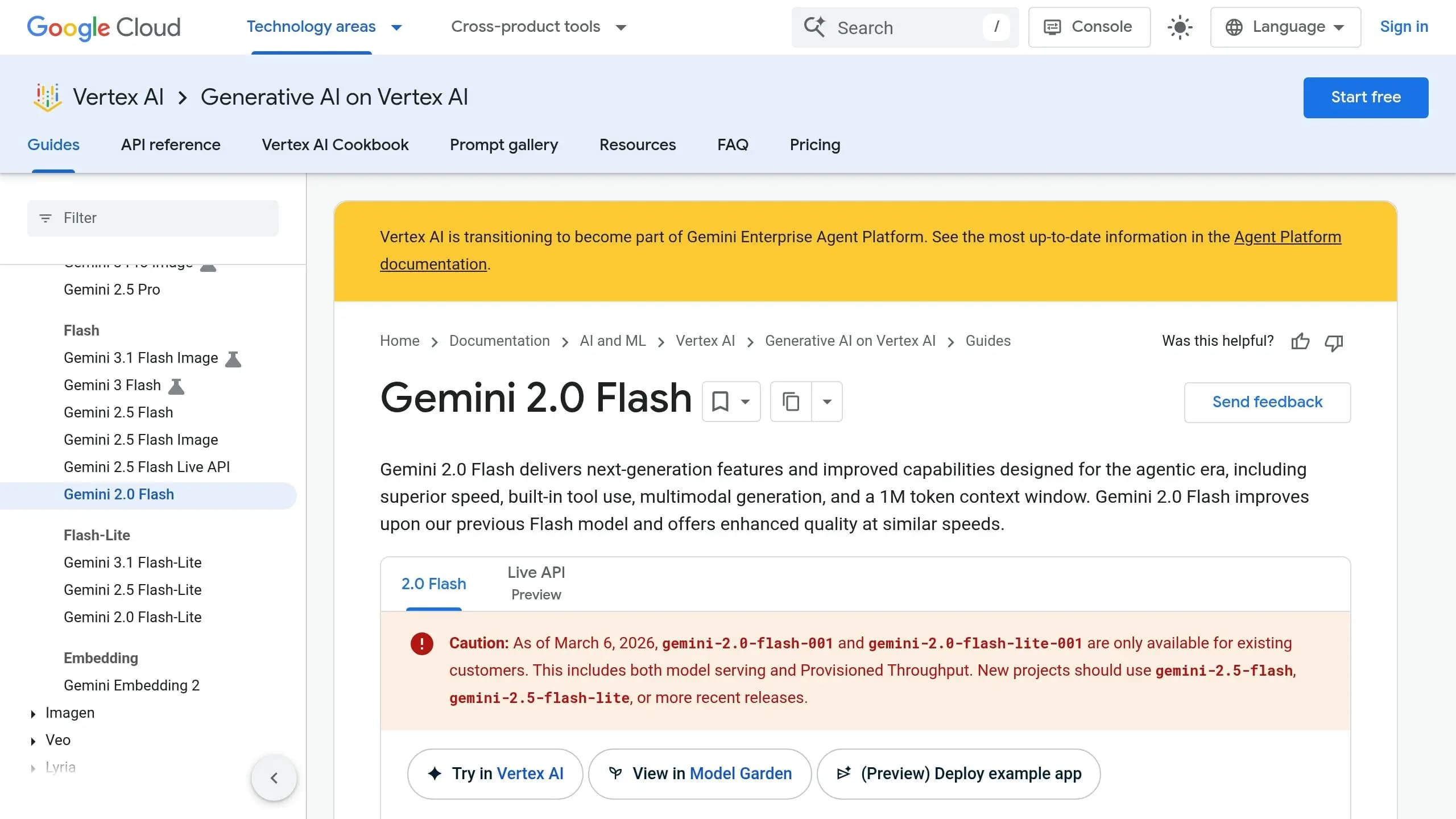
Gemini 2.0 introduces Google's multimodal AI tailored for automating e-commerce processes. Keep in mind that the Flash version will be discontinued on June 1, 2026, so transitioning to Gemini 2.5 Flash-Lite or newer is necessary [48]. With its impressive 1-million-token context window, Gemini 2.0 can handle extensive datasets like product catalogs, sales records, and customer feedback. This capability makes it a strong tool for managing inventory and pricing on a large scale.
E-commerce-Specific Capabilities
Gemini 2.0 is designed to simplify complex inventory workflows. Its Vision AI feature enhances product data and redirects search results when items are unavailable [42][43]. By using Clawify, the system evaluates real-time market trends and competitor pricing to fine-tune pricing strategies for both premium and commodity products [44]. Additionally, it audits product catalogs by analyzing images for quality factors like lighting and composition, ensuring they align with textual descriptions for better SEO performance [44].
In 2025, Albertsons Cos. partnered with Google to introduce Conversational Agents for Commerce powered by Gemini. Under the guidance of Jill Pavlovich, SVP of Digital Customer Experience, they developed the "Ask AI" tool. This feature revolutionized grocery shopping by helping customers plan meals and discover products through intuitive assistance. Pavlovich highlighted:
By collaborating with Google to bring Conversational Agents for Commerce to market, we are providing our customers a solution that moves beyond traditional search to help them digitally shop across aisles... ultimately making their experience more enjoyable.
Integration with Existing Platforms and APIs
Gemini 2.0 offers seamless integration with current e-commerce systems, enhancing automation and workflow efficiency. It connects with platforms like Google Search, executes code, and works with third-party tools [46]. The Multimodal Live API enables real-time audio and video input, perfect for interactive customer support. For Shopify users, Clawify links Gemini to live store data, covering products, orders, customers, and inventory [44]. Developers can use Vertex AI for secure deployment with features like Customer-Managed Encryption Keys (CMEK) and VPC Service Controls. Alternatively, Google AI Studio’s free tier is available for quick prototyping [47].
Several companies have already benefited from Gemini’s capabilities. Best Buy improved customer service response times by up to 90 seconds using automated call summaries, while Wayfair achieved a 55% faster setup and a 48% improvement in code performance with Gemini Code Assist [45].
Cost-Effectiveness and Scalability
Upgrading to newer Gemini versions brings cost-saving advantages. As the Flash version is phased out, Gemini 2.5 Flash-Lite offers a more affordable option at $0.10 per 1 million input tokens and $0.40 per 1 million output tokens, significantly reducing costs compared to earlier versions [48]. Context caching further cuts expenses by up to 90% for repetitive prompts, costing just $0.025 per 1 million tokens [48]. For tasks like nightly inventory summaries, the Batch API provides a 50% discount on token costs [48].
Gemini also taps into Google’s Shopping Graph, which manages over 50 billion product listings and processes approximately 2 billion updates per hour, ensuring real-time accuracy [49].
| Model | Input Price (per 1M tokens) | Output Price (per 1M tokens) | Key Feature |
|---|---|---|---|
| Gemini 2.5 Flash-Lite | $0.10 | $0.40 | Best for high-volume applications |
| Gemini 3.1 Flash-Lite | $0.25 | $1.50 | Newer generation, budget-friendly |
| Gemini 3.1 Pro | $2.00 - $4.00 | $12.00 - $18.00 | Advanced reasoning, long context |
10. Grok-3
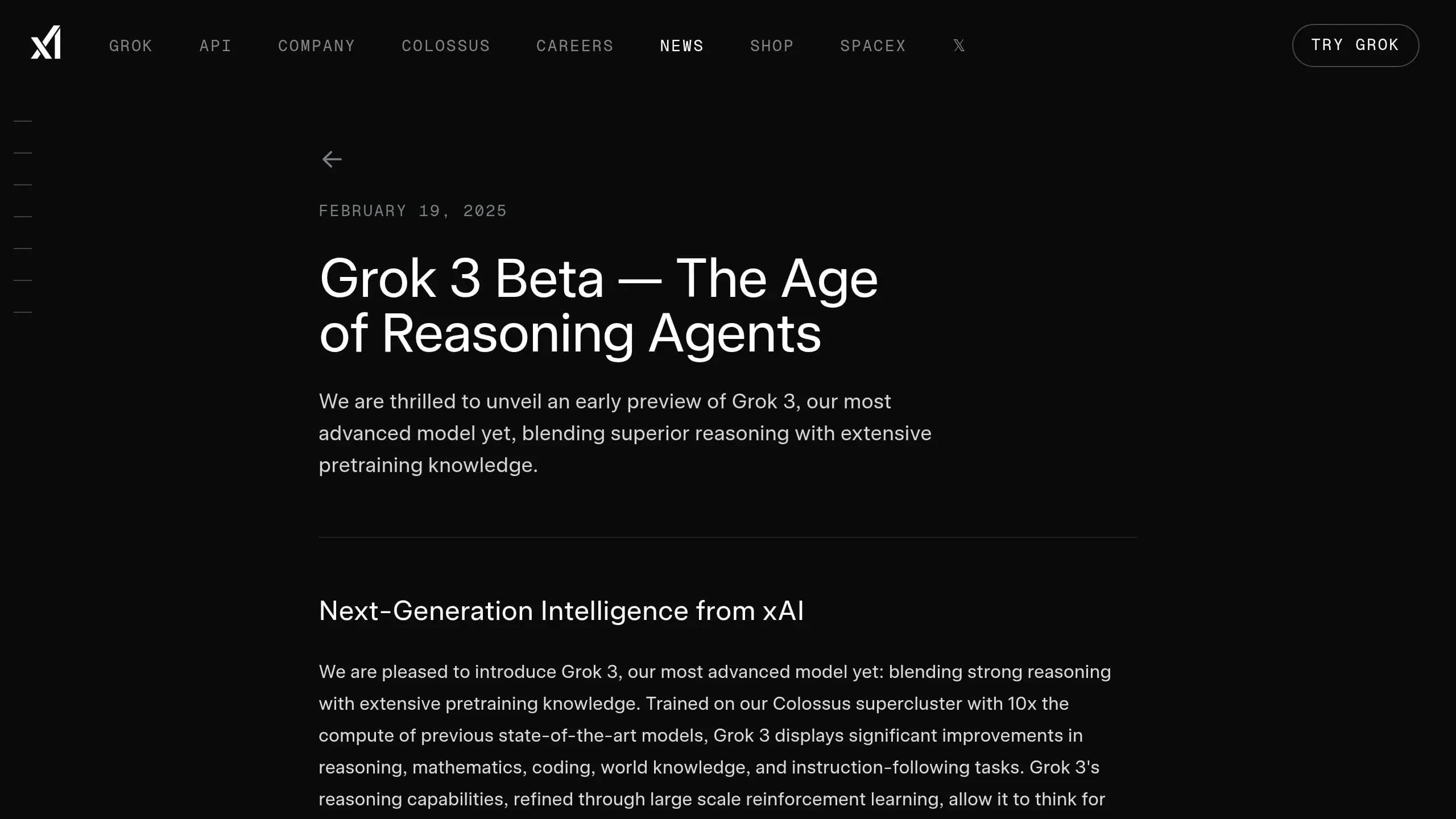
The last model in this lineup, Grok-3, delivers real-time insights designed to meet the fast-paced demands of e-commerce.
This model stands out by combining multimodal AI capabilities with real-time information access. It's especially useful for businesses needing to adapt quickly in competitive markets. Powered by a massive 200,000 Nvidia H100 GPUs - ten times more than its predecessor - and trained on the Colossus supercomputer in Memphis over just 92 days, Grok-3 offers three distinct modes: Think for step-by-step reasoning, Big Brain for solving complex problems, and DeepSearch for real-time web browsing and synthesis [50].
E-commerce-Specific Capabilities
The DeepSearch mode is a game-changer for market tracking and competitive intelligence. By continuously browsing the web, it validates sources and synthesizes up-to-date insights, making it invaluable for tasks like dynamic pricing. Meanwhile, the Big Brain mode is tailored for handling data-heavy challenges, such as sales forecasting, by analyzing complex datasets with advanced problem-solving techniques.
Additionally, Grok 3.5 (Beta) introduces “first principles reasoning,” which enables it to answer technical questions even when the information isn't available online. Elon Musk, Founder of xAI, highlighted this capability:
Grok 3.5 can answer such questions by 'reasoning through first principles,' allowing it to generate novel answers that 'simply don't exist on the Internet.'
These features provide e-commerce businesses with the tools to refine pricing strategies and improve forecasting, both of which are critical in fast-moving markets.
Integration with Existing Platforms and APIs
Grok-3 builds on the integration strengths of earlier models with its extensive context window and multi-API compatibility. It connects seamlessly with e-commerce systems using REST APIs and SDKs for Python, JavaScript, and Node.js, making it easy to integrate into existing workflows. Its 128,000-token context window allows it to process vast amounts of data, such as entire product catalogs or lengthy customer chat histories, with an inference latency of just 300-600ms [51][52].
When deployed through platforms like Berrydesk, Grok-3 can perform AI-driven tasks like verifying product availability, issuing refunds, tracking deliveries, and generating shipping labels [2]. Its native integration with X (formerly Twitter) provides real-time market intelligence, processing about 3.2 million market events daily with a latency of just 15-30 seconds [52].
Cost-Effectiveness and Scalability
Grok-3 is accessible via an X Premium+ subscription for $22 per month [50]. For those seeking more advanced features, a SuperGrok tier is rumored to cost $30 per month or $300 annually, offering early access to cutting-edge tools [50].
For businesses, usage-based billing through providers like AnyAPI.ai ensures scalable costs by charging only for tokens consumed [51]. Deployment options are flexible, including public cloud platforms like AWS and GCP, hybrid setups (on-premises reasoning with cloud training), or fully offline configurations for enhanced security. Grok-3 also supports over 25 languages and comes with pre-built compliance templates for standards like GDPR, HIPAA, and FINRA [51][52].
Feature and Pricing Comparison
These AI models combine advanced features with the goal of simplifying e-commerce workflows. Selecting the right model for your business requires weighing cost, capabilities, and intended use cases. The ten models highlighted here cater to a variety of needs, from generating product videos to automating customer support or forecasting sales. Here's a detailed breakdown of their pricing, features, and best applications:
| AI Model | Pricing Structure | Primary Features | Best E-commerce Use Case |
|---|---|---|---|
| Kling V3 Omni | $0.0672/sec (720P) | Multi-modal inputs, cinematic quality, 15-second videos, multilingual support | Product demos, social media ads, visual storytelling |
| Kling V3 | $0.0672/sec (720P) | High-quality visuals, dynamic lighting, smooth transitions, 15-second videos | High-end product videos, brand campaigns |
| MiniMax Hailuo 2.3 | $0.025/sec | Rapid turnaround, low cost, short video generation | Quick social content, budget-friendly ad creative |
| Sora 2 Preview | $0.08/sec | Balanced quality and cost, suitable for most creative scenarios | General product marketing, versatile content creation |
| Vidu Q3 Pro | $0.12/sec | Intelligent optimization, complex scenarios, high performance | Premium product launches, detailed visual narratives |
| GPT-5 | $20/month (ChatGPT Plus); Enterprise ~$60/user/month | Advanced reasoning, hyper-personalization, agentic workflows | Customer support automation, personalized shopping assistants |
| Claude | $20/month (Pro); Team plans vary | 1M token context window, multi-step task execution, policy retention | Complex customer inquiries, returns management, help center integration |
| Llama 3.1 | Usage-based (~$0.01-$0.03 per task) | Open-source, high data privacy, custom deployment | Fraud detection, internal supply chain optimization, secure data handling |
| Gemini 2.0 | Google Workspace integration; API usage-based | 2M token context window, data-heavy analysis, forecasting | Demand forecasting, inventory management, large-scale data processing |
| Grok-3 | Billed per API credit | Real-time web browsing, DeepSearch mode, first principles reasoning | Dynamic pricing, competitive intelligence, market trend tracking |
This comparison highlights how each model supports specific e-commerce needs, helping you decide which solution aligns best with your operational goals.
When evaluating costs, keep in mind that pricing goes beyond subscription fees. Total Cost of Ownership includes integration, training, and operational expenses. Initial setup costs may be higher due to implementation fees, while ongoing expenses like training and API overages can add up. Interestingly, competition has driven AI software prices down by 15% since 2024 [53].
Video generation models, which are billed per second, are ideal for businesses producing large amounts of visual content. Meanwhile, language models like GPT-5 and Claude excel in "Agentic Commerce", where autonomous systems manage tasks such as customer support and personalized recommendations [55][56].
For businesses with strict data privacy needs, open-source options like Llama 3.1 provide flexibility, especially for handling sensitive payment data or fraud detection. AI fraud-detection systems now boast accuracy rates of 87% to 96.8%, far outperforming traditional rule-based methods, which achieve only 37.8% [54]. If market trend tracking is critical, Grok-3’s DeepSearch mode processes approximately 3.2 million market events daily with a latency of just 15-30 seconds.
To manage costs effectively, consider optimizing your AI tools quarterly - this can cut expenses by 20-30% [53]. Start with free trials or freemium tiers to assess output quality before committing to paid plans. Look for models with seamless integration into your existing platforms, such as Shopify, ERP systems, or APIMart, which offers access to over 500 AI models with competitive pricing and volume discounts.
Conclusion
Choosing the best AI model comes down to aligning your automation goals with your budget. Models like Kling V3 Omni and MiniMax Hailuo 2.3 shine in creating product demos and social media content, while language models such as GPT-5 and Claude are better suited for tasks like customer support and advanced reasoning. One of the most notable trends in 2026 is the evolution from generative AI to agentic AI - systems that can take autonomous actions like issuing refunds or managing inventory updates [2]. This shift underscores the importance of selecting models that meet both operational needs and cost constraints.
For businesses working with limited budgets, MiniMax Hailuo 2.3 and Llama 3.1 deliver excellent performance at a significantly lower cost. MiniMax, for instance, operates at just 8% of the price of Claude Sonnet while offering twice the speed [2]. As Chirag Asarpota, Founder of Strawberry Labs, puts it:
The mental model that used to be 'use AI sparingly because it is expensive' became 'use AI as the default and reserve premium models for the hard cases'
[2].
A smart cost-saving strategy involves routing simpler tasks to budget-friendly models while reserving high-end models for more complex challenges [2]. For example, deploying AI in customer support can help address 60-80% of routine inquiries, leading to quick returns on investment [2].
Before rolling out AI on a larger scale, it's wise to test it on your toughest 1-5% of use cases. This approach helps identify weaknesses and fine-tune the system. Alex Pilon, Senior Developer at Shopify, recommends:
Think small, iterate fast, then scale... running AI-based processes on small batches makes it easier to spot-check and battle-test your process
[1].
Platforms like APIMart make this testing phase easier by offering access to over 500 AI models through a single API. Their competitive pricing and volume discounts let businesses experiment without committing to large investments upfront.
Each AI model brings distinct advantages tailored to specific e-commerce challenges. For instance, if your priority is fraud detection with strict data privacy, Llama 3.1 offers open-source flexibility. On the other hand, for large-scale demand forecasting, Gemini 2.0 - with its 2M token context window - handles massive datasets effortlessly. The key is finding the model that addresses your unique needs at a manageable cost.
FAQs
Which AI model should I start with for my store?
Focusing on an AI model for inventory management is a smart first step, especially in e-commerce where inventory plays a key role. These tools rely on machine learning to fine-tune stock levels, forecast demand, and reduce the risk of stockouts. The result? Smoother operations and happier customers.
Starting here not only delivers quick wins but also sets the stage for integrating more advanced AI solutions down the line - think personalized recommendations or dynamic pricing - as your business scales.
How do I estimate total AI costs beyond the listed pricing?
When calculating the full cost of AI implementation, it's important to account for more than just the listed pricing. Additional expenses often include integration, customization, maintenance, and model optimization. You might also need to budget for data storage, API usage, and any necessary hardware or cloud infrastructure.
It’s a good idea to reach out to vendors for tailored quotes that reflect your specific needs. Also, consider the scalability of the solution, as growth can bring unforeseen costs. While the listed prices typically cover core features, extra charges can come from things like customization, ongoing support, or fine-tuning the AI models to suit your requirements.
How can I use multiple models together without hurting data security?
To work with multiple AI models securely, it's crucial to implement layered security measures and adhere to best practices. Start by isolating each model in secure environments, such as containers or VPNs, to limit exposure. Enforce strict access controls to ensure only authorized users can interact with the models, and always encrypt data - both at rest and during transit - to safeguard sensitive information.
Centralized data management can help streamline security oversight, while secure APIs provide a safe channel for communication between systems. Regular security audits are essential to identify and address vulnerabilities. Additionally, complying with data privacy regulations like GDPR or CCPA adds another layer of protection, ensuring your practices align with legal standards for data security.
Related Blog Posts
Choose the model you want in the model marketplace
Try chat, image and video models in the APIMart model marketplace, and experience model capabilities quickly with one unified API.