Best AI Models for Multilingual Captions
Compare top AI models for multilingual image captions, including GPT-5, Claude, Qwen-VL, InternVL, and Llama Vision for quality, cost, speed, and workflows.
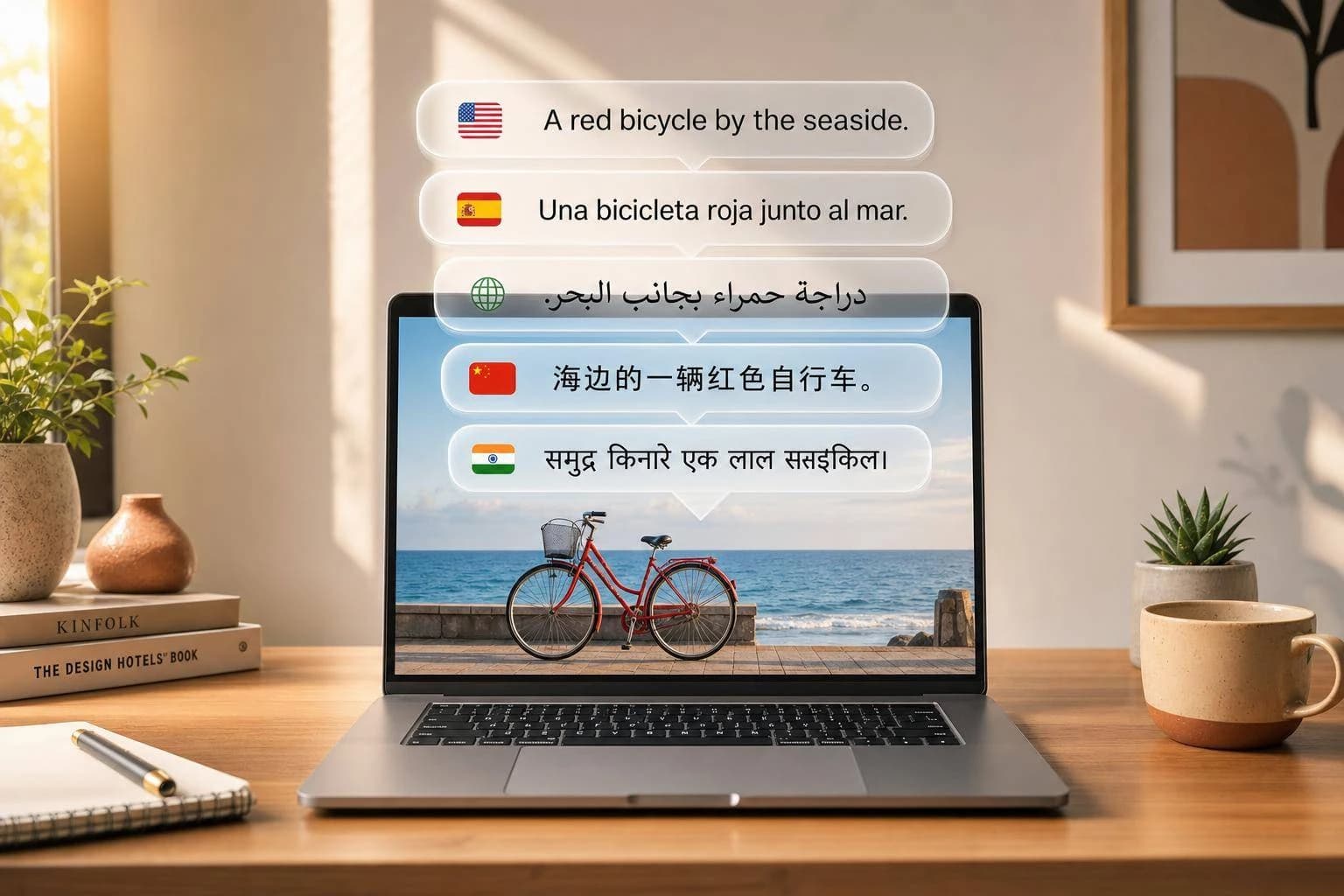
Creating multilingual image captions is more than just translating text - it requires AI to analyze images, understand their content, and generate accurate descriptions in various languages. This technology is essential for industries like e-commerce, media, and accessibility, but most tools still prioritize English, leaving a gap for global users. Here's what you need to know:
- Top Models: GPT-5 excels in detailed captions for high-resolution images, Claude ensures safety and accuracy for compliance-heavy industries, and Qwen-VL specializes in multilingual OCR and diverse scripts.
- Key Metrics: Evaluate models using CIDEr, BLEU@4, CLIPScore, and CE Loss for language quality, visual understanding, and cost-effectiveness.
- Cost and Speed: Open-source models like CapFlow-72B can lower costs significantly for large-scale projects, while platforms like APIMart simplify access to over 500 models.
- Specialized Tools: Models like InternVL handle technical images, and Llama Vision offers customizable solutions for privacy-focused industries.
Quick Tip: Use tiered workflows to match tasks with the right model - lightweight models for simple tasks and advanced ones for complex captions. Platforms like APIMart make this process seamless, saving time and resources.
For businesses, choosing the right model depends on your task, budget, and language needs. Dive into the details to find the best fit for your multilingual captioning goals.
Automated Image Captioning with LLMs - Recognize Anything, BLIP-2, and Kosmos-2
How to Evaluate Multilingual Image Captioning Models
When it comes to multilingual image captioning, evaluating models involves looking at their performance across three key areas: language, vision, and cost. The best model for you will depend on your specific needs, but the criteria below can help guide your decision-making.
Language Coverage and Caption Quality
Start by examining how many languages the model supports and how well it performs in each one. A model might claim to support 30 languages, but that doesn’t guarantee it produces fluent captions across all of them. High-resource languages like English, Spanish, and German often see better performance, while results for lower-resource languages might lag behind.
The source of the training data matters too. Many multilingual datasets rely on automatic translations of English captions rather than collecting original descriptions for each language. This approach has its limitations. As Emiel van Miltenburg from Tilburg University explains:
"Many datasets have been created through (automatic) translation of English captions... The downside, of course, is that these datasets still capture a Western perspective." [3]
For U.S.-based teams aiming to reach global audiences, models trained on native captions are better at capturing cultural nuances. To evaluate this, the Crossmodal-3600 (XM3600) benchmark is a strong option. It includes 3,600 images with human-generated captions in 36 languages, offering a more balanced test compared to English-dominated datasets [3][5].
Visual Understanding and Caption Detail
Language support alone isn’t enough - visual comprehension is just as important. A model might support many languages but still fail to generate meaningful captions if it struggles to interpret the visual content. The big question is whether the model can describe the image accurately or if it defaults to generic, vague descriptions.
To measure caption quality, several metrics are commonly used:
- CIDEr: Evaluates how similar the generated captions are to human-written ones.
- BLEU@4: Focuses on fluency and overlapping n-grams with reference captions.
- CLIPScore: Assesses how well the generated text aligns with the image itself, regardless of reference captions.
- CE Loss: Indicates how well the model generalizes, especially for less common languages.
| Metric | What It Measures |
|---|---|
| CIDEr | Alignment with human-written reference captions |
| BLEU@4 | Fluency and n-gram overlap with reference captions |
| CLIPScore | Text-to-image alignment, independent of references |
| CE Loss | Generalization ability, particularly for unseen data |
Keep in mind that these metrics depend on the quality of the reference captions they’re compared against. For example, CIDEr works best with human-generated "gold" references but loses reliability when tested against machine-translated "silver" references [5].
Speed, Scale, and Cost
For large-scale projects - like tagging thousands of e-commerce images or media assets - speed and cost become critical factors. Even the most accurate model can be impractical if it’s too slow or expensive to run at scale.
Studies show that using open-source models in multi-agent workflows can cut inference costs significantly. For instance, CapFlow-72B achieves an inference cost of just $0.14 per 100 samples, compared to $1.56 for GPT-4.1-level commercial models. Despite this massive cost difference, their average caption quality scores are nearly identical (2.33 vs. 2.35) [6]. For high-volume tasks, savings like these are hard to overlook.
Platforms like APIMart simplify this process by offering access to over 500 models - including GPT-5, Claude, and Qwen-VL - through a single API. This flexibility allows teams to route tasks to the most cost-effective model without the hassle of rebuilding integrations every time they switch.
Top General-Purpose AI Models for Multilingual Image Captioning
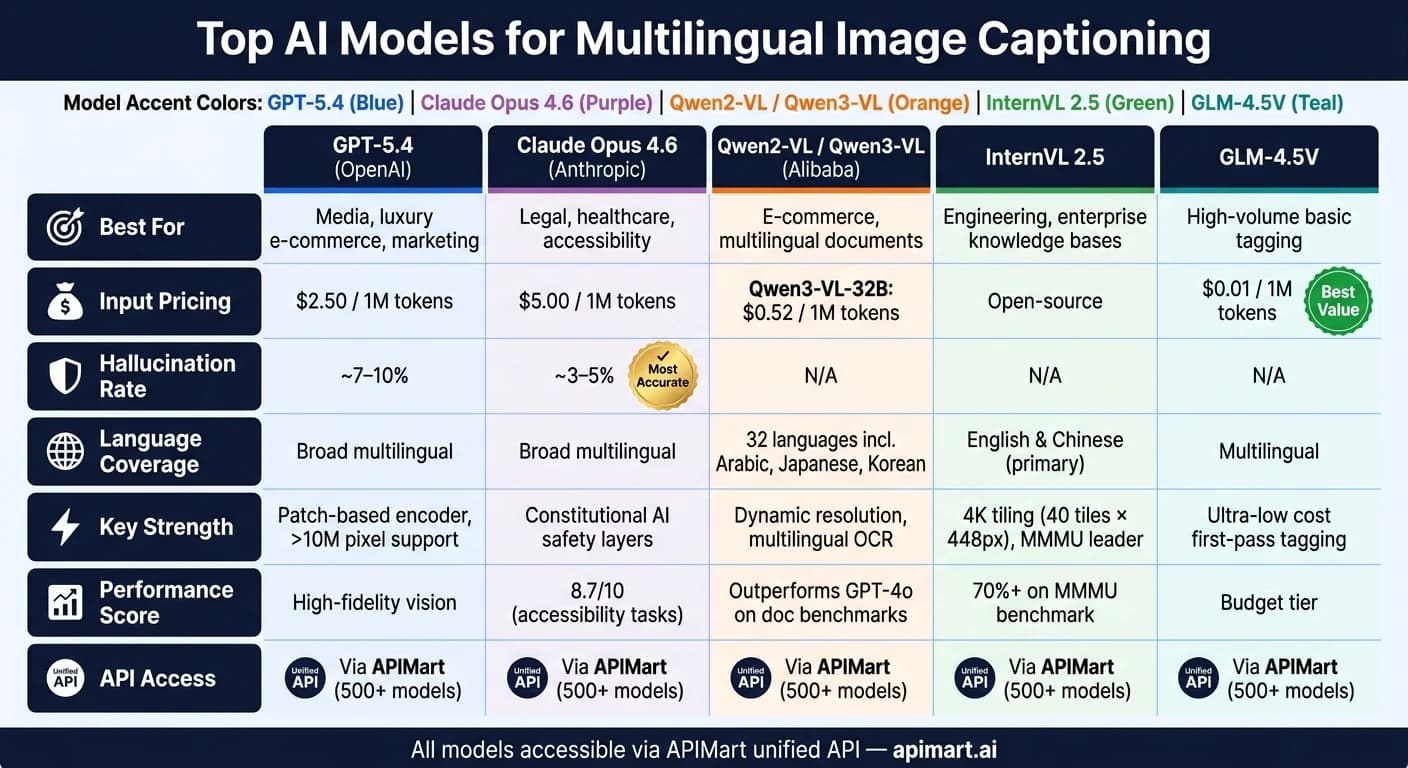
General-purpose multimodal models excel at combining visual and linguistic processing, making them versatile for various applications.
GPT-5 Vision Models
GPT-5.4 and GPT-5.5 are noteworthy for their ability to create detailed, localized captions. GPT-5.5 incorporates a patch-based vision encoder, which captures intricate details without losing quality during resizing [8].
"GPT-5.5 is OpenAI's latest multimodal flagship model, engineered for advanced reasoning and high-fidelity vision." - Timothy M, Roboflow [8]
GPT-5.4 can handle images with over 10 million pixels without compression [9]. This makes it especially useful for media publishing, premium e-commerce, and marketing, where precise and engaging captions can significantly impact audience interaction. The pricing for GPT-5.4 is $2.50 per 1M input tokens and $15.00 per 1M output tokens, with a context window of 1.05 million tokens [9]. Both models are available via APIMart, which offers access to over 500 other models as well.
While GPT-5 models focus on high-detail image processing, other models emphasize safety and contextual understanding.
Claude Multimodal Models
Claude models prioritize accuracy, consistency, and safety, making them ideal for environments where compliance and accessibility are critical.
Using a "Constitutional AI" framework, Claude applies safety-aware filtering to its generated captions [7]. This makes it an excellent choice for healthcare documentation, legal asset management, and accessibility tools, where precision is non-negotiable. Claude Opus 4.6 boasts a hallucination rate of 3–5% on factual visual queries, compared to the 7–10% range of similar models [9]. It also excels at handling complex tasks like reasoning across multi-page PDFs and interpreting image-embedded charts, where broader context is essential [9]. Pricing for Claude Opus 4.6 is $5.00 per 1M input tokens and $25.00 per 1M output tokens, with a 1 million token context window [9].
| Feature | GPT-5 Vision Models | Claude Multimodal Models |
|---|---|---|
| Primary Strength | High-detail visual recognition | Contextual reasoning & safety |
| Best For | Media, luxury e-commerce, marketing | Legal, healthcare, accessibility |
| Hallucination Rate | ~7–10% | ~3–5% |
| Input Pricing | $2.50/1M tokens (GPT-5.4) | $5.00/1M tokens (Opus 4.6) |
| Special Feature | Patch-based encoder with >10M pixel support | Constitutional AI safety layers |
| API Access | Via APIMart | Via APIMart |
Both GPT-5 and Claude models are accessible through APIMart, allowing users to integrate them seamlessly into workflows. You can even combine these models without needing to reconfigure your existing setup.
Specialized Vision-Language Models for Multilingual Captioning
Specialized vision-language models are designed to address the unique challenges of multilingual visual understanding. While general-purpose models like GPT-5 and Claude perform well across a wide range of tasks, these targeted models excel in handling intricate scripts, technical documents, and diverse languages. They fill the gaps where broader models might struggle, delivering precise results for specific applications.
Qwen-VL Models
Qwen-VL models (including Qwen2-VL and Qwen3-VL) are tailored for multilingual needs and various image types. These models support OCR in 32 languages, such as Arabic, Japanese, Korean, Vietnamese, and most European languages [13]. By using a Naive Dynamic Resolution method, Qwen-VL processes images of any size into adaptable visual tokens, ensuring no detail is lost. This flexibility makes it a strong choice for industries like e-commerce, where product catalogs and multilingual invoices require precise visual-text integration. Notably, the Qwen2-VL 72B model has outperformed competitors like GPT-4o and Claude 3.5 in document comprehension benchmarks [11].
"Qwen2-VL now supports the understanding of texts in different languages inside images, including most European languages, Japanese, Korean, Arabic, Vietnamese, etc." - Qwen Team [11]
Unlike Qwen-VL’s dynamic resolution approach, InternVL takes a different path with its tile-based method for maintaining visual detail.
InternVL
InternVL employs a high-resolution tiling approach, dividing images into as many as 40 tiles (each 448×448 pixels) to support resolutions up to 4K [12]. This method is particularly effective for technical diagrams, engineering blueprints, and dense charts where spatial clarity is critical.
At the heart of InternVL is the InternViT-6B model, a 6-billion-parameter vision encoder designed to rival larger language models in visual comprehension [10][12]. InternVL 2.5 stands out as the first open-source multimodal model to achieve over 70% on the MMMU benchmark [10]. Its bilingual focus on English and Chinese further enhances its utility for enterprise documentation and technical analysis.
"InternVL3.5-241B-A28B attains state-of-the-art results among open-source MLLMs across general multimodal, reasoning, text, and agentic tasks - narrowing the performance gap with leading commercial models like GPT-5." - InternVL Team [14]
For teams prioritizing open-source customization and data privacy, Llama-based models provide an appealing alternative.
Llama Vision Models
Llama-based vision models offer unmatched flexibility for organizations that require tailored solutions. Using frameworks like Llama-Factory, these models can be fine-tuned to meet specific multilingual captioning needs [11]. They are particularly suited for industries with strict data privacy regulations, as they allow full control over data and deployment.
| Model | Best For | Language Coverage | Key Strength |
|---|---|---|---|
| Qwen2-VL / Qwen3-VL | E-commerce, multilingual documents | 32 languages | Dynamic resolution, multilingual OCR |
| InternVL 2.5 | Engineering, enterprise knowledge bases | English & Chinese (primary) | 4K tiling, MMMU benchmark leader |
| Llama Vision | Custom deployments, regulated industries | Multilingual via LLM backbone | Open-source, fully customizable |
Building Multilingual Captioning Workflows with Unified APIs
Creating effective multilingual captioning workflows means bringing together top-tier AI models through a single API. By choosing the right models and integrating them into a seamless workflow, platforms like APIMart make it easier. APIMart gives you access to over 500 models, including GPT-5, Claude, and Qwen3-VL, all through one OpenAI-compatible endpoint. This eliminates the hassle of managing multiple API keys, rate limits, and billing accounts. Below, we’ll explore strategies for orchestrating models, crafting language-specific prompts, and ensuring top-notch output quality.
Model Orchestration Strategies
Using a unified API simplifies how you route tasks to different models. A tiered routing approach works well: assign high-volume, straightforward tasks like tagging or OCR to lightweight, cost-effective models, and reserve advanced models for complex inputs. For example, GLM-4.5V, priced at $0.01 per million output tokens, is ideal for basic product images. On the other hand, Qwen3-VL-32B, at $0.52 per million output tokens, excels in handling dense documents or supporting low-resource languages [2]. With APIMart, you can dynamically select models based on factors like language, image complexity, or budget without switching SDKs.
Prompt Design for Multilingual Outputs
The way you structure prompts has a direct impact on the quality of captions across different languages. For languages where a model has less training data, adding a language-specific prefix can unlock zero-shot capabilities. For instance, starting a prompt with "La photo montre" (French for "The photo shows") nudges the model to generate captions in French, even if no explicit language instructions are provided [1]. Beyond language accuracy, it’s also important to review captions for their cultural relevance.
Quality Checks and Evaluation Methods
Metrics such as CIDEr, BLEU, METEOR, and SPICE offer a scalable way to measure caption quality [1][4]. However, these metrics might miss nuances in non-English outputs. A more dependable method is Pivot-Language Stabilization (PLuGS). This involves generating an English caption first and then translating it into the target language. By doing so, you can use English-focused quality estimation tools to gauge the overall accuracy [4].
"The PLuGS approach appears to be best suited for leveraging an existing En QE model, due to the availability of the generated bilingual output that tends to maintain consistency between the generated EN- & X-language outputs." - Ashish V. Thapliyal and Radu Soricut, Google Research [4]
For critical content, automated evaluations should be paired with reviews by native speakers. Studies indicate that human reviewers achieve inter-rater agreement rates of 90% to 95% [4]. When building your test set, include challenging examples like low-light images, cluttered scenes, and screenshots with UI text. These edge cases often reveal real-world issues that polished benchmark images overlook [15].
Conclusion and Recommendations
Choose AI models that align with specific tasks for better results. For e-commerce workflows, Gemini 2.5 Flash scores an impressive 7.9/10 for performance, making it a solid choice [17]. If you're working with accessibility or educational content, Claude 3.5 Sonnet delivers high accuracy (8.7/10), though its outputs may require trimming to a concise 15–30 word range [17]. For teams focused on cost-effective, high-volume workflows, GLM-4.5V offers a budget-friendly option at just $0.01 per million output tokens for first-pass tagging. Meanwhile, Qwen3-VL-32B, priced at $0.52 per million tokens, is ideal for handling more complex or multilingual documents [2].
A tiered, modality-based routing strategy can help balance cost and precision. Assign lightweight models to straightforward classification tasks, and reserve advanced models like Claude Opus 4.6 or GPT-5.4 for handling intricate image-based content - all while maintaining high-quality standards.
"In 2026, the best AI image understanding model is usually the one that matches your task, output format, operating constraints, and review process."
- Digital Vision Editorial [15]
Multilingual models also prove their worth without compromising English performance.
"Multilingual models, trained on equally sized datasets, perform just as well as English-only models on English assessments, while also excelling across various evaluation tasks that involve multilingual and multicultural data."
- Gonçalo Gomes, Researcher, University of Lisbon [16]
These findings highlight the importance of tailoring AI model selection to the specific requirements of your tasks.
For teams managing global captioning pipelines, APIMart simplifies workflows by offering access to over 500 models. Whether you're creating captions for a global e-commerce catalog or scaling up accessible alt text production, combining smart model routing, language-prefix prompting, and automated quality checks through PLuGS ensures reliable, cost-efficient results. This streamlined approach supports large-scale captioning needs without sacrificing quality or budget.
FAQs
Which model should I use for my target languages?
Models such as CLIP Vision + mBART-50 or Meta’s NLLB-200 are strong options for multilingual image captioning tasks. These models excel in supporting multiple languages, with NLLB-200 offering coverage for over 200 languages. Additionally, fine-tuned multilingual CLIP models, especially those trained on diverse datasets, show impressive performance, particularly with low-resource languages. By combining vision encoders with multilingual language models, these systems often achieve optimal results when designed to handle a wide range of languages effectively.
How can I reduce hallucinations in image captions?
To make AI-generated image captions more accurate, it's essential to anchor the outputs in reliable data. One effective approach is Retrieval-Augmented Generation (RAG). This method integrates trustworthy sources into the process, allowing the AI to pull in verified information before creating captions.
Other helpful strategies include:
- Pre-answer checks: These ensure the AI evaluates the context and data before generating a response.
- Structured templates: Using predefined formats can guide the model to produce accurate and consistent captions.
- Clear refusal conditions: This involves programming the AI to decline generating a caption if it lacks sufficient information.
By combining these techniques, the process becomes more controlled, reducing errors and ensuring that captions are grounded in factual information.
Should I caption directly in the target language or use English first?
When creating captions, it's often a good idea to start by generating them in English and then translating them into the desired language. This method typically leads to higher quality and consistency because multilingual datasets are limited, while translation tools like GPT-4 and NLLB-200 are highly effective.