
How Multi-Modal AI Enhances Video Compression
See how multi-modal AI reshapes video compression—using text, audio, motion, and intent signals to cut bitrate hard while keeping the details that matter most.
Video compression is shifting from pixel matching to meaning-based decisions. From the research in this article, my main takeaway is simple: when AI uses text, audio, motion, or user intent alongside video, it can cut bitrate harder while keeping the parts that matter most.
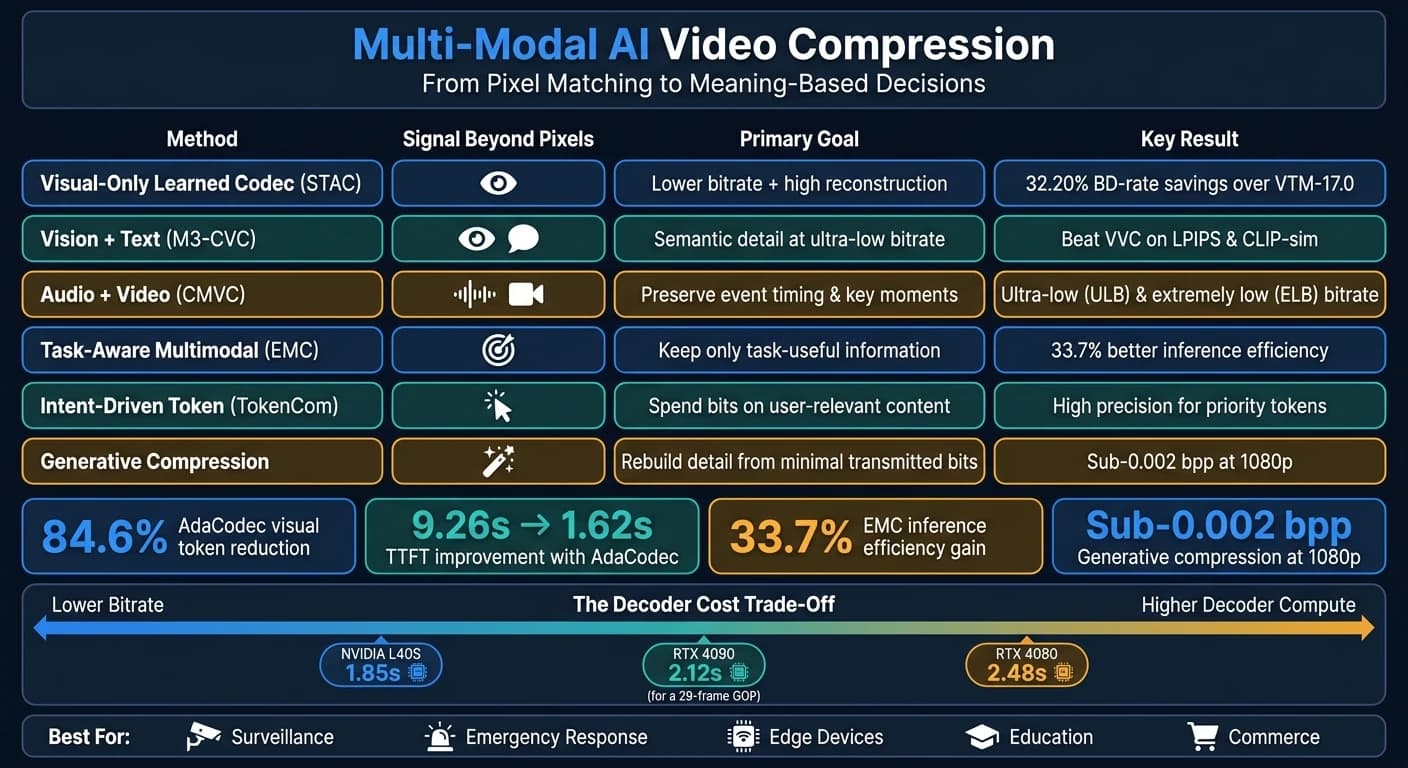
Here’s the short version:
- Visual-only learned codecs are already strong. STAC posted 32.20% BD-rate savings over VTM-17.0.
- Multi-modal methods change bit allocation. They use scene meaning, timing, or task goals to decide what gets more bits.
- Token-based systems can cut load a lot. AdaCodec reduced visual token use by 84.6% and dropped TTFT from 9.26 seconds to 1.62 seconds.
- Task-focused compression can trim compute waste. EMC improved inference efficiency by 33.7% for video-language work.
- Generative methods can push bitrate very low. Recent results reached 0.005 bpp and even sub-0.002 bpp at 1080p.
- The trade-off is decoder cost. Lower transmission cost often means more GPU work at the receiving side, with decode times around 1.85 to 2.48 seconds for a 29-frame GOP on consumer and prosumer GPUs.
What this means for you: if your goal is streaming or storage, pixel quality still matters. But if your goal is surveillance, edge AI, emergency response, education, or commerce, then semantic and task-aware compression may matter more than perfect frame reconstruction.
Understanding Is Compression: LLM Models Crush All Currently Known Compression Methods
Quick Comparison
| Method | Main input beyond pixels | Main goal | Example result |
|---|---|---|---|
| Visual-only learned codec | None | Lower bitrate with high reconstruction quality | STAC: 32.20% BD-rate savings |
| Vision + text | Multimodal conversations using text descriptions of scene content | Keep semantic detail at ultra-low bitrate | M3-CVC beat VVC on LPIPS and CLIP-sim |
| Audio + video | Audio timing and event cues | Keep event timing and key moments | CMVC targets ultra-low and extremely low bitrate settings |
| Task-aware multimodal compression | Downstream task signals | Keep only task-useful information | EMC: 33.7% better inference efficiency |
| Intent-driven token compression | User instructions or token priority | Spend bits on what the user cares about | TokenCom keeps high precision for high-priority tokens |
| Generative compression | Compact latents plus decoder priors | Rebuild detail from very few transmitted bits | As low as sub-0.002 bpp at 1080p |
So if I strip the article down to one point, it’s this: multi-modal AI helps codecs decide what matters, not just what changed. That is where a lot of the current progress is coming from.
What Recent Studies Show About Multi-Modal Compression
Visual-Only Learned Codecs as the Baseline
The STAC framework (Spatio-Temporal Adaptive Context) gives a clear picture of where visual-only learned codecs stand right now. It delivered a 32.20% average BD-rate saving over VTM-17.0 (VVC) [2], and it beat the earlier state-of-the-art model, DCMVC, by 2.7 percentage points. STAC does this with an Adaptive Context Selector that chooses the most useful reference frames, plus a dual-path entropy model that improves prediction [2].
That leads to better pixel-level fidelity. But there’s a catch: STAC still works without semantic context. So it sets a strong baseline for visual compression, while also making the next step pretty obvious. If a model can understand scene meaning, it may place bits where they matter most instead of treating every region like it deserves the same attention.
How Semantic and Cross-Modal Signals Change Encoder Decisions
The main idea behind recent multi-modal work is simple: not every part of a frame needs the same number of bits. Once an encoder has some sense of what’s happening in the scene, it can spend more on important regions and be more aggressive everywhere else.
AdaCodec from Shanghai Jiao Tong University and JD.com is a good example. It stores frame-to-frame changes as P-tokens and keeps full visual tokens for reference frames [3]. That setup cut visual token use by 84.6% and reduced time to first token (TTFT) from 9.26 seconds to 1.62 seconds [3]. It also outperformed the Qwen3-VL-8B baseline on long-video benchmarks while using only about one-seventh of the token budget [3].
Another path focuses less on reconstructing pixels and more on keeping only what the end task needs. Endomorphic Multimodal Compression (EMC) follows that idea by preserving just the information needed for tasks like VideoQA. Put plainly, it applies compression logic to semantic evidence instead of raw pixels. When EMC was integrated, it improved inference efficiency by 33.7% and training efficiency by 7.33% for video-language understanding [4].
So the split is becoming clearer. Visual-only codecs chase fidelity. Multi-modal methods push toward semantic consistency and task-aware token use.
Where APIMart Fits for Prototyping and Deployment

For teams building and testing these cross-modal pipelines, APIMart can make the early work less messy. It offers a single API for trying video, image, and language models together, which helps when you want to test how cross-modal signals change frame selection and reconstruction.
Three Multi-Modal Signals That Improve Compression
The previous section showed, at a high level, how semantic and cross-modal signals change encoder choices. Across all three directions here, the pattern is pretty clear: semantic awareness changes where bits go, audio-visual timing sharpens what stays, and token-level intent narrows the process even more.
Semantic-Aware Compression Using Vision and Text Signals
These methods show how text and vision can steer bitrate toward semantic content. If an encoder knows what matters in a scene, it can send more bits to important regions and compress everything else harder.
M3-CVC (Fudan University, December 2024) uses a dialogue-based large multimodal model to pull hierarchical text descriptions from frames. It then uses those descriptions to guide a diffusion-based decoder during reconstruction at ultra-low bitrates. The result: it beats VVC by a clear margin on LPIPS and CLIP-sim, even in cases where VVC shows heavy blocking artifacts [1].
SMC++ (Shanghai Jiao Tong University and Shanghai AI Laboratory, October 2025) cuts detail that costs bits but does not help the downstream task. It does this with a Masked Video Modeling objective, while a guided Transformer lines up features across modalities. Across 7 datasets and 3 tasks - action recognition, MOT, and VOS - SMC++ kept task accuracy high even when the base VVC layer had severe signal degradation [6].
The same idea carries into time-based signals too. Instead of asking only what matters in the frame, these systems also ask when does it matter.
Audio-Aware Compression for Speech and Event Timing
Audio-visual timing and event structure help models choose representative keyframes and motion segments. That lowers bitrate without throwing off event timing [5]. In Cross-Modality Video Coding (CMVC), videos are split into spatial content and motion components, then turned into compact multimodal representations [5].
"MLLMs excel at handling sequential data and understanding the temporal relationships of events in videos." - Pingping Zhang et al. [5]
| Approach | Bitrate Target | Quality Metric Focus | Key Technology |
|---|---|---|---|
| TT2V (CMVC) | Ultra-Low (ULB) | Semantic Consistency | Text-to-Video Generation [5] |
| IT2V (CMVC) | Extremely Low (ELB) | Perceptual Consistency | Image-Text-to-Video + LoRA [5] |
That shifts compression from frame-by-frame storage toward event-aware representation. And from there, the next step is even tighter: compressing based on direct user intent.
Token-Driven Compression for User Intent
Video TokenCom gives full precision to intent-relevant tokens and lowers precision for lower-priority ones. In plain English, the system spends bits on what the user cares about and eases off everywhere else, which cuts bitrate while keeping the most important content intact [7].
"Token Communication (TokenCom) is a new paradigm... where tokens serve as unified units of communication and computation, enabling efficient semantic- and goal-oriented information exchange." - Jingxuan Men et al. [7]
| Encoding Approach | Bitrate Behavior | Detail Preservation | Best Use Case |
|---|---|---|---|
| Uniform encoding | Constant across the frame | Even detail distribution | Baseline video delivery |
| Semantic intent-guided TokenCom | Lower for lower-priority tokens | Higher detail for intent-relevant content | User-guided video compression |
Instead of treating every part of a frame the same, this approach makes compression goal-aware and selective [7].
Generative Compression and Real-Time Deployment Trade-Offs
How Generative and Token-Based Methods Reduce Bitrate
Building on token-level compression, generative methods push things further. Instead of keeping every pixel, they rebuild visual detail at the decoder. In practice, generative compression sends a compact latent representation, then uses generative priors to fill in what wasn't transmitted.
That shift can slash bitrate. TeleAI's mid-2025 maritime-satellite demo hit 0.005 bpp, and Waseda's April 2026 zero-shot GVCC delivered sub-0.002 bpp 1080p reconstruction while reducing LPIPS by 70.3% versus DCVC-RT [9] [10].
Token-based compression takes another path. Tokenized Video Compression (TVC) uses masked tokens and spatiotemporal prediction to make use of semantic redundancy across frames [8].
Real-Time Constraints: Compute, Latency, and Cost
Those bitrate cuts only matter if decoding stays fast enough for production. That's where the trade-off shows up in plain terms: as bitrate goes down, more of the burden moves from transmission to inference. So the decoder has to run large models in real time.
The numbers make that clear. On an NVIDIA L40S, RTX 4090, and RTX 4080, GVC decoding for a 29-frame GOP takes 1.85 seconds, 2.12 seconds, and 2.48 seconds [9].
This is the compression-computation-quality trade-off. Put simply, you save bandwidth, but you pay for it with more decoding work. That’s why distillation and faster sampling are the main routes toward consumer-grade deployment [9].
Using APIMart to Test Multi-Modal Video Workflows
For prototyping, APIMart can tie semantic extraction, reconstruction, and evaluation into one workflow. Teams can use it to chain video, image, and language models through a single API for semantic extraction, reconstruction, and latency testing.
If you're trying to see how a multi-modal video pipeline behaves before full deployment, that's a practical way to test the moving parts in one place.
Conclusion: What Multi-Modal AI Changes for Video Compression
Multi-modal AI changes video compression in a simple but important way: it moves the goal from matching pixels to keeping what matters for the job. Semantic signals, audio cues, and gaze data help the system spend bits on the parts that carry the most meaning. The result is better compression because the codec protects the information that people or downstream systems actually need. This shift is central to how unified AI platforms manage diverse model outputs.
You can see that change in both visual quality and token use. The benchmark results back it up. STAC reached a 32.20% BD-rate saving over VTM-17.0 [2], while AdaCodec cut visual token use by 84.6% and kept or improved accuracy [3].
That’s why generative compression makes the most sense when you think of it as task-oriented communication [9].
Where does that matter first? The near-term gains are strongest in bandwidth-constrained, task-sensitive settings, including:
- surveillance
- emergency response
- edge devices
- education
- commerce
The main trade-off is still decoder cost. Decoder compute remains the bottleneck, even so, smaller generative models are already getting close to about 2-second inference on consumer GPUs [9].
FAQs
How is multi-modal compression different from regular video compression?
Video compression usually tries to keep as much pixel detail as possible in every frame. Multi-modal compression takes a different path. It focuses more on the information needed for downstream goals or perceptual quality than on reproducing every single pixel.
With generative models, it swaps bandwidth for computation. The sender describes a video’s composition and style, and AI on the receiving end rebuilds it from that description.
When should I choose semantic compression over pixel-perfect quality?
Choose semantic compression when the goal is to help downstream tasks or match what people need to see, not to keep bit-level accuracy.
It works especially well in low-bandwidth settings, like satellite connections, where pixel-accurate codecs can break down or produce harsh artifacts. Semantic methods swap compute for compression by keeping task-relevant information instead of using bits on redundant background textures.
What are the biggest trade-offs with generative video compression?
The main trade-off is a shift away from strict pixel-by-pixel accuracy and toward semantic and perceptual quality.
Old-school codecs try to cut pixel error. But when bandwidth gets tight, that approach often falls apart in ways viewers can spot right away: blocking, blur, and temporal flicker.
Generative compression takes a different path. It leans on strong priors to synthesize high-quality detail and push compression much further.
The catch is simple: the rebuilt video may look convincing and high quality, even when it doesn't match the original frame pixel for pixel. In other words, it tends to favor visual plausibility over exact replication.
Choose the model you want in the model marketplace
Try chat, image and video models in the APIMart model marketplace, and experience model capabilities quickly with one unified API.