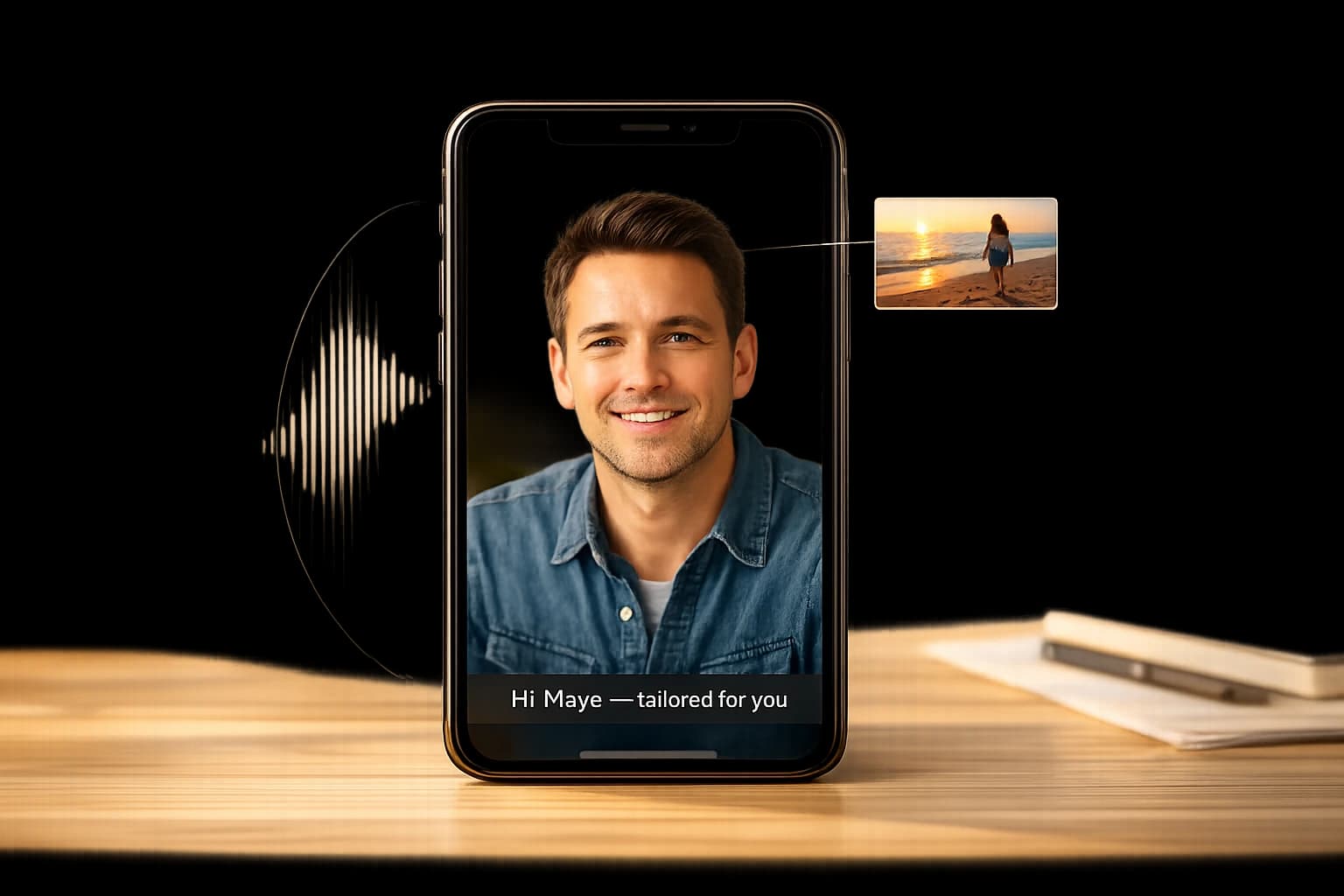
Multi-Modal AI Video Personalization Uses
Explore multi-modal AI video personalization use cases, including dynamic ads, shoppable video, education, real-time rendering, privacy controls, and workflows.
Multi-modal AI is transforming how videos are personalized, making them more tailored and engaging for individual viewers. By combining data from text, images, audio, and video, this technology enables the creation of highly customized content at scale. Here’s what you need to know:
- What is Multi-Modal AI? It processes multiple data types (e.g., text, images, video) to create unified, intent-driven outputs.
- What is Video Personalization? It uses user data to tailor video content, like inserting names, preferences, or locations seamlessly into videos.
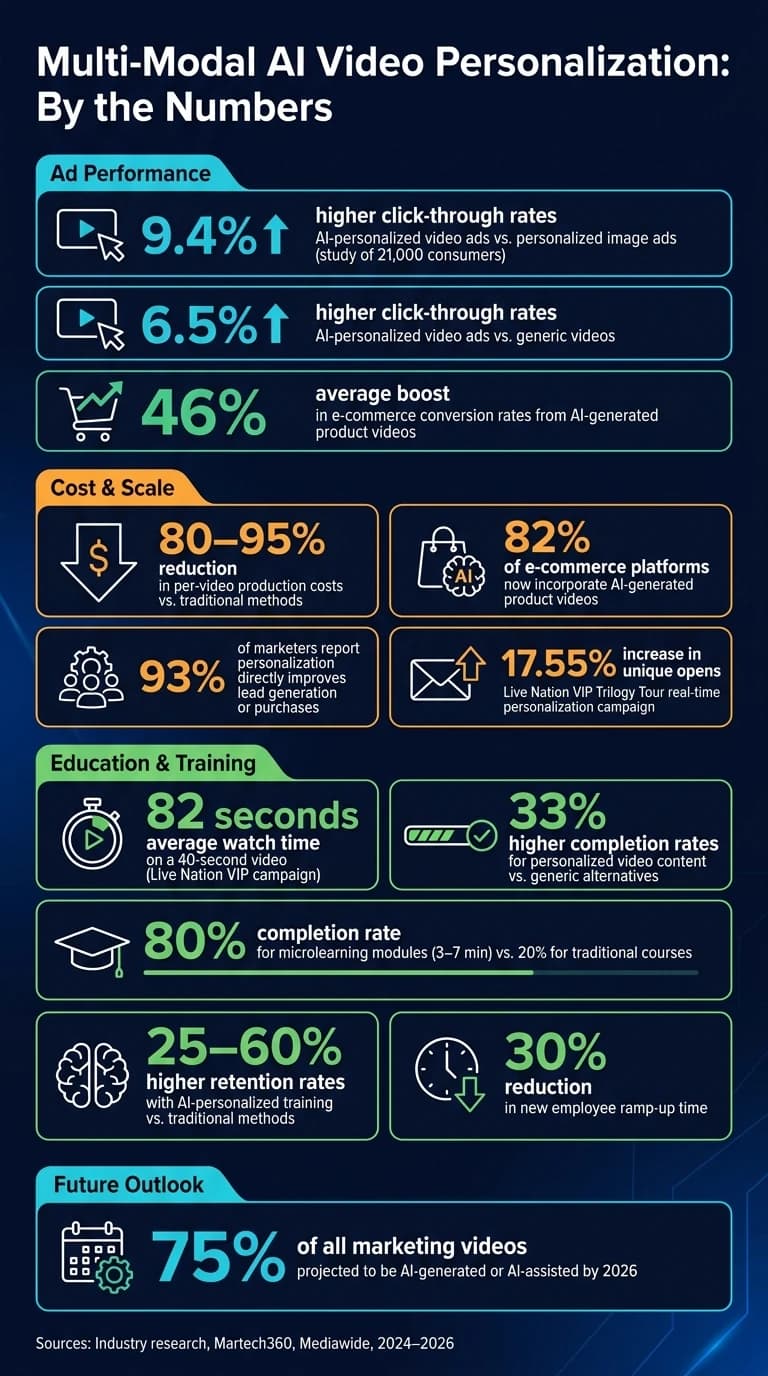
- Why it Matters: Multi-modal AI reduces production time and costs while improving engagement. For instance, personalized video ads deliver 9.4% higher click-through rates than image-based ads.
- Key Applications: Marketing campaigns, dynamic ads, shoppable videos, and education benefit from this technology, allowing for real-time customization and better user experiences.
The future of video personalization lies in creating dynamic, interactive content that adjusts to viewers' behaviors and preferences in real-time.
How Multi-Modal AI Powers Video Personalization
Core Concepts and Architectures
Multi-modal AI systems are built on four distinct layers, each playing a crucial role in delivering personalized video experiences.
- Data Integration Layer: This layer connects to platforms like Salesforce or HubSpot via APIs, pulling in key personalization signals such as purchase history and browsing habits.
- Creative Template Engine: It houses the master video, which includes dynamic zones - these are placeholders that adapt content based on specific conditions. For example, a VIP background might appear for Gold Members.
- Generative AI Module: This handles complex tasks like voice cloning, text-to-speech, lip-syncing, and creating images.
- Rendering Pipeline: Using distributed cloud GPU clusters, this layer can generate thousands of unique videos at the same time [1].
To improve precision, the system aligns data types through a cross-attention mechanism. This matches video latents (internal frame representations) with combined text and image tokens. Text anchors like "[R1]" and "[R2]" link reference images to specific concepts, ensuring identities remain distinct and accurate [6].
Using Data to Drive Personalization
By tapping into user signals and CRM data, the system customizes video content to suit individual viewers. Privacy remains a top priority, especially with regulations like CCPA in the U.S. To address this, many systems are shifting to zero-party data strategies. This approach relies on users voluntarily sharing their preferences, ensuring compliance while maintaining relevance [5]. These data insights enable on-demand personalization that feels immediate and tailored.
Real-Time Personalization Pipelines
Modern personalization pipelines use MP5 technology, a client-side rendering method. Here’s how it works: the video assembles on the viewer’s device in real time, using live data pulled through a URL. This approach eliminates the need for heavy storage and computational overhead while still delivering a unique experience for every viewer [7].
The impact of this technology is clear in real-world applications. For instance, in May 2026, Live Nation VIP used real-time, tier- and language-matched personalization during the Trilogy Tour. The results? A 17.55% increase in unique opens and an average watch time of 82 seconds on a 40-second video [7].
Personalize Audience Experiences with Multimodal Generative AI
Multi-Modal AI Use Cases in Marketing
Multi-modal AI is reshaping marketing by creating highly tailored video experiences that go far beyond traditional personalization methods. By integrating real-time data pipelines with advanced AI capabilities, marketers can deliver content that feels uniquely crafted for each viewer.
Hyper-Personalized Product Explainer Videos
Gone are the days of one-size-fits-all explainer videos. Multi-modal AI allows marketers to create modular, behavior-aware videos that adapt to individual viewer preferences. Instead of producing separate videos for each audience segment, a single master video can include customizable elements like industry-specific intros, tailored product screenshots, and role-based calls-to-action (CTAs). These elements are dynamically inserted based on viewer data.
By connecting with CRM platforms like HubSpot or Salesforce, this approach can scale effortlessly. For instance, if a user downloads a cybersecurity report, the video can automatically open with a security-focused introduction. This kind of personalization transcends basic tactics like addressing viewers by name:
"The future is not one video going viral. It is one video system generating thousands of context-aware experiences automatically." - Tejas Tahmankar, Staff Writer, Martech360 [2]
However, the success of such personalization hinges on accurate and up-to-date data. If CRM records are incomplete or outdated, personalization efforts can fall flat. Clean and precise audience segmentation is a must-have, not an afterthought [2]. This same framework can also be applied to dynamic ad creation.
Dynamic Ad Creatives and Offers
Multi-modal AI simplifies ad production by automating the creation of ad variants tailored to diverse audiences. Modern systems dynamically assemble video ads, selecting the most relevant visuals, voiceovers, and CTAs based on real-time viewer data [2][1].
The results speak for themselves. A study involving 21,000 consumers found that AI-personalized video ads achieved click-through rates 9.4% higher than personalized image ads and 6.5% higher than generic videos. Additionally, AI-generated product videos have been shown to boost e-commerce conversion rates by an average of 46% [3][1]. Beyond improving engagement, these methods also cut costs significantly, with businesses reporting an 80–95% reduction in per-video production costs compared to traditional methods [1].
The real magic lies in the logic layer. For example, if a viewer visits a pricing page twice in one week, the AI can automatically adjust the ad’s CTA from an awareness message to a direct "Book a Demo" prompt. Platforms like APIMart make this possible by offering access to over 500 AI models through a single API. This allows businesses to allocate resources efficiently - using cost-effective models for routine tasks while reserving premium ones for high-priority creative work.
Interactive Shoppable Video Experiences
Multi-modal AI also enables videos that don't just inform but actively drive purchases. These videos include clickable hotspots and embedded CTAs, such as product tours, add-to-cart buttons, or demo booking links, allowing viewers to act without leaving the video [2][1].
The personalization aspect takes this to the next level. By leveraging CRM data like purchase history or cart abandonment signals, the AI determines which products to feature for each viewer. For example, someone interested in running shoes might see an entirely different set of products than a viewer exploring hiking gear. This approach explains why 82% of e-commerce platforms now incorporate AI-generated product videos [1] and why 93% of marketers report that personalization directly improves lead generation or purchases [2].
"Interactive CTAs... turn passive viewers into active buyers without forcing them through extra friction." - Martech360 [2]
For teams creating these experiences, linking behavioral triggers - such as a second visit to a pricing page or an abandoned cart - to the video personalization engine is a straightforward way to achieve measurable increases in conversions [2].
Multi-Modal AI Use Cases in Education and Training
The same technology powering personalized marketing videos is reshaping education. This evolution is making learning materials more efficient and tailored to individual needs.
Adaptive Learning Videos by Skill Level
Multi-modal AI leverages dynamic scene selection and branching logic to customize educational content in real time, based on a learner's existing knowledge. Instructional designers can create a single master video with modular "dynamic zones" that adjust visuals, voiceovers, or examples depending on the learner's data [1][2]. Studies show that personalized video content boosts completion rates by 33% compared to generic alternatives [8]. To ensure reliability, these systems include fallback logic - so if a data source or AI model fails, a high-quality default scene is delivered instead [1].
This ability to adapt content by skill level is also transforming corporate training.
Personalized Microlearning for Corporate Training
Microlearning - short modules lasting 3 to 7 minutes - has proven to achieve an 80% completion rate, far surpassing the 20% rate of traditional courses [10]. Multi-modal AI makes it easier to produce and update these modules at scale. The real game-changer is role-specific customization, where content is tailored for different audiences, such as senior managers versus new hires. AI can swap visuals, adjust pacing, and localize case studies to align with regional contexts [10][11].
When regulations change or products are updated, only the relevant module needs to be revised, saving time and resources. This approach has led to retention rates 25% to 60% higher than traditional training methods and a 30% reduction in the time it takes new employees to become productive [10]. Tools like APIMart simplify this process by offering access to over 500 AI models for scriptwriting, narration, and video production.
Accessibility-Focused Learning Videos
Accessibility is a critical part of effective education. Multi-modal AI can create audio descriptions for visuals, narrating elements like charts, diagrams, and animations for visually impaired learners [12]. It can also adjust voiceover tone, accent, and pace to match individual comprehension needs [12]. For example, selective animation tools can reduce cognitive load by animating only relevant parts of a diagram - such as the flow of electrons in a circuit - while keeping other elements static [13]. As Artoon Solutions explains:
"AI makes audio-visual content accessible by default." [12]
AI also supports multi-language captions, culturally relevant visuals, and simplified language tracks, enabling a single video to effectively reach a diverse, global audience [9][8].
Building Multi-Modal Video Personalization with Unified APIs
In the past, integrating various tools meant juggling multiple vendor contracts and spending months on engineering work. Today, unified APIs simplify this process by offering a single integration point for hundreds of models. This shift lets teams focus on crafting personalization strategies instead of dealing with complex technical setups.
Orchestrating Multi-Modal Models
Unified APIs streamline what used to be a four-layer pipeline - data integration, creative templating, generative synthesis, and high-concurrency rendering - into a single, cohesive workflow. Tools like APIMart make this possible by offering centralized access to a wide variety of models. This allows you to handle tasks ranging from high-resolution branding to multilingual video production with ease.
Selecting the right model for each task is key. For example:
- High-resolution branding might require advanced models like Sora 2 Pro or Kling V3.
- Multilingual ad production benefits from models with native lip-sync capabilities.
- Cost-efficient models help maintain scalability without overspending.
With access to over 500 models through a single API, platforms like APIMart make it easier to match the right tool to the job, ensuring efficient and high-quality results.
Optimizing Data Pipelines for Real-Time Personalization
Once model orchestration is simplified, the next hurdle is managing real-time data flows with minimal latency. The industry is shifting from relying on pre-rendered video libraries to assembling videos dynamically using live viewer data - a significant architectural leap [2]. To support this, your data pipeline needs to provide fast access to user signals alongside a well-organized, tagged content library.
AI-powered tagging in Media Asset Management (MAM) systems and pre-render validation are critical here. These tools ensure that personalized videos are rendered accurately and consistently [4][1]. As Chrissy Clark, Media Workflow Manager at Tubescience, explains:
"We can pull the data from the data team and cross-reference it in our MAM system, which is amazing." [4]
Once your data flows are optimized, the next step is ensuring that the content meets quality and safety standards.
Content Safety and Quality Evaluation
When working at scale, AI outputs can sometimes stray, leading to minor inconsistencies in visuals or tone. For high-profile accounts, incorporating human-in-the-loop (HITL) quality checks is essential [2]. While automation works well for high-volume campaigns, manual oversight is crucial for catching errors that could harm brand trust.
Fallback mechanisms are another must-have. If a model becomes unresponsive or a data source fails, the system should default to a polished, pre-approved video rather than delivering a broken result [1].
On the privacy side, many platforms are adopting zero-knowledge principles, where sensitive user data is resolved only on the viewer’s device during playback and never stored on the platform’s servers [7]. This ensures compliance with data privacy regulations while still enabling personalized, context-aware experiences.
The Future of Video Personalization with Multi-Modal AI
Video content is shifting from being a one-way broadcast to becoming a dynamic, interactive experience. Glenn Bailey, a Personalized Video Platform Expert at Mediawide, captures this transformation perfectly:
"Personalization transforms video from a broadcast medium into a dialogue medium." [15]
This shift is fueled by advancements in multi-modal AI frameworks and dynamic personalization pipelines. By 2026, projections suggest that 75% of all marketing videos will either be AI-generated or AI-assisted [14]. And personalization is evolving far beyond simply adding a viewer's name to a video. The next frontier involves creating content that adjusts to real-time viewer behavior. Imagine a video that changes its storyline based on whether someone is browsing a specific product or has left items in their cart [2]. Fast forward to 2028, and videos are expected to adapt mid-stream, responding to gestures, voice commands, or even where the viewer's gaze lands [5].
These advancements rely heavily on real-time personalization pipelines. For marketers, this means a shift toward individualized content. Instead of targeting broad demographic groups, AI systems will use CRM data to craft unique narratives for each viewer. This approach is already proving its worth, driving higher click-through rates and conversions [3].
Template-driven production is at the core of these innovations. Instead of creating separate videos for different audiences, teams now design master templates with dynamic zones. AI fills these zones with personalized data points during rendering [1][2]. This method not only slashes production costs but also maintains high-quality output. Platforms like APIMart make this process even easier by offering access to over 500 AI models through a single API. Tasks like multilingual lip-syncing, high-resolution branding, and rapid prototyping can be routed to the right model seamlessly.
The businesses that succeed in this new era will treat personalization as a tool to provide genuine value. Whether it's showcasing a product that complements a viewer's previous purchase or adjusting the difficulty of a training video based on quiz results, personalization works best when it enhances the user experience rather than feeling invasive.
FAQs
What data is needed to personalize videos effectively?
To create videos that feel personal and tailored, start by collecting viewer or customer data. This data helps you segment your audience and include dynamic elements like industry, intent, role, language, company name, or even details from past interactions (like downloads or webinar attendance).
Leverage CRM systems or data enrichment tools to gather and organize this information effectively. Be sure to account for instances where data might be missing by planning fallback options to avoid gaps in personalization.
Consistency is key, so ensure all formatting is clean and uniform - like using proper name casing. Additionally, have reference assets ready, such as brand logos, images, or even optional audio samples, to keep the creative style cohesive throughout your videos.
How does real-time client-side video rendering work?
Real-time client-side rendering swaps out the old approach of pre-rendered videos with a Dynamic Master Template. This template outlines the structure of scenes, text placeholders, and data variables. When someone views the video, their device processes the template on the spot, fetching personalized details like names or offers through a live URL. This approach makes it possible to deliver personalized, high-quality videos at scale without generating countless files, cutting down on both delays and the expenses tied to manual rendering.
How can I personalize videos while staying compliant with privacy laws?
To create personalized videos while adhering to privacy laws, it's crucial to focus on transparency and rely on consent-based, first-party data. Striking the right balance between personalization and maintaining customer trust ensures your efforts don't feel intrusive.
Incorporate human oversight to review video content before it goes live, ensuring it aligns with both privacy standards and ethical practices. Additionally, stay updated on regulations like FCC mandates that require AI-generated content to be clearly disclosed. Taking these steps helps protect your brand's reputation while respecting users' privacy.
Choose the model you want in the model marketplace
Try chat, image and video models in the APIMart model marketplace, and experience model capabilities quickly with one unified API.