Wan 2.6 vs Kling: Best Chinese AI Video Model?
Compare Wan 2.6 and Kling, the two leading Chinese AI video models, on quality, motion, audio, speed, and pricing — and find which best fits your project.
When choosing between Wan 2.6 and Kling, it all boils down to your project's needs:
- Wan 2.6 (by Alibaba Cloud) is ideal for storytelling and structured narratives. It offers tools like multi-shot generation, consistent character portrayal, and precise lip-syncing with voice cloning. It works best for ads, e-learning, or any content requiring character stability and narrative depth.
- Kling (by Kuaishou) focuses on cinematic realism, smooth motion, and integrated audio. It's perfect for dynamic, visually stunning clips like social media videos or cinematic ads, where lifelike physics and seamless sound are key.
Quick Comparison
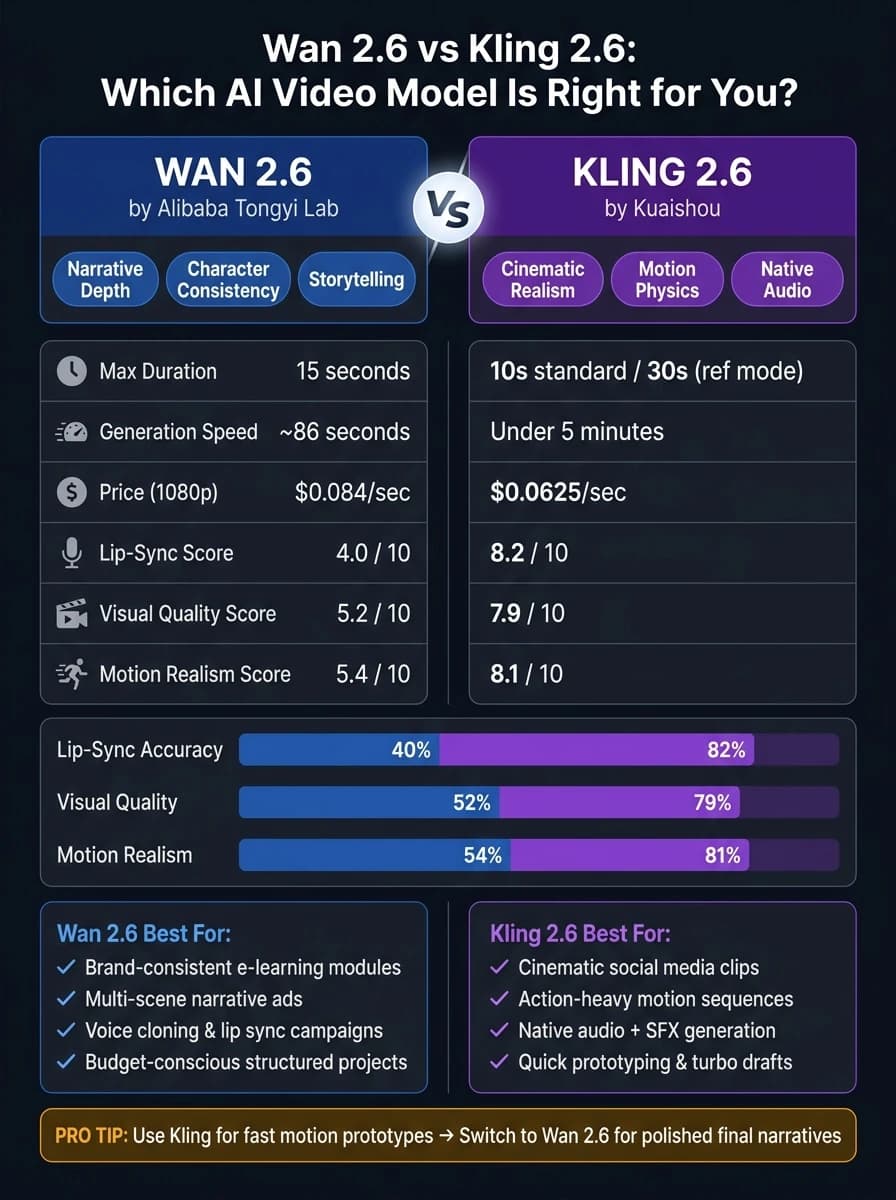
| Feature | Wan 2.6 | Kling 2.6 |
|---|---|---|
| Core Focus | Narrative depth & control | Cinematic motion & realism |
| Max Duration | 15 seconds | 10 seconds (30 with ref) |
| Audio Support | Voice cloning & lip sync | Native audio (voice, SFX) |
| Generation Speed | ~86 seconds | Under 5 minutes |
| Price (1080p) | $0.084/sec | $0.0625/sec |
Wan 2.6 is better for structured, multi-scene projects, while Kling excels in producing high-impact, visually realistic clips. If you need both, many creators use Kling for quick tests and Wan 2.6 for polished narratives.
Model Overview: Features and Capabilities
Wan 2.6 Key Features
Wan 2.6, developed by Alibaba's Tongyi Lab, is designed for creators seeking control over storytelling. Its standout feature is multi-shot storytelling, where a single prompt produces multiple camera angles and seamless scene transitions [1][14].
The model also supports a dual-input system, allowing up to two input videos to define character appearance, motion style, and voice consistency across scenes [1]. With phoneme-level lip synchronization and voice cloning, it ensures branded content remains cohesive. Moreover, Wan 2.6 accepts video, image, and text inputs, offering flexibility for creators [11].
Kling Key Features

Kling, created by Kuaishou, takes a different angle by focusing on motion and sound quality. For developers, the Kling V3 API provides programmatic access to these cinematic capabilities. Its skeletal coherence system ensures limbs remain natural and unwarped during complex movements [4], creating motion that feels grounded and realistic.
On the audio front, Kling introduces the Native Audio model, which generates voiceovers, sound effects, and ambient noise in a single pass [7]. It supports multi-person dialogue, singing, and action-specific sounds like footsteps or breaking glass [7]. As Kling AI describes it:
"The all-new VIDEO 2.6 Model... generates visuals, natural voiceovers, matching sound effects, and ambient atmosphere in a single pass, bridging the worlds of 'sound' and 'visuals'." [7]
Comparison Table
| Feature | Wan 2.6 | Kling 2.6 |
|---|---|---|
| Developer | Alibaba (Tongyi Lab) | Kuaishou |
| Core Focus | Narrative depth & consistency | Cinematic motion & physics |
| Max Duration | 15 seconds | 10 seconds |
| Max Resolution | 1080p | 1080p |
| Storytelling | Multi-shot (smart split) | Single continuous shot |
| Audio Support | Voice cloning & lip sync | Native audio (SFX, ambient, voice) |
| Reference Input | Video, image, text | Image, text |
| Motion Style | Controlled and stable | Dynamic and cinematic |
In essence, Wan 2.6 excels in delivering structured, visually consistent narratives, while Kling emphasizes smooth, realistic motion and integrated audio. As PiAPI's analysis highlights:
"Wan 2.6 stands out in visual clarity, structured outputs, and overall stability... Kling 2.6 consistently delivers more natural motion, better scene continuity, and stronger cinematic realism." [2]
Video and Audio Quality
Visual Fidelity and Motion Realism
When comparing the visual and motion capabilities of these models, the differences are striking. Kling 2.6 consistently delivers visuals that feel straight out of a movie, with lifelike physics that make elements like water, fabric, and human movement appear incredibly natural[2][6]. In blind motion tests, Kling 2.6 outperformed Wan 2.2 in 76% of cases. As Atlas Cloud noted:
"Kling 2.6 Motion Control delivers a masterclass performance... it doesn't just replicate the trajectory perfectly; it actually captures the kinetic energy"[6].
On the other hand, Wan 2.6 takes a different approach with a highly controlled, studio-like aesthetic. Reviewers often describe its visuals as resembling a "3D-rendered game" - sharp and stable but missing the organic texture of real-world footage[5]. However, Wan 2.6 shines in multi-shot storyboard logic, ensuring structural coherence where Kling sometimes falls short. According to 302.AI:
"Wan 2.6 is a model that 'has a good mind but needs more refinement.' It is recommended for commercial ad storyboards that emphasize background sound effects and atmosphere."[5].
Audio Integration and Lip Sync Accuracy
Audio performance is another area where these models diverge significantly. Kling 2.6 features a Native Audio system that generates voiceovers, ambient sounds, and sound effects in sync with the video, resulting in natural lip-sync and seamless audio-visual coordination[7]. On MaxVideoAI's benchmark, Kling 2.6 Pro scored an impressive 8.2 out of 10 for Audio & Lip Sync[8].
In contrast, Wan 2.6 uses a phoneme-level lip synchronization system combined with voice cloning, which allows it to replicate specific brand voices across scenes[1][13]. While this is a powerful tool for projects requiring consistent branding, Wan 2.6 scored only 4.0 out of 10 for Audio & Lip Sync on the same benchmark[8]. Kling's audio output is generally more natural without additional adjustments, while Wan 2.6's strength lies in its ability to maintain brand-specific voice consistency.
Quality Comparison Table
| Metric | Wan 2.6 | Kling 2.6 |
|---|---|---|
| Visual Style | Stable, color-accurate, often "game-like"[2][5] | Cinematic, photorealistic, high fidelity[2][15] |
| Motion Realism | Controlled and predictable | Dynamic, physics-accurate, fluid[2][6] |
| Physics Accuracy | Occasional artifacts (e.g., floating objects)[2] | Strong – handles fabric, fluids, and gravity well[6] |
| Skin Detail Retention | Approximately 78%[9] | Approximately 94%[9] |
| Audio System | Voice cloning with phoneme-level lip sync[1][13] | Native audio (voice, SFX, ambient)[7] |
| Lip-Sync Score | 4.0 / 10[8] | 8.2 / 10[8] |
| Visual Quality Score | 5.2 / 10[8] | 7.9 / 10[8] |
Performance and Workflow Integration
Clip Duration and Extension Options
One of the most noticeable distinctions between Wan 2.6 and Kling 2.6 is clip duration. Wan 2.6 allows for native clips up to 15 seconds, with options to generate 5, 10, or 15-second clips. This flexibility works well for creating product explainers, trailers, or educational videos. On the other hand, Kling 2.6 caps standard clip generation at 10 seconds but offers a motion reference mode that can stretch clips to 30 seconds [7]. Wan 2.6 also includes a "Smart Split" feature, which automatically generates multiple angles or scenes from a single prompt, saving time by reducing the need for manual editing later. These duration capabilities directly affect both speed and workflow efficiency, as explained further below.
Generation Speed and Iteration
The clip duration options tie directly into the overall efficiency of these models. Kling 2.6 uses turbo queues to keep wait times under 5 minutes [3]. In contrast, Wan 2.6 averages just 86 seconds per render [8], making it ideal for production scenarios where consistent output matters. Many teams use Kling 2.6 for quick 5-second drafts to test motion and composition, then switch to Wan 2.6 for polished 15-second final versions. Independent Animator Wei Zhang shared:
"The consistency of WAN 2.6 is amazing! Character images remain stable across multiple clips, which was previously hard to achieve." [12]
Integration via APIMart

Ease of API integration is critical for embedding these models into production workflows seamlessly. Both models are accessible through APIMart's unified /v1/videos/generations endpoint, with the model parameter determining which one is used [11]. Pricing is based on usage, charged in U.S. dollars: Wan 2.6 starts at $0.05 per second for 720p and $0.084 per second for 1080p, while Kling 2.6 begins at $0.0368 per second for 720p and $0.0625 per second for 1080p. For tasks requiring both video and audio, Kling 2.6 offers a Pro + Audio tier at $0.15 per second [12][16]. Additionally, APIMart offers a cost-effective variant, wan2.6-i2v-flash, which reduces both expenses and generation time for high-volume needs. Developers can also use the Playground feature to test prompts and fine-tune parameters before committing to full API integration. David Chen, a Full-Stack Engineer, commented:
"As a developer, I value stability and speed. WAN 2.6 on APIMart delivers great performance with an easy-to-use API." [12]
Performance Comparison Table
| Feature | Wan 2.6 | Kling 2.6 |
|---|---|---|
| Max Native Duration | 15 seconds [1] | 10 seconds (standard) / 30 seconds (motion ref) [7] |
| Selectable Durations | 5, 10, 15 seconds | 5 seconds (standard) / up to 30 seconds (ref mode) |
| Avg. Generation Time | ~86 seconds [8] | Under 5 minutes [3] |
| Multi-Shot Support | Yes (Smart Split) [1] | Single shot only |
| APIMart Price (720p) | $0.05/sec [12] | $0.0368/sec [16] |
| APIMart Price (1080p) | $0.084/sec [12] | $0.0625/sec [16] |
| API Endpoint | Unified (/v1/videos/generations) [11] | Unified (/v1/videos/generations) [11] |
| SLA | 99.9% uptime [12] | 99.9% uptime [12] |
Use Case Fit: Marketing, Education, and Entertainment
Marketing and Advertising
Wan 2.6 shines in product explainers, e-commerce visuals, and narrative campaigns where maintaining brand consistency is critical. Its "Starring" feature ensures a character's appearance and voice remain consistent across scripts [5]. Meanwhile, the "Director's Mind" feature handles complex, multi-scene briefs with precision, avoiding the pitfall of reducing everything to generic visuals [18].
On the other hand, Kling stands out when visual impact is the main goal. Its advanced physics simulation capabilities - covering realistic fabric movement, fluid dynamics, and dynamic lighting - make it the go-to choice for cinematic brand videos and attention-grabbing social media content [10].
"Wan 2.6 is about storytelling depth and production quality, while Kling 2.6 is about speed, simplicity, and efficient content output." - Jacky Wang, WAN Video Generator [1]
Now, let's dive into how these tools perform in the realm of educational content creation.
Education and Training
For e-learning, Wan 2.6 delivers consistency through its voice cloning and reference video system, which ensures the same instructor persona appears throughout a course [1]. Its smart multi-shot logic also simplifies production by generating multi-angle explainers from a single prompt, saving valuable post-production time.
Kling, however, excels in motion-based training materials. Whether it's breaking down sports techniques, simulating medical procedures, or demonstrating mechanical assemblies, its high-realism skeletal movement and built-in audio generation create lifelike, engaging instructional videos [7][4].
These capabilities also extend into the entertainment world, where creators leverage the unique strengths of both models.
Entertainment and Creator Content
For creators, Kling is often the first choice for producing short, high-energy clips. Its motion realism, rated 8.1/10 on MaxVideoAI compared to Wan 2.6's 5.4/10 [8], makes it ideal for quick hooks. However, for longer narrative segments, Wan 2.6 takes the lead with its efficient production workflow and storytelling focus.
In short films and character-driven storytelling, Kling 3.0's ability to output in 4K offers a cinematic edge, outperforming Wan 2.6's stitched-shot approach for extended scenes [10].
"Kling 3.0 is currently the stronger choice for most creators who want to move beyond 'cool AI clips' toward short cinematic storytelling with sound." - SeaVerse [10]
Decision Guidance
Here's a quick breakdown to help you decide which model fits your needs:
Opt for Wan 2.6 if:
- You need a consistent brand character or instructor voice across multiple videos [1][5].
- Structured, multi-scene content is required, and you want to streamline production using smart multi-shot logic.
- Staying within a tight budget is important.
Go with Kling if:
- Realistic human movement, intricate micro-expressions, or advanced physics are essential to your project [10].
- Native audio generation, including voiceovers, ambient sounds, and effects, is a priority [7].
- You're aiming for cinematic highlights or impactful social media visuals where visual quality drives engagement [2][17].
- Your content involves action-heavy sequences where motion coherence is critical [17].
Multi-Shot AI Videos: Wan 2.6 vs Kling 2.6 (Stress Test)
Conclusion: Choosing the Right Model
Deciding between Wan 2.6 and Kling boils down to your production needs. If narrative consistency and character stability are key - like in e-learning modules or micro-films where a unified character presence is critical - Wan 2.6 is a strong choice. On the other hand, Kling shines when motion realism, native audio generation, and quick prototyping are top priorities, making it ideal for social media content or cinematic ads [1][3].
Cost and workflow considerations also play a big role. Kling's tiered subscription plans ($15–$99/month) are great for low-to-medium production volumes. Meanwhile, Wan 2.6 offers more flexibility with self-hosting or pay-as-you-go options. For instance, self-hosting Wan 2.6 on an RTX 3090/4090 can recover an initial $1,500 investment in just 2–3 months. Alternatively, teams can use APIMart's pay-as-you-go pricing, which costs $0.05/second for 720p and $0.084/second for 1080p [12][19].
A hybrid approach is also popular among creators. Many start with Kling to create a quick motion prototype, then transition to Wan 2.6 for deeper, more coherent narratives. As Cliprise explains:
"Kling speeds prototyping (5s turbo), Wan depths narratives (10-15s coherence)." - Cliprise [3]
FAQs
Which model is easier to prompt for beginners?
Kling AI is a user-friendly, cloud-based platform that doesn't require any setup, hardware, or installation. With a simple web interface, users can dive right in and start creating videos immediately. On the other hand, Wan 2.6, an open-source tool, is geared toward those with technical expertise. It requires a high-end GPU with at least 24GB of VRAM, making it better suited for professionals who need advanced customization options for their workflows.
How can I keep the same character consistent across multiple clips?
To keep characters consistent across clips, you can use Kling v2.6's motion control feature through the APIMart API. Here's how it works:
- Reference Inputs: Provide a reference image to define the character's appearance and a reference video for their motion.
- Orientation Options: Use the
character_orientationparameter to decide whether the image or the video should take priority in the final output.
When you're ready, submit your request to the /v1/videos/generations endpoint. Keep in mind the duration limits: up to 10 seconds for image-based requests and up to 30 seconds for video-based ones.
Which model is better if I need realistic motion and synced sound?
If you're after lifelike motion and perfectly synced sound, Kling 2.6 stands out as the better choice. It shines in creating realistic movements, smooth cinematic flow, and natural physics. Plus, its built-in audio-visual synchronization ensures that video and sound come together seamlessly. While Wan 2.6 excels in areas like structured storytelling and voice cloning, Kling 2.6 produces more polished, ready-to-use content with fluid motion and integrated sound.
Choose the model you want in the model marketplace
Try chat, image and video models in the APIMart model marketplace, and experience model capabilities quickly with one unified API.