MAI Models on Fireworks, Baseten, Open Router
See how MAI models fit across Fireworks AI, Baseten, and Open Router, with platform tradeoffs for latency, compliance, routing, and production rollout.
Microsoft's MAI suite, featuring advanced multimedia models like MAI-Transcribe-1, MAI-Voice-1, and MAI-Image-2, is now accessible through Fireworks AI, Baseten, and Open Router. These platforms simplify API integration and cater to various needs:
- Fireworks AI: Prioritizes speed with prompt caching, supports multimodal inputs, and offers serverless and dedicated GPU options.
- Baseten: Focuses on enterprise features like SOC 2 Type II and HIPAA compliance, model ownership, and multi-modal processing.
- Open Router: Provides a unified API for over 400 models, handling text, image, audio, and video tasks with flexible credit-based pricing.
Each platform offers distinct advantages depending on your goals - whether it's prototyping, performance optimization, or compliance-focused deployments. Below, we explore their features, pricing, and use cases to help you choose the right fit.
Microsoft New AI Is 60X Faster Than Real Time (Beats Top Models)
1. Fireworks AI
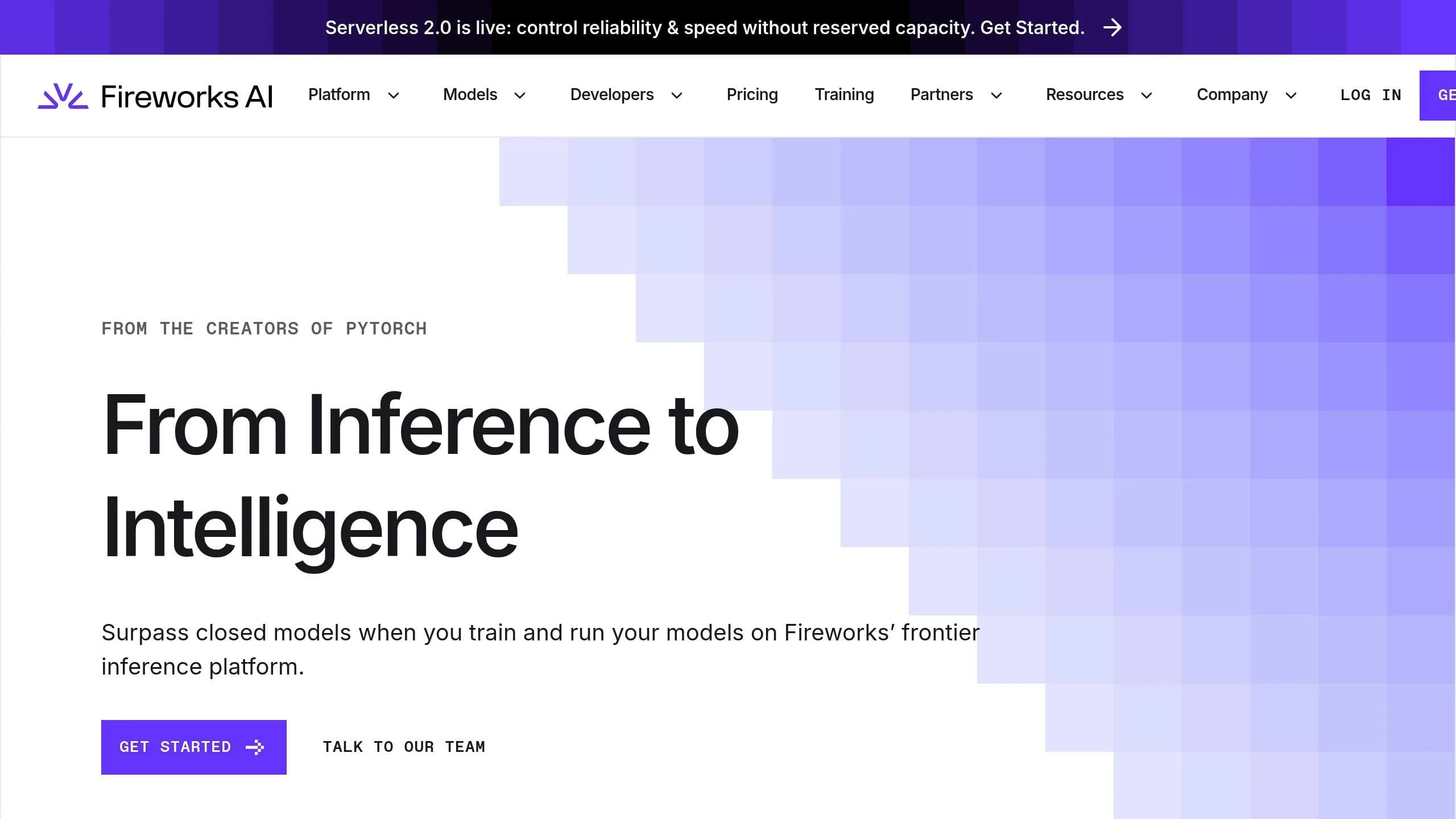
Fireworks AI connects seamlessly to MAI models using an unified LLM API compatible with OpenAI. This means you can integrate it with your existing SDK by simply updating the base URL and API key. The platform supports text, images, audio, and video inputs, combining all these formats into a single, streamlined workflow.
One standout feature is prompt caching, which can reduce Time to First Token (TTFT) by up to 80% for text and image requests [3][5]. This is especially useful for multi-turn conversations or complex pipelines where the same visual context is reused. To maximize efficiency, structure your prompts with static instructions at the beginning and variable content at the end.
For video and audio processing, Fireworks supports advanced models like Qwen3 Omni 30B. However, these models require dedicated deployments and aren’t available on serverless endpoints [1]. To ensure smooth processing, Fireworks suggests preprocessing videos to 1 FPS and 360p resolution using ffmpeg, with audio extracted in Opus format at 24kbps. Keep your base64-encoded payloads under 10MB and video clips under 60 seconds to avoid errors and maintain stable performance [1].
Sarah Sachs, AI Lead at Notion, highlighted the impact of fine-tuning on latency, sharing how it enabled enterprise-level scalability [7]:
"By partnering with Fireworks to fine-tune models, we reduced latency from about 2 seconds to 350 milliseconds, significantly improving performance and enabling us to launch AI features at scale." [7]
When it comes to pricing, serverless inference operates on a pay-per-token basis, with cached input tokens discounted by 50% [8]. For dedicated GPU deployments, the cost starts at $7.00/hour for an H100 80GB GPU [8]. Additionally, Fireworks offers fine-tuning through LoRA, which is free for models under 16B parameters when using Reinforcement Fine-Tuning [6]. Next, we’ll dive into how Baseten leverages these features for enterprise-scale deployments.
2. Baseten
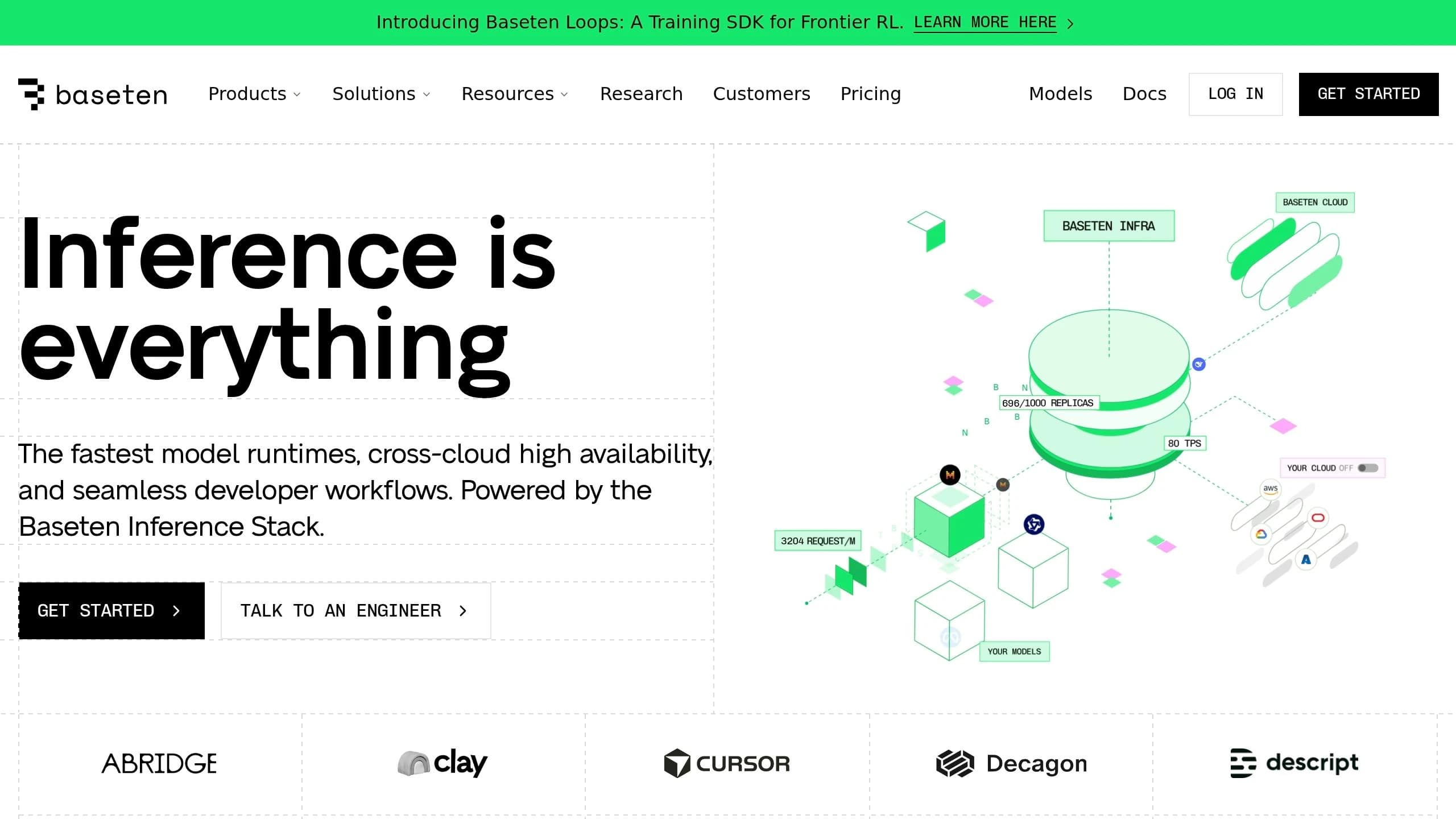
Baseten stands out by emphasizing direct model ownership and efficient multi-modal processing, setting it apart from platforms like Fireworks AI.
One of Baseten's key features is allowing you to own the fine-tuned model weights. For instance, when you deploy MAI-Thinking-1 - a mid-sized reasoning model with 35 billion active parameters - you gain full ownership of the fine-tuned checkpoint. As Marylise Tauzia from Baseten explains:
"With MAI-Thinking-1 on Baseten, the fine-tuned checkpoint is yours to control, the distribution channel is independent from the model creator, and Microsoft has no visibility into what you build on top." [9]
For handling multi-modal workflows, Baseten supports NVIDIA Nemotron 3 Nano Omni. This technology processes audio, images, and video simultaneously using 3D convolutional layers, eliminating latency issues [10]. When working with video inputs, Baseten recommends using HTTPS URLs instead of Base64 encoding to stay within the platform's 240 MB media cap and 8 MB request body limit [11].
Baseten also offers powerful tools for fine-tuning and deployment. Baseten Loops enables quick fine-tuning and direct deployment to NVIDIA Blackwell GPUs for inference. Meanwhile, Baseten Chains connects models directly, optimizing GPU usage by up to 6x and reducing latency by half [14].
Pricing Models
Baseten provides two pricing options: Model APIs (pay-per-token) and Dedicated Deployments (pay-per-compute). For image and video inputs, tokens are calculated based on file size. For example, a 1024×1024 image translates to approximately 5,329 tokens when using Kimi K2.5 or K2.6 [11]. Below is a breakdown of token rates for available models:
| Model | Input (per 1M tokens) | Cached Input (per 1M tokens) | Output (per 1M tokens) |
|---|---|---|---|
| Kimi K2.6 | $0.95 | $0.16 | $4.00 |
| Kimi K2.5 | $0.60 | $0.12 | $3.00 |
| DeepSeek V4-Pro | $1.74 | $0.145 | $3.48 |
| NVIDIA Nemotron 3 Super | $0.30 | $0.06 | $0.75 |
| MAI-Thinking-1 | Coming soon | - | - |
Compliance and Migration
Baseten meets SOC 2 Type II and HIPAA compliance standards, offering self-hosting options within your own VPC for teams with strict data residency needs [10]. Migrating to Baseten is simple: update your base URL to https://inference.baseten.co/v1 and replace your API key [12].
3. Open Router
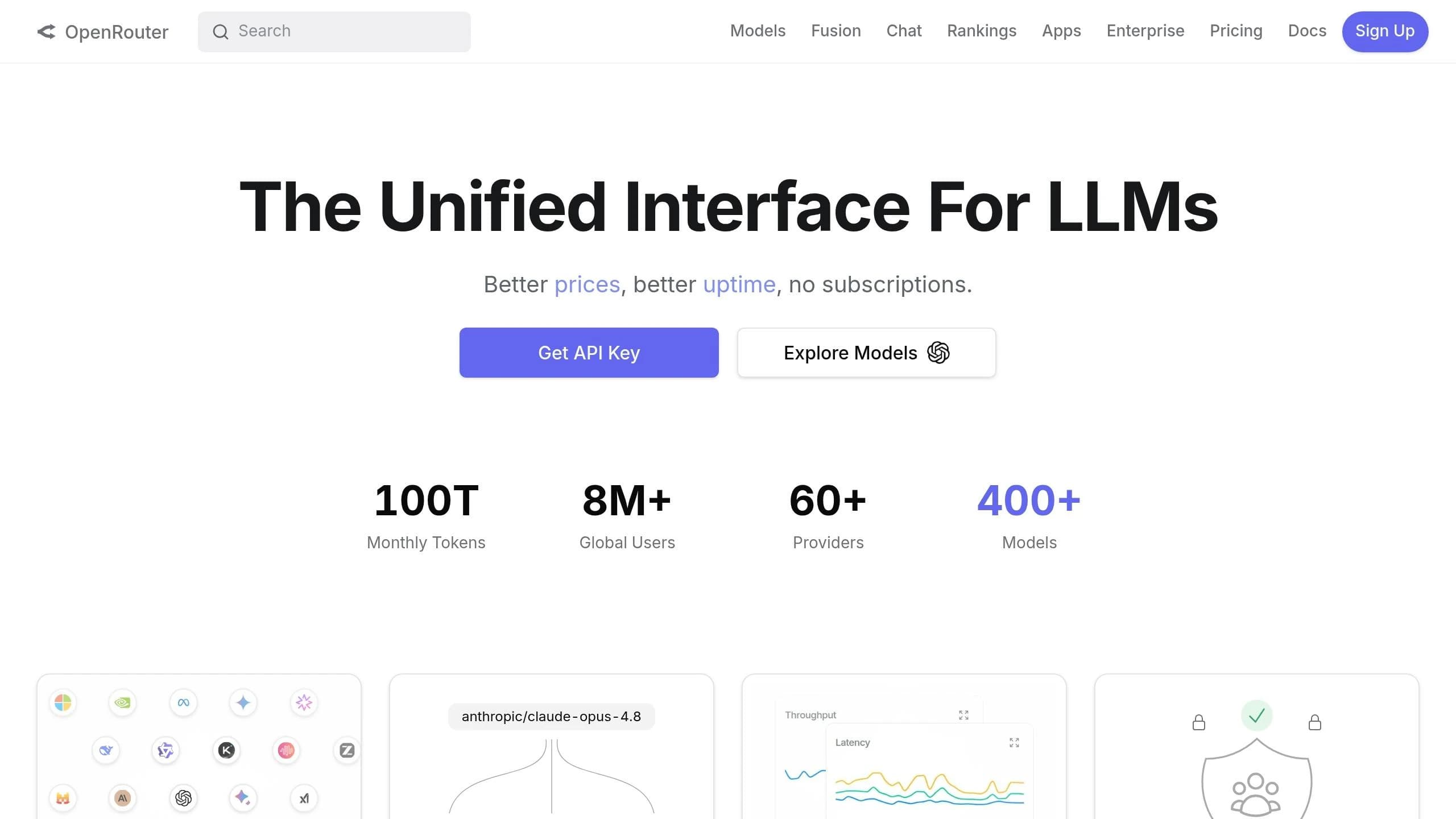
Open Router provides a seamless API experience, making multi-modal deployments easier than ever. Acting as a central gateway, it connects users to over 400 models and 60+ providers - all accessible through a single API. By June 2026, Open Router was processing an impressive 100 trillion tokens monthly, catering to more than 8 million users worldwide, and had secured $113 million in Series B funding to further enhance its distributed infrastructure [19].
MAI models integrate into Open Router's standard /api/v1/chat/completions endpoint for text and image tasks, while separate endpoints are available for audio and video. For example, using MAI-Image-2.5 for image generation involves specifying modalities like ['image', 'text'] in the request body. The system then returns generated images as encoded data URLs within the assistant's response. This model supports resolutions up to 4K and offers seven aspect ratios (ranging from 1:1 to 16:9), which can be adjusted via the image_config parameter [15][17]. By mid-2026, MAI-Image-2.5 was handling 11.5 million tokens weekly, with pricing set at $5.00 per million tokens [15]. These capabilities align with Open Router's mission to simplify multi-modal workflows, complementing solutions like Fireworks AI and Baseten.
For audio tasks, MAI-Voice-2 offers text-to-speech functionality in over 10 languages and includes expressive SSML styles such as "cheerful" or "excited." Meanwhile, MAI-Transcribe 1.5 provides speech-to-text services across more than 100 BCP-47 locales, with billing based on audio duration [15][16]. Video generation, including 高品質音声付きAI動画生成 capabilities, is managed through the asynchronous POST /api/v1/videos API. After submitting a request, users receive a job ID and can either poll a status URL or set up a callback_url for webhook notifications when the video is ready. However, video generation does not qualify for Zero Data Retention (ZDR) since the output must be stored temporarily until retrieved [18].
Open Router uses a flexible credit-based pricing model - no subscriptions required. Credits can be spent across any available model, and its pricing structure accounts for various factors, including input/output tokens, fixed request fees, image inputs, internal reasoning tokens, and cached input reads/writes [19][20]. For models like MAI-DS-R1 - Microsoft's safety-optimized version of DeepSeek-R1 - internal reasoning tokens are billed separately as an additional line item [15][20].
| MAI Model | Modality | Endpoint | Key Feature |
|---|---|---|---|
| MAI-Image-2.5 | Image Generation | /api/v1/chat/completions | Up to 4K resolution; 7 aspect ratios |
| MAI-Voice-2 | Text-to-Speech | /api/v1/audio/speech | 10+ languages; expressive SSML styles |
| MAI-Transcribe 1.5 | Speech-to-Text | /api/v1/audio/transcriptions | 100+ locales; per-second billing |
| Phi-4 Multimodal | Vision-Text | /api/v1/chat/completions | Reasoning across text and images |
| MAI-DS-R1 | Text Reasoning | /api/v1/chat/completions | Safety-optimized DeepSeek-R1 variant |
To optimize costs, developers can implement a few practical strategies. For instance, using direct URLs instead of base64 encoding for large media files can significantly reduce payload sizes [21]. When working with video generation, trimming clips to relevant segments and lowering the resolution to 720p (when high detail isn't essential) can help manage expenses [4].
Pros and Cons of Each Platform
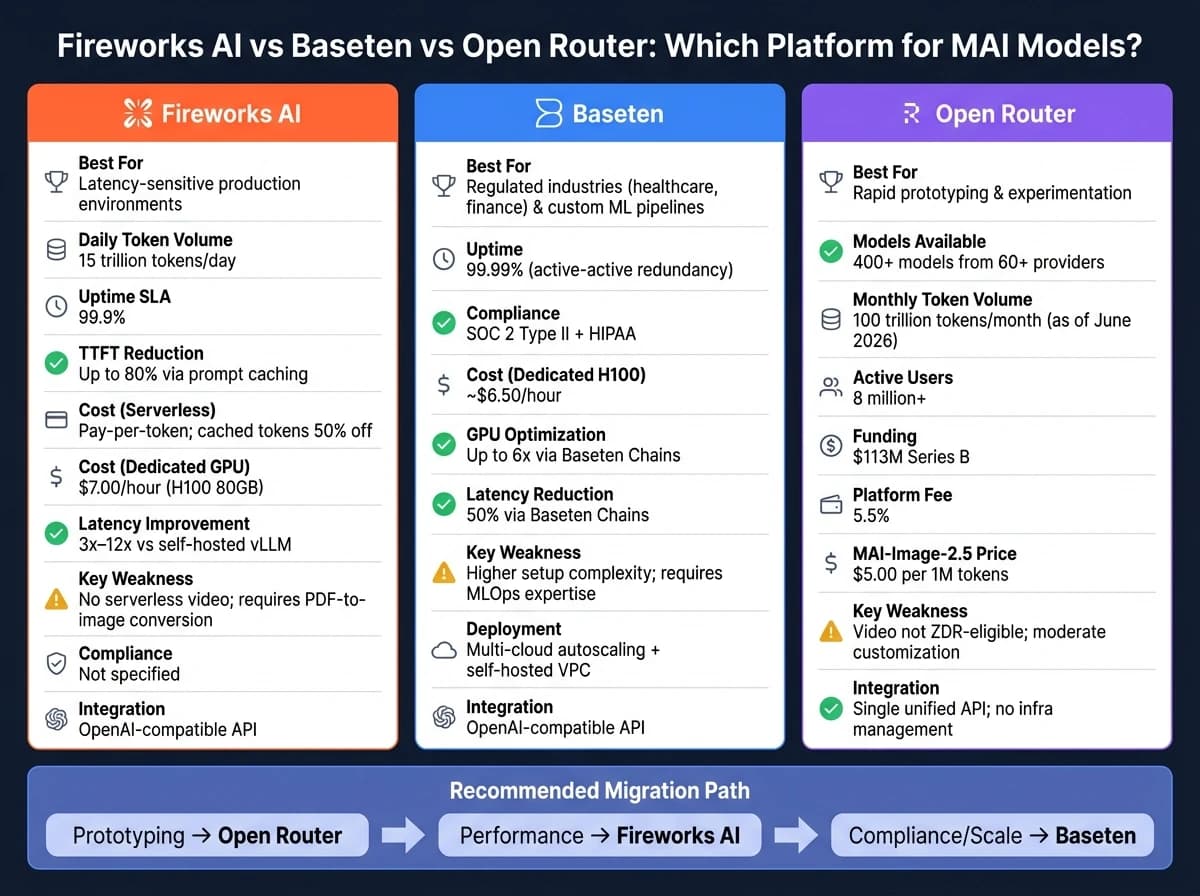
Each platform offers its own strengths when it comes to deploying MAI models, and the best choice depends on your team's specific needs and priorities.
Fireworks AI is all about speed. Its FireAttention serving stack can cut the time to first token by up to 80%, thanks to prompt caching, and it has handled 228 billion VLM tokens across 104 million requests [3]. That said, some models like Qwen3 Omni aren't available with the serverless option, requiring dedicated deployments that can increase costs and setup complexity. Another limitation is that PDFs must be manually converted to images before submission [5].
Baseten shines for teams with strict compliance needs. It's SOC 2 Type II certified, HIPAA compliant, and boasts a claimed 99.99% uptime through active-active redundancy [2]. Its pricing model - based on GPU/CPU hours rather than per token - can be more budget-friendly for consistent workloads. Deployment options include multi-cloud autoscaling and self-hosted VPCs, offering flexibility but adding complexity. This platform is better suited for teams needing full control over their pipelines rather than a quick, plug-and-play solution.
Open Router stands out for its flexibility and ability to handle various modalities. It provides a unified API that aggregates multiple providers and offers automatic routing for different modalities, making it great for rapid prototyping without the hassle of managing infrastructure. Pricing is based on aggregated per-token costs, with video charged per second. However, video generation isn't eligible for Zero Data Retention (ZDR) due to temporary storage requirements for outputs [18].
Here's a quick comparison of the key features and drawbacks for each platform:
| Factor | Fireworks AI | Baseten | Open Router |
|---|---|---|---|
| Integration Model | OpenAI-compatible; Serverless & Dedicated [3] | OpenAI-compatible; Model APIs & Dedicated VPC [2] | Unified aggregator API; no infra management [16] |
| Video Capabilities | Video understanding via dedicated deployments only [1] | Infrastructure for custom video workloads (e.g., HeyGen) [14] | Async text-to-video & image-to-video; up to 4K [18] |
| Cost Structure | Per-token (serverless) or GPU-based (dedicated) [3] | Per-compute or per-token Model APIs [2] | Aggregated per-token pricing with video charged per second [18] |
| Deployment | Serverless 2.0 (no cold starts) or dedicated GPUs [7] | Multi-cloud autoscaling; self-hosted VPC option [14] | Fully managed; no hardware required [16] |
| Key Weakness | Lacks serverless video and requires PDF conversion [1][5] | Higher setup complexity [13] | Video outputs not ZDR-eligible; moderate customization [18] |
"Fireworks delivers unmatched speed for real-time visual intelligence applications." - Fireworks AI [3]
"Baseten Model APIs are built for production first, with the performance and reliability that only the Baseten Inference Stack can enable." - Baseten [2]
For teams just starting out, Open Router offers a practical way to experiment with multiple MAI models through a single API before investing in dedicated infrastructure. Once traffic patterns become clear, Fireworks AI is ideal for latency-sensitive production environments, while Baseten is a strong choice for regulated industries or teams managing large-scale custom pipelines [13]. These distinctions allow teams to align their platform choice with their technical needs and business goals.
Conclusion
Your choice of platform ultimately hinges on where you are in your development journey, the level of performance you need, and any compliance requirements you must meet. Each option serves a distinct purpose, guiding you from early experimentation to high-performance production and fully compliant deployments.
Open Router is an excellent entry point. It simplifies prototyping by offering access to over 300 models from 60+ providers with just one API key. With automatic failover and no need to manage infrastructure, it’s a hassle-free option. The 5.5% platform fee is a manageable cost during the early stages of development [23].
Fireworks AI shines in production settings. It handles over 15 trillion tokens daily and boasts a 99.9% uptime SLA. Its FireAttention engine significantly reduces latency - anywhere from 3× to 12× compared to self-hosted vLLM setups. Plus, it’s the only platform here that provides a complete self-serve post-training stack (SFT, LoRA, RFT, and RL) through a single API [22].
Baseten is ideal for teams that prioritize compliance or manage intricate, custom ML pipelines. With SOC 2 Type II certification and HIPAA compliance, it’s particularly suited for U.S. healthcare and finance applications. However, its dedicated H100 instances cost about $6.50 per hour and require a solid grasp of MLOps [2][22].
For many U.S.-based developers and businesses, a logical path is to begin with Open Router for prototyping, transition to Fireworks AI when performance and customization become priorities, and adopt Baseten when compliance or advanced infrastructure control is necessary.
FAQs
Which platform should I choose for my MAI use case?
The best platform for you hinges on your specific needs - whether that's speed, control over infrastructure, or the ability to tailor solutions. Fireworks AI shines when handling tasks that demand high throughput and low latency. It offers features like prompt caching, serverless inference, and private deployment options. On the other hand, Baseten emphasizes production stability, providing OpenAI-compatible APIs and the ability to scale flexibly, including dedicated hardware as your demands increase.
How do I connect MAI models if my app already uses the OpenAI API?
Connecting MAI models is simple because these platforms are built to work with OpenAI-compatible APIs. You don’t need to overhaul your existing application logic - just update your client configuration with the new service’s base URL and API key.
Here’s an example in Python:
from openai import OpenAI
client = OpenAI(base_url="https://api.fireworks.ai/inference/v1", api_key="<YOUR_API_KEY>")
And in JavaScript:
const client = new OpenAI({ apiKey: process.env.API_KEY, baseURL: "https://api.fireworks.ai/inference/v1" });
With these minor adjustments, you can quickly integrate MAI models into your workflow.
What are the main limits and best practices for sending images, audio, and video?
When working with different media types, make sure your selected model can handle the required format.
For images, it's best to use HTTPS URLs to reduce latency and keep request sizes manageable. If you opt for base64 encoding, aim to keep the payload under 8–10 MB to avoid performance issues.
For videos, focus on trimming the content to the most relevant segments. Keep the duration under 60 seconds and preprocess the video to 1 FPS at 360p resolution to ensure efficiency.
Always review the model-specific guidelines for details like media count, file size, and duration limits to ensure compatibility.