
Real-Time Multimodal AI SDK Guide
Compare real-time multimodal AI SDK patterns for voice, video, and XR apps, including latency, context management, security, and APIMart integration tips.
Real-time multimodal AI SDKs allow apps to process multiple data types (text, audio, video) simultaneously, ensuring fast, synchronized responses. These SDKs are essential for applications like voice assistants, autonomous systems, and industrial tools, where response times under 500ms - or even as low as 50ms - are critical. Key features include persistent streaming, context-aware processing, and tools for managing latency and synchronization.
Highlights:
- Why Speed Matters: Sub-second responses are crucial for natural interactions.
- Core Concepts: Token-based billing, context-aware systems, and hybrid edge-cloud setups.
- Top Tools: Platforms like APIMart simplify integration with over 500 AI models.
- Optimization Tips: Use lower frame rates (2–5 fps) for video and lightweight models for cost control.
- Security: Protect data with PII redaction and session management.
With SDKs like APIMart, developers can streamline multimodal AI integration, reducing complexity and costs while meeting demanding performance benchmarks.
Core Concepts in Real-Time Multimodal Processing
Key Terms and Concepts
Real-time multimodal systems are designed to handle various types of data - like text, audio, video, and images - simultaneously. They rely on persistent streaming APIs to ensure a continuous flow of data, enabling seamless interaction across multiple modalities.
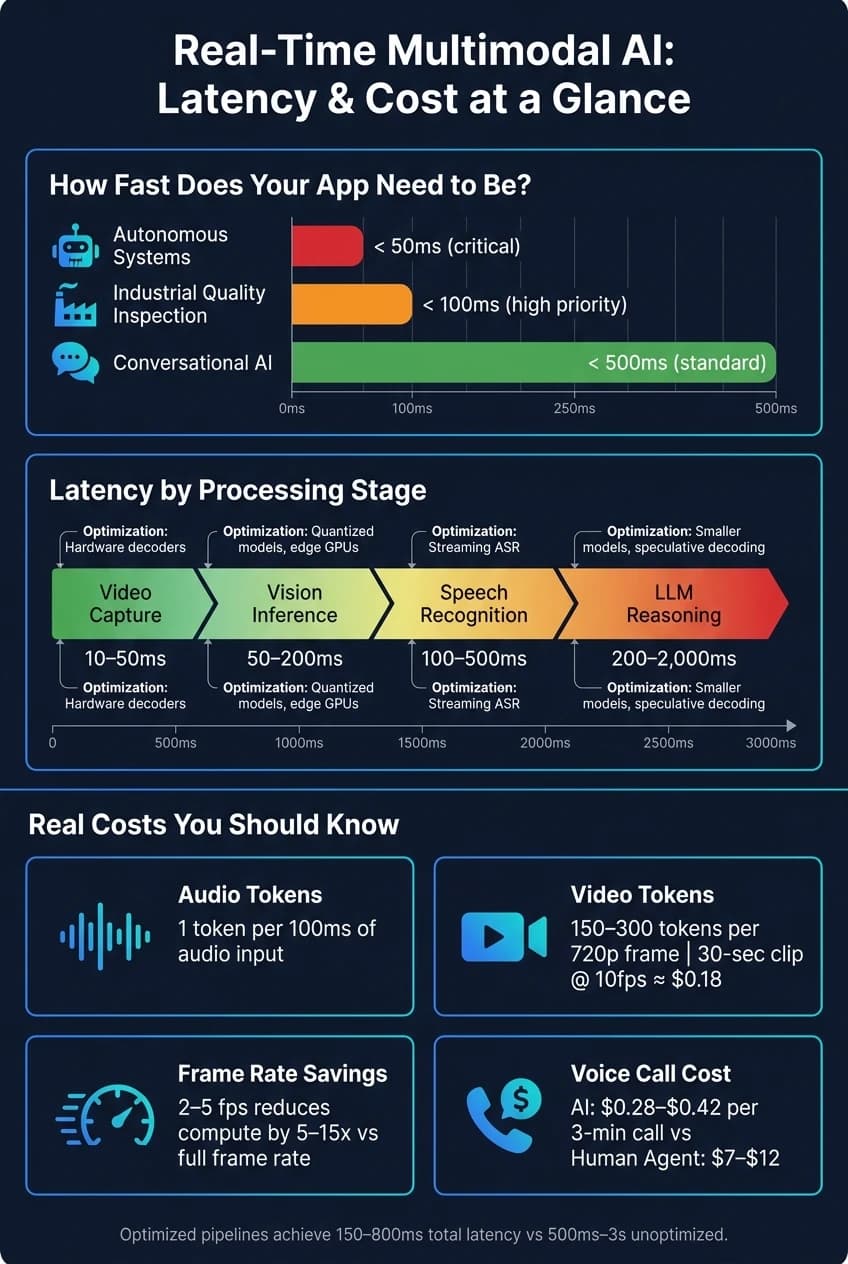
Token-based processing is a way to measure and charge for model input. For instance, audio is typically billed at about 1 token per 100 milliseconds of input [4]. Video, on the other hand, is more resource-intensive. A single 720p video frame consumes between 150–300 tokens, meaning a 30-second clip sampled at 10 frames per second could cost around $0.18 in video tokens alone. Understanding these metrics is essential for building cost-effective, real-time systems.
Context-aware systems are another core concept. These systems retain memory of session details - such as earlier interactions, tool outputs, or visual data - allowing the model to process inputs as part of a larger conversation rather than treating each one as isolated.
Common Architecture Patterns
Real-time multimodal systems often follow specific architecture patterns. One of the most common is the four-layer stack, where each layer has a unique role:
| Layer | Function | Example Components |
|---|---|---|
| Transport | Media delivery, authentication, recording | WebRTC, SIP Bridge [4] |
| Perception | Speech-to-text (STT), voice activity detection (VAD), noise cancellation, vision | Deepgram, Whisper, Silero VAD [4] |
| Reasoning | Large language model (LLM) or vision-language model (VLM) processing, memory, tools | GPT-5, Claude 4.5, Gemini 2.0 [4] |
| Expression | Text-to-speech (TTS), audio pacing, visual outputs | ElevenLabs, Cartesia [4] |
Another emerging pattern is the agent-centric loop, which cycles through Input → Buffer → Model → Tool → Memory. This design allows agents to take in context, interact with external tools like CRMs or payment systems via structured JSON function calls, and update their memory - all within one streamlined loop [6][8].
A growing trend is hybrid edge-cloud deployment. In this setup, a lightweight model runs on the edge for quick, low-latency tasks, while more complex inputs are sent to a cloud-based model for deeper analysis [10]. As Raymond F, an engineer at GetStream, explains:
"The honest answer is that almost every production system ends up hybrid." - Raymond F, Engineering, GetStream [10]
When choosing an architecture, it’s crucial to define your latency budget. For tasks requiring responses under 200 milliseconds, edge inference is ideal. For tasks where a delay of 2 seconds or more is acceptable, cloud processing is a better fit.
How APIMart Fits Into These Architectures

Managing multiple models can be challenging, but APIMart simplifies this by integrating these architecture layers into one platform. Acting as a centralized gateway at the reasoning layer, APIMart provides a single OpenAI-compatible endpoint, routing requests to over 500 models, including GPT-5, Claude 4.5, and Gemini 2.0 [4][7].
Switching to APIMart is quick - just update your base URL to https://api.apimart.ai/v1 within your existing OpenAI SDK. With edge locations around the globe, APIMart reduces network round-trip times, helping real-time applications meet sub-500ms latency goals. For teams building agent-centric or hybrid systems, this flexibility allows you to swap or cascade models without having to rewrite your integration code.
Building Real-Time Multimodal Agents with LiveKit and Azure
Key Features to Look for in Multimodal Real-Time SDKs
Real-Time Media Handling and Synchronization
After selecting an architecture, it's essential that the SDK addresses complex issues like synchronization. For example, audio and video streams often drift apart, and keeping them perfectly aligned is critical to avoid errors [2]. A robust SDK should handle this alignment automatically, eliminating the need for manual buffering adjustments.
Latency requirements depend heavily on the application. Conversational AI needs responses in under 500ms, industrial quality inspections demand sub-100ms latency, and autonomous systems aim for under 50ms [2]. Typically, a basic multimodal pipeline has latencies between 500ms and 3 seconds, whereas an optimized setup can bring this down to 150ms to 800ms [2]. These improvements rely on optimization strategies tailored to each processing stage:
| Component | Typical Latency | Optimization Strategy |
|---|---|---|
| Video Capture | 10–50ms | Use hardware decoders |
| Vision Inference | 50–200ms | Quantized models, edge GPUs |
| Speech Recognition | 100–500ms | Streaming ASR |
| LLM Reasoning | 200–2,000ms | Smaller models, speculative decoding |
For video, full frame rates are often unnecessary. Many real-time vision models work effectively at just 2–5 fps for monitoring tasks, which can significantly cut down processing costs [2]. Additionally, GPU-accelerated preprocessing - like resizing and resampling frames before they hit the model - can reduce computational demands by 5–15x [2]. On the audio side, targeting 16kHz mono PCM16 is ideal, as models such as Whisper are designed to perform best with this format [1][12].
Developer Experience and Integration Support
Performance is only part of the equation; the SDK should also simplify development. Top-tier SDKs provide multi-language support (e.g., Python, Node.js, Java), async-first architectures, and built-in tools like WebSocket and WebRTC utilities. These tools efficiently manage high-bandwidth audio-visual data without blocking the main event loop. Specialized WebSocket implementations for audio-visual streams can even cut inference latency by about 40% compared to standard REST APIs [9].
Other critical features include handling edge cases like session resumption for dropped connections (with session limits around 10 minutes [13]) and sliding-window memory management for long-running conversations. Interruptions are also managed intelligently, truncating assistant audio playback based on real-time progress rather than estimated timing [11][1]. These capabilities are essential for moving beyond a prototype to a production-ready system. The right unified API can make these advanced features accessible with minimal effort.
What APIMart's Unified API Offers
APIMart provides a single OpenAI-compatible endpoint that connects users to over 500 models, including GPT-5, Claude 4.5, Gemini 2.0, Sora, and Kling V3 [7][14]. Switching between models is as simple as adjusting a parameter, which eliminates the need to rewrite integration code. For teams that use tiered model strategies - starting with a lightweight model for initial tasks and escalating to a more complex model for deeper analysis - this unified API can reduce API costs by as much as 60–75% [9].
In addition, APIMart ensures high reliability and low latency with a 99.9% uptime SLA, achieved through intelligent multi-provider routing [7]. This makes it a dependable choice for enterprise-grade applications.
Integration Patterns and Architectures for Real-Time Multimodal Apps
Building Multimodal Conversational Agents
A well-designed multimodal conversational agent operates through three essential layers: an ingestion layer to capture and preprocess audio or video input, an inference layer that communicates with the model via a unified API call, and a response layer that delivers feedback to users through WebSockets or Server-Sent Events (SSE) [9]. Keeping these layers separate makes it easier to debug issues and scale the system as needed.
This structure also supports integration with external tools through methods like Function Calling or the Model Context Protocol (MCP). These techniques allow the model to trigger external queries based on the input it processes. For instance, the system might retrieve a customer record upon recognizing a face or fetch live inventory details when identifying a product [9][14]. Additionally, switching between models becomes straightforward by adjusting a configuration parameter.
"A conversational voice agent must respond within 500 to 700 ms of the user finishing their sentence, or the conversation feels broken." - Jesse Hall, LiveKit [16]
These patterns showcase how real-time SDKs help address traditional challenges in processing multimodal data.
Streaming Video and XR Applications
Real-time applications like video streaming and XR (Extended Reality) require different architectural approaches. Efficient video transport often relies on WebRTC paired with a Selective Forwarding Unit (SFU). This setup adjusts frame rates based on activity levels and compresses visual assets to resolutions between 1,024 and 2,048 pixels, using formats like JPEG or WebP at 80–90% quality. These optimizations reduce processing costs while maintaining accuracy for models [8][15]. WebRTC with an SFU also simplifies NAT traversal and scales effectively for more than two participants [15].
For longer video sessions, such as a 30-minute XR training module, a sliding window approach ensures continuity by overlapping each new segment slightly with the previous one. This prevents exceeding context limits while maintaining a seamless experience [9]. Models like Sora and Kling V3, available on platforms like APIMart, are particularly suited for tasks like enhancing live video feeds or generating dynamic scene transitions.
Web and Mobile Real-Time Applications
Web and mobile applications add another layer of complexity, requiring secure and low-latency integration. To protect your system, avoid exposing the main API key in client-side code. Instead, use your backend to generate short-lived, ephemeral tokens for client sessions [3]. Ensure your user interface can handle session renewals smoothly to avoid interruptions [3][15].
To minimize latency, co-locate your agent workers, SFU, and model endpoints in the same cloud region - such as us-east-1. This eliminates cross-region delays, which can add 50–150ms to interactions [4]. Additionally, in cascaded setups (e.g., STT → LLM → TTS), sending text to the TTS engine at sentence boundaries can shave off hundreds of milliseconds in perceived latency [16].
The cost benefits are also notable: a typical 3-minute AI-driven voice call costs around $0.28 to $0.42, compared to $7–$12 for a human agent [4].
Designing and Managing Multimodal Systems
Maintaining Context Across Sessions
One of the main challenges in real-time multimodal systems is keeping track of session context without overwhelming the model with too much data. A smart way to handle this is through rolling summarization. Instead of replaying the entire conversation history, older parts are condensed into a short summary, while only the most recent exchanges are added in full. This avoids "token bloat" and ensures the system stays within the model's context window [4][9].
For media streams like audio and video, a 30-second rolling buffer works well to provide the model with immediate context for reasoning [2]. For extended sessions - like a 2-hour XR training module - a sliding window strategy can help manage context efficiently. On the technical side, atomic state updates are critical. Tools like Decart allow you to update prompts, reference images, and session settings in one set() call, preventing inconsistencies that can arise from staggered updates [17]. Additionally, uploading media assets once and using their File IDs for future references avoids the inefficiency of re-uploading data during reconnects [17].
"The hard part isn't wiring modalities together... The hard part is designing the context budget: what the model sees, how often, at what resolution, with what retention." - Fora Soft [4]
By combining rolling buffers, sliding windows, and atomic updates, you can streamline session context while preparing for the next hurdle: balancing performance and cost.
Balancing Performance and Cost
To keep costs manageable, model cascading is a practical solution. Most inputs can be routed through a lightweight model - such as Gemini Flash Lite, which costs $0.10 per million input tokens. This setup handles 70–85% of requests while cutting costs by 60–75%. Only when confidence drops below a preset threshold does the system escalate to a more powerful model [5][9].
Video processing, however, can quickly drive up expenses. For example, a 30-second video clip at 10fps costs around $0.18 in video tokens [9]. Lowering the frame rate to 2–5 fps can reduce compute demands by 5–15x for most monitoring tasks, without significantly impacting accuracy [2]. Additionally, implementing session length caps - commonly set at 60 minutes - helps prevent idle tabs from racking up unnecessary charges and ensures overall system efficiency [3].
Monitoring and Security for Multimodal Systems
Once performance and cost are optimized, the next step is ensuring system security and robust monitoring. Observability in multimodal systems goes beyond simple uptime tracking. It requires end-to-end tracing that covers everything from media uploads to model inference, tool calls, and TTS outputs. This level of detail helps you pinpoint where latency issues arise [8][4]. A useful KPI framework might look like this:
| Metric | KPI | Target |
|---|---|---|
| Latency | End-of-turn to first-audible-token | < 500ms [4] |
| Reliability | Error rate by modality | < 1% [8] |
| Security | PII leakage rate | 0% [9] |
| Cost | Token usage per feature | SQL-logged for optimization [9] |
On the security front, redacting PII at ingress is critical. This includes blurring faces, masking sensitive areas in video, and removing identifying details from audio transcripts before the data reaches the model or storage [4][9]. For applications in the U.S., this step is crucial for compliance with regulations like HIPAA and PCI-DSS. Other important measures include setting Time-To-Live (TTL) expirations on stored media and transcripts and using idempotency keys to avoid duplicate tool executions during retries or reconnects [8]. Neglecting these controls can delay production pilots by months, so it’s far more practical to integrate them upfront than to retrofit later [4].
Conclusion: Getting Started with Real-Time Multimodal AI
Building real-time multimodal systems comes with its fair share of hurdles. But by focusing on key strategies like context budgeting, model cascading, and optimizing frame sampling to 2–5 fps, it’s possible to create efficient, production-ready implementations. These techniques, grounded in the principles of context management, synchronization, and architectural design covered here, provide a roadmap for overcoming common challenges with a streamlined approach.
Interestingly, the biggest obstacle isn’t the AI itself - it’s managing provider APIs while maintaining sub-500ms latency for interactions that feel natural. Disciplined context management and smart data sampling are critical here, helping teams cut down both latency and costs. APIMart serves as a prime example of these principles in action.
APIMart simplifies integration by offering a single OpenAI-compatible endpoint (https://api.apimart.ai/v1) that seamlessly routes requests to models like GPT-5, Claude Sonnet 4.5, Gemini 2.0 Flash, Sora 2, and over 500 others. With a 99.9% uptime SLA, it ensures reliability [7]. Migrating to APIMart is straightforward - just update the base URL and API key.
"Treat models as probabilistic components behind a robust orchestrator: validate outputs, stream for responsiveness, use tools for grounding, and measure cost and quality continuously." - ASOasis [8]
For asynchronous tasks, such as video generation, APIMart provides webhook support and a /tasks/{id} polling endpoint. This automates retry logic, saving teams from having to develop custom solutions. The pricing model is pay-as-you-go, featuring transparent per-token rates and volume discounts for enterprise users - no subscriptions required [7].
FAQs
What’s the simplest way to hit sub-500ms latency end-to-end?
To keep end-to-end latency under 500ms, opt for native real-time multimodal models such as OpenAI gpt-realtime or Google Gemini Live. Pair these with persistent streaming protocols like WebSockets or WebRTC. This setup integrates processes like speech-to-text, large language models (LLMs), and text-to-speech into a single model endpoint, cutting down delays. Platforms like APIMart simplify access to these tools by offering a unified interface, ensuring smooth integration and steady performance in production workflows.
How do I keep audio and video perfectly in sync while streaming?
To maintain synchronization between audio and video during streaming, it's essential to align timestamps across both formats. Here's how you can achieve this:
- Use an orchestration layer: This ensures that audio and video timestamps are properly matched, keeping everything in sync.
- Stream concurrently: Process partial inputs and outputs at the same time to minimize delays and maintain a smooth flow.
- Handle audio in chunks: Break audio into smaller chunks and use cross-fading techniques to eliminate any unwanted artifacts or disruptions.
- Optimize video with batching: Group frames into batches and use keyframe sampling to process video frames more efficiently.
Additionally, relying on real-time models and WebRTC technology helps ensure low-latency transport, making synchronization seamless from the start. These tools are designed to handle the challenges of real-time streaming, so your audio and video stay perfectly aligned.
How can I reduce token costs without hurting quality?
Efficiency is the key to cutting token costs while keeping quality intact. Here are some strategies to achieve this:
- Image and Video Optimization: Downscale images to sizes like 768x768 and adjust video frame rates to something like 1 FPS. This reduces the token load significantly without a noticeable drop in quality.
- Prefix Caching: For elements that repeat frequently, use prefix caching. This avoids reprocessing the same data over and over.
- Choose Efficient Models: Models like GPT-5.5 are designed to use fewer tokens. Additionally, route straightforward text queries to models optimized specifically for text tasks to save even more.
- Streamline Workflows with APIMart: Tools like APIMart’s unified API simplify the process of managing these optimizations, making it easier to integrate efficiency into your operations.
By applying these techniques, you can maintain high-quality outputs while keeping token usage under control.
Related Blog Posts
Choose the model you want in the model marketplace
Try chat, image and video models in the APIMart model marketplace, and experience model capabilities quickly with one unified API.